The world you know no longer exists. There is no government. No army. No civilization. The United States have collapsed. And now, thirty years after the war started, new powers finally try to take control over the ruined country, try to establish a new order, try to control others and create a new country, a new State: the 51st State.
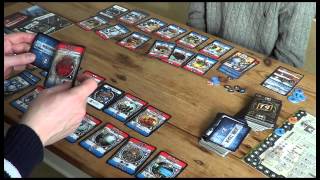
51st State is a card game in which players control one of the four powers (mutants, traders, New Yorkers and Appalachians) and try to build their very own new country. Players put new locations into the game, they hire leaders, and send people to work in buildings to gain resources and new skills.
Every card in 51st State can be put into play in three different ways. You can invade a location to gain many resources once, or you can sign a contract with this location to gain one resource every turn, or you can attach the location to your State so you can use its skill. One card, three possibilities. Lots of decisions and choices that matter.
- Engaging deck-building and action economy
- Tight scoring with opportunities for dramatic comebacks
- Rich thematic flavor with production and market tokens
- Can be heavy and lengthy for casual players
- Rules and scoring can be complex and intimidating for newcomers
- Expansion content (New Year) adds more complexity
- Resource management, engine-building, and faction development
- Post-apocalyptic rebuilding of a new faction after societal collapse
- Competitive, evolving board with card-driven actions
- Waves of the Galaxy
Mechanics (from transcript analysis)
- area advancement / redevelopment — Redevelopments allow transforming locations or abilities for victory points.
- combat / conflict — Direct or indirect combat elements through card plays and token effects.
- deck-building — Players build a personal deck that determines actions and combinations for generating resources and taking moves.
- Resource management — Gaining and spending resources like bricks, weapons, and fuel to perform actions and score points.
- sabotage / interaction — Inter-player interactions include sabotaging opponents' factories or plans.
- worker placement / action resolution — Workers are placed and used to execute actions, gain resources, or develop the board.
Video topics + discussion points
Quotes (from this video)
- good game well played
- I hope you've learned how to play 51st state
- we were neck and neck all the way up that track
References (from this video)
Mechanics (from transcript analysis)
Video topics + discussion points
Quotes (from this video)
- This video is brought to you by the 3minut board game patrons. Keep us independent by supporting us on Patreon.
- It's to talk these games out of my collection to say goodbye to them.
- The bigger the game boxes are, the easier they are to get rid of.
- The purpose of these videos is really catharsis for me.
- Two copies of Pandemic Legacy sheltered away.
- I have to thank my patrons and everyone who watches these videos for giving me this opportunity as well.
References (from this video)
- Compelling solo mode with an AI that challenges pacing and strategy
- Card drafting with three usable modes per card adds depth and flexibility
- Production-driven engine-building creates a tangible, recurring reward loop
- Location-based scoring and end-game trigger provide layered strategic planning
- Deal-building and token economy create meaningful choices each turn
- AI can accumulate VP through locations and automatic scoring, potentially outpacing the player
- Round-end resource waste is possible if storage is not secured or prioritized
- Rule comprehension and strategic planning can be dense for new players
- Early-game drafting balance may require nuanced understanding to optimize engine
- Component density and iconography might impose a learning curve
- engine-building, area control, and alliance-building within a ruined America
- post-apocalyptic United States, rebuilding a new society
- faction-driven reconstruction narrative with tangible location-based scoring and resource interplay
Mechanics (from transcript analysis)
- Card drafting and hand management — each turn begins with drawing four cards; players choose one to keep, one to discard, and the remainder flow through the drafting sequence, determining immediate options and future opportunities.
- combat/attack sequence against an AI opponent — after the AI’s turn, it executes automated attacks; card symbols determine whether an attack harms you or alters your board, with Rubble and Spoils mechanics shaping board state.
- deal-making and token economy — blue, red, and grey tokens enable deals, raises, and building actions; deals can grant free VP or other advantages at production rounds.
- end-of-round cleanup vs. storage — resources are cleared at the end of each round unless you possess storage, introducing a trade-off between rapid growth and retention of assets for future rounds.
- location-based scoring and end condition via VP — the objective is to reach 25 victory points; locations contribute to scoring, and bonuses from certain actions or deals can accelerate the pace toward the end condition.
- multi-use cards and flexible actions — every card can be played in three ways: as an action, as a deal/raise mechanic using tokens, or as a direct resource/income source, enabling flexible play paths.
- production phase and resource management — production occurs automatically based on your current locations; you accumulate workers, bricks, grey tokens, and cards that enable future actions and raises.
- spoils, rubble, and priority rules — when conflict occurs, certain outcomes become rubble or spoils based on a priority list; this affects what gets discarded or flipped and can shift control of locations.
Video topics + discussion points
Quotes (from this video)
- we are racing against that AI player to be the first to get to 25 victory points
- every car that's in your hand you can choose to play in three different ways
- the end of each round you clear out all the stuff that you accumulated unless you have a storage facility
- the AI attacks you
- production is probably my priority right now
- I'm gonna pay three and I'm gonna destroy one of the pubs because the spoils for a pub is three cards
References (from this video)
- Flexible ammo as wild card resource
- Strong endgame scoring potential via rubble and locations
- Diverse drafting and building options
- Aggressive interaction with AI adds tension
- AI can accumulate locations quickly
- Endgame can be lengthy and analysis-heavy
- Complexity may be steep for new players
- Resource management and faction building with combat and diplomacy
- Post-apocalyptic city-building competition across a war-torn state
- Dry, instructional narration of playthrough events
Mechanics (from transcript analysis)
- action drafting / card drafting — Drafting connection cards and action cards to plan turns
- area control / location scoring — Gaining victory points from number of locations and their effects
- combat / attack — Attacking opponent's actions and destroying their cards using tokens
- deck-building — Drafting and playing cards to acquire resources, actions, and buildings
- Resource management — Managing bricks, gas, ammo, and workers to build and develop
Video topics + discussion points
Quotes (from this video)
- ammo is actually great because it is basically like a wild card
- building is always good in this game
- I just hit 24 victory points once I get to 25 the game's gonna be over
- it's 51st State thanks for watching
References (from this video)

- Rich card interactions and engine depth
- Familiar feel for fans of engine-building
- Appears to have saturation in replay value over time
- Some expansions needed to refresh the experience
- engine-building and deck-building
- post-apocalyptic faction-building
- deck-driven, card synergy with long-term planning
- Imperial Settlers
Mechanics (from transcript analysis)
- Deck-building / card-driven engine — Build and optimize a deck to generate resources and actions.
- Resource management / combat options — Trade and compete for resources; can engage opponents for value.
Video topics + discussion points
Quotes (from this video)
- there are stories in a giant book and it randomizes when you go down in the caves
- it's always a new adventure
- the one thing I like is the way that people can take people on missions
- it's got aspects of why I love Battlestar Galactica and the hidden Trader
- the stock market of this game
- it's still there, it's still a great game to play
- the Rondell is so neat
- you can lock out tiles if you take one of the scoring spaces
- the more cards you pull back to your hand when you recall them the better the benefit is
- the minis are really cute, this like cute chibi style
- the artwork and graphic design of this game it is just gorgeous
- it's fascinating to watch people and their logic for figuring out who is The Insider