You are the leader of one of the 7 great cities of the Ancient World. Gather resources, develop commercial routes, and affirm your military supremacy. Build your city and erect an architectural wonder which will transcend future times.
7 Wonders lasts three ages. In each age, players receive seven cards from a particular deck, choose one of those cards, then pass the remainder to an adjacent player. Players reveal their cards simultaneously, paying resources if needed or collecting resources or interacting with other players in various ways. (Players have individual boards with special powers on which to organize their cards, and the boards are double-sided). Each player then chooses another card from the deck they were passed, and the process repeats until players have six cards in play from that age. After three ages, the game ends.
In essence, 7 Wonders is a card development game. Some cards have immediate effects, while others provide bonuses or upgrades later in the game. Some cards provide discounts on future purchases. Some provide military strength to overpower your neighbors and others give nothing but victory points. Each card is played immediately after being drafted, so you'll know which cards your neighbor is receiving and how her choices might affect what you've already built up. Cards are passed left-right-left over the three ages, so you need to keep an eye on the neighbors in both directions.
Though the box of earlier editions is listed as being for 3–7 players, there is an official 2-player variant included in the instructions.

- Lots of action
- Interesting card play
- Complex to follow
- Less enjoyable than 7 Wonders Duel
- Building civilizations
- Ancient Civilizations
- Strategy
- 7 Wonders Duel
Mechanics (from transcript analysis)
- card drafting — Drafting cards to build civilization
- Simultaneous Play — All players play simultaneously
Video topics + discussion points
Quotes (from this video)
- Foster the Meeple - a channel all about board games
- we have our team jeff team jamie patreons who are going to be voting on what the loser has to do
- i love res arcana res arcana is quickly becoming one of my favorite games
- adult where's waldo
- knocked our socks off
- i love it
- so much fun
- winter is coming
- board game city up in here
References (from this video)
- Recreates the epic civilization feel in a compact form
- Multiple viable paths to victory
- Asymmetrical Wonders create unique goals for each player
- Resource retention adds strategic depth
- Engaging drafting mechanic with player interaction
- Icon-based rules can be hard for new players to learn
- Two-player variant is weak; best with 3-7 players
- Random card draw can hinder access to desired cards late game
- Limited direct interaction beyond adjacent players
- Civilization building through resource management, military, science, and wonder construction
- Ancient world civilizations building wonders
- Eurogame-style progression: three ages condensed into three decks; asymmetrical wonders add personal goals
- Settlers of Catan
Mechanics (from transcript analysis)
- card drafting — Players select a card from their hand and pass the remaining cards to the left or right.
- Currency and commerce — Coins are used to pay costs; trading and economic decisions influence card placement.
- Engine building / wonder construction — Blue/gray resource interplay to build structures and eventually complete a wonder, which grants bonuses.
- Iconography-based rule set — Card effects and costs are primarily depicted with icons, requiring learning and reference.
- military scoring — End-of-age combat with neighbors yields victory points based on relative strength.
- resource management and production — Resource cards in brown/gray produce ongoing materials; resources are not spent on a one-off basis but accumulate for use across the game.
- Set collection / science symbols — Green science cards reward players for collecting different symbol combinations.
Video topics + discussion points
Quotes (from this video)
- this is a five star game no doubt about it
- we love this since the day it was made we still play it now
- resources they're not finite in this game and that's absolutely fantastic
- there's no resource cards in age free of seven wonders
- the drafting mechanism in a beginning of each each turn so you'll be choosing a cars passing them on
- the epic feel whilst condensing an epic game down into three decks of cards
References (from this video)

- Too complex for 4-6 year olds
- Referenced as example of inappropriate game for children
- Not age-appropriate
- Building civilizations
- Ancient civilizations
- Complex strategy
Mechanics (from transcript analysis)
- Heavy game — Complex civilization building
Video topics + discussion points
Quotes (from this video)
- a series of videos where I take a bunch of different possible scenarios some of them provided by you the viewers and I shuffle them up into a deck of cards I reveal a scenario and roll a dice to see how many players I've got
- I got in lots of trouble last time for using the word dice as a singular so we'll be sticking with die as long as I remember today
- everything economic uh that I really really love seems to cap out at five players
- I can't imagine how long it would take so I think that would probably ruin ruin game
- frankly I played that with uh two players once and we gave up after about seven hours
- there's some good ones but most games before 1995 would ruin game night if you tried to play them today
- you're not allowed to speak to each other and you're playing against the time so it's very frantic
- the only way you're able to communicate is by tapping this wooden token to say look I need you to do something
- I think Mysterium would fall apart if they didn't speak the language and that's odd isn't it because it does isn't a game that has any text in it
- I think a terrible idea there's not that much interaction and the game gets longer with each player that you add
- I don't understand the people who put down a big you know they stick down Scythe in front of kids or boast about the fact their four-year-old can play sides
- there's no reason to be playing um Snakes and Ladders or or Candyland I would say not that Candyland is a big thing in the UK
References (from this video)

- well-known, plays up to 7 players
- fast with multiple players
- not considered a party game
- civilization building via cards
- ancient civilizations
- abstract civilization development
- Forgotten Waters
- Watergate
Mechanics (from transcript analysis)
- card drafting — players draft cards to construct structures and advance their civilization
Video topics + discussion points
Quotes (from this video)
- it's very important that kids and grown-ups enjoy it
- you either lose together or win together
- menara would be a great unique option for this
- one guy is a quick polyomino speed game ... it's a bit thinky
- the avengers robin hood is a storytelling adventure game
- it's a story game where you are pirates and try to fulfill your destiny
- you can play magic maze... it's a real-time experience
- don't blame the kid if you lose
References (from this video)
- Engaging card drafting creates dynamic player interaction and opportunities for bluffing.
- Clear strategic guidance with concrete tips for decision-making across ages.
- Multiple board sides offer viable options and boost replayability.
- Diverse card types (military, culture, science) provide multiple viable paths to scoring.
- Military pressure and defensive options add strategic tension and neighbor interaction.
- civilization development, competition for wonders
- Ancient world civilizations and wonder construction
- instructional with strategic, light-humored commentary and think-aloud guidance
Mechanics (from transcript analysis)
- age progression — Three ages with distinct card pools and interactions shaping strategy.
- card drafting — Players draft cards from a hand to build structures and advance through ages.
- cost reduction / free plays — Certain cards provide discounts or free resources (e.g., aqueduct) to accelerate builds.
- military scoring — Military cards affect neighbors' scores, influencing risk-reward decisions.
- Resource management — Trade and manage resources to pay for cards and build efficiently.
- set collection / science cards — Collect symbols from science cards to build bonuses and score points.
- Wonder construction — Construct Wonders in several stages across ages for victory points and special effects.
Video topics + discussion points
Quotes (from this video)
- if you don't roll the dice you'll never win the game oh unless it's a game that doesn't have dice in which case don't roll any people
References (from this video)

- Accessible for all player counts
- Fast and scalable across player counts
- Limited interaction sometimes; can feel abstract
- Premium sleeve fit considerations depend on insert sizes
- Civilization building and resource management
- Ancient civilizations competing across a developing world
- Fast, competitive drafting with simultaneous play
Mechanics (from transcript analysis)
- drafting — Players draft cards to build civilizations and structures
- Set collection / resource optimization — Players collect resources to build Wonders and improve scores
- Simultaneous Play — All players take turns in the same round without waiting on others
Video topics + discussion points
Quotes (from this video)
- there's no perfect sleeve
- buy premium sleeves the thin ones the penny sleeves are a false economy
- the thick sleeves shuffle better, they feel better
- and if you get rid of the game you can just take them off and reuse the sleeves on another game
References (from this video)
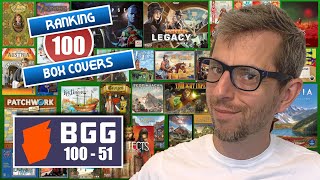
- Excellent color combinations
- Evocative title
- Images of seven wonders around border
- Nice central statue
- Looks like proper civilization game
- Civilization building
- Ancient world
- Historical
Mechanics (from transcript analysis)
- card drafting — Civilization game about seven wonders
Video topics + discussion points
Quotes (from this video)
- The box cover makes a promise to the customer
- Every box cover tells me what I'm going to be doing and how I'm going to be feeling
- This artist is one of the best board game artists working in the industry right now
- This is how you do it
- This cover is a mess
- Striking iconic design
- The box cover is not selling the game