エセ芸術家ニューヨークへ行く – which is pronounced as "Ese Geijutsuka New York e Iku" and can be translated as Fake Artist Goes to New York – is a party game for 5-10 players. Players take turns being the Question Master, whose role is to set a category, write a word within that category on dry erase cards, and hand those out to other players as artists. At the same time, one player will have only an "X" written on his card: they are the fake artist!
Players will then go around the table twice, drawing one contiguous stroke each on a paper to draw the word established by the Question Master, then guess who the fake artist is. If the fake artist is not caught, both the fake artist and the Question Master earn points; if the fake artist is caught and cannot guess what the word is, the artists earn points.
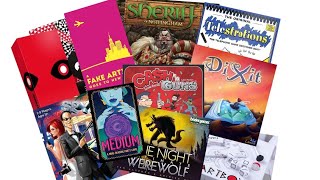
- Fast and fun; good for quick sessions
- Lots of laugh-out-loud moments
- Wingin' it can win or fail quickly; pacing depends on group
- art theft / undercover drawing
- Collaborative drawing with a single player who can't see the others' drawings
- light, quick, and humorous
Mechanics (from transcript analysis)
- cooperative drawing / deception — all players contribute to a communal drawing; one fake artist must imitate others without knowing what is being drawn
Video topics + discussion points
Quotes (from this video)
- it's a word-based game
- an ultra simple game
- it's a strong party game not my favorite but certainly one that i would happily play again
- one of the most under pressure games
- one of the best examples of a social deduction game
- Dixit is a weird and wonderful game
- the fake artist goes to New York
- novel concepts that it went down quite well for me over christmas
- longevity this game doesn't hold up
References (from this video)

- Super fun party game
- You don't need to be good at drawing
- Similar to other hidden role games
- Interactive and engaging
- Art and deception
- New York art scene
- Pictionary
- Telestrations
- Spyfall
- Chameleon
Mechanics (from transcript analysis)
- Cooperative drawing — Each player makes one mark on shared drawing
- Hidden role — One player doesn't know what they're drawing
- Party game mechanics — Social deduction and guessing
Video topics + discussion points
Quotes (from this video)
- I play Qwirkle every morning - it's a perfect way to start my day
- The art is just beautiful and I'm really proud to own and show off to people when they come over
- The game is whatever you create it to be
- This game blew my mind
- It feels like you can do anything and because of that I was just blown away
- You can play a hundred different ways and you could probably still win
- This is not gonna get old - we may not play it a ton but when we do play it it's always a blast
References (from this video)

- Encourages social interaction and creativity
- Accessible and quick to learn
- Fun with online play and audience participation
- Can be chaotic and confusing
- Drawing quality heavily affects guessing
- Pacing depends on group dynamics
- artistic deception, collaborative drawing
- Urban art scene, New York City
- abstract, humorous
- N/A
Mechanics (from transcript analysis)
- Category-based guessing — Players vote to identify the fake artist; points awarded accordingly.
- Hidden artist — One player knows the category but not the specific object; others know the category.
- Public voting and point economy — Scoring rewards both correct identification and the fake artist's ability to evade suspicion.
- Unbroken-line drawing — Players add one continuous line per turn to build a communal drawing.
Video topics + discussion points
Quotes (from this video)
- Let's separate the Picassos from the pick.
- Dolphins don't have gills.
- The front is its big old lips. What is that?
- It's an abomination. Save it, Dom.
- We know it's not puke when startled; it's not.
- Adam, you bastard. It's a bike stand.
- It's a stag beetle.
- Perspective. Perspective.
- Blair is on the level.