A Feast for Odin is a saga in the form of a board game. You are reliving the cultural achievements, mercantile expeditions, and pillages of those tribes we know as Viking today — a term that was used quite differently towards the end of the first millennium.
When the northerners went out for a raid, they used to say they headed out for a viking. Their Scandinavian ancestors, however, were much more than just pirates. They were explorers and founders of states. Leif Eriksson is said to be the first European in America, long before Columbus.
In what is known today as Normandy, the intruders were not called Vikings but Normans. One of them is the famous William the Conqueror who invaded England in 1066. He managed to do what the king of Norway failed to do only a few years prior: conquer the Throne of England. The reason the people of these times became such strong seafarers was their unfortunate agricultural situation: crop shortfalls caused great distress.
In this game, you will raid and explore new territories. You will also engage in the day-to-day activity of collecting goods with which to achieve a financially secure position in society. In the end, the player whose possessions bear the greatest value will be declared the winner.
--gameplay description from @StoryBoardGamer's review:
A Feast for Odin is a points-driven game, with a plethora of pathways to victory, with a range of risks balanced against rewards. A significant portion of this is your central hall, which has a whopping -86 points of squares and a major part of your game is attempting to cover these up with various tiles. Likewise, long halls and island colonies can also offer large rewards, but they will have penalties of their own.
Each year follows a familiar pattern of preparation, worker placement, and then meeting the requirements of your feast. The main phase of each year is a worker placement affair. You start with a selection of Vikings, and a large action board with a whopping 61 different options to choose from. Each of these will be arranged from left to right in one of four columns. Each column requires an additional Viking to activate, but they are proportionally more powerful.
At the end of each round, you will need to fill a feast table with food, alternating between plants and vegetable matter. You will also have a chance to lay the valuable green and blue tiles into your main hall. The configuration of these tiles must follow certain requirements, but your main goal is to both cover up a line of coin icons to increase your income, while otherwise encircling certain printed icons to generate those.
You will build your engine over time, following an alternating pattern of outward expansion and hunting against development and cultivation. It all comes down to how much you’re willing to take on at any one time, and what risks you’re willing to set yourself up with for their rewards.
UPC 681706716909
- Huge variety of actions and strategies
- Engaging puzzle with multiple boards and expansion potential
- Long-term play value
- Complex and heavy; steep learning curve
- Can be cumbersome to set up and manage components
- resource management, engine-building, and polyomino tiling
- Viking Age; exploration and settlement
- Eurogame puzzle
Mechanics (from transcript analysis)
- Engine building / resource conversion — Balance inputs to generate income and points
- Exploration / island expansion — Unlock and develop new islands for bonuses
- Resource management — Manage a large variety of resources and food to sustain workers
- Tile placement / polyomino tiling — Fit resource shapes on your board to optimize scoring
- worker placement — Place Viking workers to activate actions and gain resources
Video topics + discussion points
Quotes (from this video)
- this game is so much fun because it gives you such a wide variety of things that you could do
- I think this is a game of skill and you don't see games of skill very often with very short
- Isle of Skye Journeyman adds a lot to this game but it detracts from some of the greatness of the original game
- Lisboa is a heavy game; there's a lot going on
- Teotihuacan has a lot going on
- Western Legends is a sandbox with tons of directions you can go
References (from this video)

- strong thematic integration and tension between tracks
- unique personal boards and multi-use cards
- sandboxy feel can be unfocused for some players
- heavy teach and long playtime; expansion adds complexity
- multi-track resource management with island simulation
- Norse exploration and settlement
- sandbox with thematic cohesion
- Agricola
- Terraforming Mars
Mechanics (from transcript analysis)
- card deck interactions — cards provide labor value and special abilities
- dual-tracks tension — income vs. population creates strategic tension
- tile drafting/placement — build a city/island grid with interwoven tile effects
- worker placement — multi-use actions with income and population implications
Video topics + discussion points
Quotes (from this video)
- Cat in the Box is a fascinating Twist on trick taking
- the killer for me was I just don't think it was a game that was going to be an evergreen for me
- Endless Winter ... feels kind of like a kitchen sink Euro design
- it's not easy to teach
- I rate this an 8 out of 10
- Nemesis is one of my favorite games of all time
- the crew is a great game
- the new edition feels to me like the one that's going to be best for me
References (from this video)

- Massive scope and high replayability
- Rich, varied strategies with multiple pathways to score
- Beautiful integration of worker placement with resource engine and tiles
- Heavy and long; steep learning curve
- Rules can be dense and intimidating for casual players
- session-building, resource management and exploration
- Viking era exploration and economy
- historical/experimental
- Le Havre
- Agricola
Mechanics (from transcript analysis)
- engine building — Accumulating resources and abilities to improve future rounds.
- Polyomino tiling and placement — Tiling rules influence income and scoring opportunities.
- Roguelike variability via modules — Multiple modules or options create varied setups across plays.
- worker placement — You assign workers to actions to gain resources, goods, and abilities.
Video topics + discussion points
Quotes (from this video)
- the partner Dynamics in tiu are so fun because you can't talk to each other
- it's the best card game trick-taking game
- this is the game that we keep coming back to for group drama and big moments
- you can't beat the drama at the end when both teams are close to a thousand points
References (from this video)
- Huge content and replayability
- Stellar production/art
- Lots of strategic depth
- Heavy and expensive; not for casual players
- Resource management with broad worker placement
- Viking-age exploration and raiding
- Rich thematic feel with diverse paths
- Through the Ages
Mechanics (from transcript analysis)
- Square-grid/resource allocation — Managing a large set of actions and resources with many options
- worker placement — Assign workers to gather resources and take actions
Video topics + discussion points
Quotes (from this video)
- Railways of the World is the best train game ever.
- Concordia could be the best game I've ever played.
- Nemo's War is a masterpiece from Ian O'Toole.
- Glory to Rome is a masterpiece.
- Dungeons & Dragons is clearly my number-one favorite game of all time.
References (from this video)
- arguably the greatest two-player game ever made according to the speaker
- huge board, nested decisions, and a sense of discovery every game
- expansion changes the board and tightens the two-player experience; significantly improves balance
- extremely heavy and sprawling; can be overwhelming without expansions
- time commitment is very high per session
- massive action selection and explorer-style scoring
- Viking-era exploration and resource management
- discovery-driven, sandbox-style strategy
Mechanics (from transcript analysis)
- action selection — Player choice drives a large number of potential actions per turn.
- resource management / drafting — Managing a broad suite of resources to build, explore, and score.
- worker placement — A sprawling, multiactivity engine with many ways to score.
Video topics + discussion points
Quotes (from this video)
- Blocking becomes super important because you can only build roofs and pillars so many times during the game.
- There's a ton of mind games involved in this game.
- The dice rolls affect everybody equally. So, we both have to work with the same puzzle.
- It's tense, it's brainy, and it's super satisfying.
- I don't understand why it's not up there with the likes of Brass, Terrammystica, Bough Island, even a bunch of other big strategic games.
- For me, it is Magnum Opus and it deserves all the credit in the universe.
- This is my favorite co-op game of all time and I believe it's the best two-player co-op experience ever.
- There are multiple ways to win and the exploration of discovering new scoring methods is thrilling.
References (from this video)
- tight worker-placement feel
- large variability and thematic flavor
- some players may find it heavy or sprawling
- worker-placement, resource management with an array of actions
- Viking-era expansion and exploration
- sandbox-y, action-packed
- Sushi Go
Mechanics (from transcript analysis)
- Resource management — currency/resource economy to support various lanes of play
- tile/ship integration — actions are enabled through various tiles and ships
- worker placement — players place workers to gather resources and take actions
Video topics + discussion points
Quotes (from this video)
- it's just such a unique mechanic right throwing dice at a Target going through a dungeon together
- that g that game has one of the best table presence of uh of games you have you know it's one people just look at and like wow that looks really fun
- I love Feast for Odin and it's one that I think about a lot for its tight worker-placement, yet sandboxy feel
- Earth Reborn... it’s ahead of its time in that it was this big over the with like Miniatures
- eight hours per game time commitment
- the mechanics of it are solid; the wall mechanic and the way factions feel different is really fun
- the military side of it was brutal, especially in two-player
- the switch to cooperative really vaulted Mage Knight into our top games
- the best blend of mechanisms tied in with the theme
- card drafting vaulted into the mainstream after Seven Wonders
- there's so much content for campaigns; you can play forever with a great group
- it's so satisfying to get those cards and build this engine
- rolling dice and it feels so overwhelming and hard, but in a good way
- Dominion—you can randomize the set of the cards; it's the purity of deck-building
References (from this video)
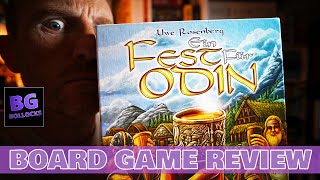
- Income vs. points conundrum creates a genuinely interesting strategic tension.
- 60+ action/worker spaces provide multiple viable pathways and strategic flexibility.
- Upgrade/crafting system offers meaningful variation compared to some prior Rosenberg games.
- Short/long variant options give pacing flexibility for different sessions.
- Strong solo play potential and depth for dedicated players.
- Extremely large and complex; can be overwhelming and hard to absorb.
- Fiddly components and small tokens can be difficult to manipulate, especially at table edge.
- Limited to no player interaction, which may deter players seeking direct competition.
- Some land/board features feel misaligned or have holes in applicability, reducing cohesion.
- Very long playtime (roughly four hours) and heavy commitment may deter casual players.
- Controversy around theme/pillage can affect perceived value for some players.
- Resource management, exploration, raiding, and settlement
- The Viking Age, exploration and raiding across distant lands
- Historical/mythic framing with heavy puzzle/engine-building focus
- Agricola
- Caverna: The Cave Farmers
- Viticulture
Mechanics (from transcript analysis)
- Occupation cards — Draw and play occupation cards when meeting action cost requirements to gain ongoing benefits.
- Pillage/raid actions — Engage in raiding actions via distant land boards to gain rewards.
- Resource management and income tracking — Income is determined by exposed coins on your board and surrounding resources; optimize to maximize yield.
- Tile placement / tetramino tiles — Place polyomino tiles on distant land boards to claim points and resources.
- Upgrade / crafting system — Upgrade goods and craft items to progressively improve capabilities and point potential.
- worker placement — Place workers on action spaces to gain resources and unlock subsequent actions.
Video topics + discussion points
Quotes (from this video)
- Income minus points conundrum is a genuinely interesting struggle.
- The 60 plus worker placement spaces means there is always going to be some pathway to enact your strategy.
- No player interaction whatsoever.
- It's long, about four hours.
- There is a short version and a long version.
- It's probably far too big for its boots.
References (from this video)
- rich, sandboxy design with deep strategic depth
- high replayability and density of choices
- very complex; can be hard to focus on a single path
- long playtime; not ideal for casual sessions
- resource management, exploration, and settlement
- Viking era; exploration and settlement
- epic sandbox
Mechanics (from transcript analysis)
- Dice rolling — Dice usage introduces randomness in certain actions/events.
- Polyomino tiling / pattern building — Place tiles in patterns to gain resources and bonuses.
- set collection / resource management — Collect resources and equipment to complete goals and optimize scoring.
- worker placement — Allocate workers to a wide range of actions (ship travel, hunting, raiding, etc.).
Video topics + discussion points
Quotes (from this video)
- this is probably one of the best abstract style games I've played
- it's a shame it's not taking off as well as it could have
- I could still appreciate this game and I think it has huge untapped potential
- it's way better than it sounds on paper
- the best way to play it is shortening the map to keep it nice and snappy
- co-op isn't really my forte
References (from this video)
- Noteworthy worker placement game
- vikings
- exploration
- seafaring
Mechanics (from transcript analysis)
Video topics + discussion points
Quotes (from this video)
References (from this video)
- Massive menu of options for strategies
- Infinitely playable with base game alone
- Multiple paths to victory
- Exploration and experimentation encouraged
- Hundreds of occupation cards provide variation
- Viking settlement and exploration
- Viking era with raiding and exploration
- Economic simulation with narrative flavor
- Terraforming Mars
Mechanics (from transcript analysis)
- Island exploration — Visit islands to get additional boards to fill out
- Negative scoring balance — Start with negative points and work to cover up negatives to reach positive score
- Ship immigration — Immigrate ships for feeding people, making them more valuable
- Tile acquisition and upgrading — Acquire and upgrade tiles to place on player board for income and bonuses
- worker placement — Large grid of worker placement spaces requiring different numbers of workers
Video topics + discussion points
Quotes (from this video)
- the infinite replayability of cartographers...is because like the order that the cards come out that show those land types will always be different
- the game is how do I deal with the puzzle that's given to me right
- you're playing the player right...it's about positioning it's about all that kind of stuff
- this is a game that's been around for a very long time it's still such a lifestyle game for some people
- you can just play forever and ever and ever there's always strategies to explore
- the playability comes with the fact that there's this massive menu of options
- we'll never create the same Clover twice
- literally has millions of combinations of different puzzles
- the entire purpose of the game is you were given this hand of cards...how do I make this work
- the puzzle is always interesting because the puzzle is what's in your hand
- the puzzles going to be different every time and it's just always always interesting and fun to play
- every single one of these Spirits plays wildly differently...they're super asymmetric
- it's infinitely playable...it really is...a lifestyle game for so many many people
References (from this video)
- Excellent solo experience
- Sandbox nature allows varied play styles
- Cool occupation cards system
- Great AI system for solo play
- Exceptional polyomino mechanics
- Norse expansion improved game balance
- Nightmare to teach (50-60 action spaces)
- Very long gameplay with multiple players
- Massive setup
- Heavy component management
- Requires expansion for balance
- Vikings
- Exploration
- Settlement Building
- Historical
Mechanics (from transcript analysis)
Video topics + discussion points
Quotes (from this video)
- these are my top 100 games not necessarily the top 100 games
- the lower end of my top 100 is still games I rank 8-9 out of ten if there are no sevens on this list
- everything on here is the creme de la creme as far as I'm concerned
- it hurt a lot
- this can really destroy friendships if you're not careful
- I have played through the whole game and I feel like I've barely scratched the surface
- there is such a thing as too much for a game
- I really want to play this but maybe not quite every single week
- I am serious and don't call me Shirley
- there's a lot of new content to throw in there
- I do love a good sandbox game
References (from this video)

- deep strategic depth
- high replayability and variability
- strong thematic immersion
- heavy rules and learning curve
- long playtime
- complex setup and bookkeeping
- raiding, seafaring, settlement-building
- Viking Age exploration and resource management
- engine-oriented strategic depth
Mechanics (from transcript analysis)
- resource_management — Balance diverse resources (food, wood, metal, etc.) to fund actions and scoring.
- tile_placement — Acquire and place variable tiles to develop your island and production network.
- worker_placement — Assign family members to actions on your board to gain resources, build ships, or score points.
Video topics + discussion points
Quotes (from this video)
- I love a big box game
- I hate these chairs I hate them so much
- most anticipated by us like it has a video this is the video we've been excited to do
- it's blue you've got literally the heat on Jamie
- I love a there's no way I can say without you laughing
References (from this video)
- huge scope and depth
- flexible playstyle across player counts
- heavy; long play time
- wide-ranging resource management and exploration
- vikings era with a feast and exploration
- grand, sandboxy
- Ticket to Ride
Mechanics (from transcript analysis)
- engine-building — chain actions to unlock powerful combinations
- polyomino placement — place shapes to maximize scoring options
- worker placement — assign workers to various actions and gather resources
Video topics + discussion points
Quotes (from this video)
- this game is poo
- it does as i said just take that edge off the randomness
- one of the best card games i've ever played
- it's almost like a eurofied Ticket to Ride
- the ambition of this game is absolutely mind-blowing
- a game that rewards repeated plays
- the board is always flux and alive
References (from this video)
- huge replayability and tactile puzzle
- flexible play paths: farming, exploration, or optimization
- heavy on rules and setup
- can be long and punishing if mismanaged
- exploration, raiding, resource gathering
- Viking age sea-faring and raiding
- sandbox with multiple viable paths
- Terra Mystica
- Gaia Project
Mechanics (from transcript analysis)
- Deck-building with heavy tableau building — Acquire and spend cards to take actions; cards cycle back into play.
- Tetris-like spatial puzzle — Strategic placement of actions to maximize throughput and scoring.
- Tile-placement / polyomino-like placement — Arranged pieces determine long-term resource flow and scoring.
Video topics + discussion points
Quotes (from this video)
- Be excellent to each other.
- Sidereal Confluence is grand. It is so grand it will not be contained by such trivialities as a table.
References (from this video)

- Massive depth and thematic immersion
- Excellent solo and multiplayer options
- Expandable with numerous modules
- Complex rules and long playtime
- Hard to teach to new players
- resource engine, fleet management, exploration
- Viking-era exploration and raiding with island expansion.
- dense, thematic euro
- Lisboa
- Kanban
Mechanics (from transcript analysis)
- Resource management — Balance resources, space, and scoring to optimize performance.
- Tile/engine building — Tiles and engines create pathways for scoring and production.
- worker placement — Assign workers to gather resources and perform actions.
Video topics + discussion points
Quotes (from this video)
- There's Nostalgia to it
- Kanban EV is prettier definitely
- the end game sneaks up on you a little bit faster than you're ready for
- we've traveled with this game for about five six years
References (from this video)
- Deep engine-building and multiple viable strategies
- Long setup and lengthy play sessions
- High cognitive load
- Resource management and engine-building
- Viking exploration and raiding
- Historic-inspired strategic flavor
Mechanics (from transcript analysis)
- Resource management — Must balance budgets of many resources with varied rewards.
- Tile/polynomino placement — Tiles represent resources, voyages, and ventures.
- worker placement — Multiple action spaces for resource gathering and actions.
Video topics + discussion points
Quotes (from this video)
- BGG top 100 list is broken.
- Two Brass games in the top 10? duplicates are broken.
- I hate Eclipse Second Dawn for the galaxy.
- Ticket to Ride should be number one on Board Game Geek.
- Ark Nova being at number three, I would like to see it creep up a bit more.
- This is how exploitative the BGG top 100 list is.
- Three brass games in the top 25? It's going to highlight even more how broken this list is.
- You cannot look at that and call it fair without being the most biased individual.
- The system itself is broken.
- It's a gamers list. It is purely based on diehard dedicated board gamers who make this list what it is.
References (from this video)

- huge sandbox with many viable strategies
- deep worker-placement and engine options
- exploratory and highly replayable
- very large footprint and long setup
- heavy for casual players
- worker placement in a sprawling sandbox
- Norse exploration and Viking-age provisioning
- exploratory, sandboxy strategy with massive options
- Le Havre
- Kemet
Mechanics (from transcript analysis)
- engine-building / resource management — workers generate various resources and allow deeper actions
- multi-path scoring / island building — focus on diverse scoring avenues and exploration
- worker placement — large board with columns of increasing power
Video topics + discussion points
Quotes (from this video)
- Flavor text is absolutely on point because these cards that you're collecting are just kind of colors.
- I melted my brain. It was just like way too heavy for me.
- Star Wars in a box. This is Star Wars in a box.
- I absolutely love the original Clank.
- This is a cooperative programming game where you need to do one of them… it’s so much fun.
- I love the networks.
- I really like tiling games in general. I like citybuilding games and Quadropolis adds that really extra interesting unique uh tile selection mechanism.
- Feast for Odin is a game where you are Norwegians. It is just so darn good.
References (from this video)
- Offers lots of different mechanical options
- Sandbox-style Euro with high replay value
- Good polyomino mechanics
- Many worker placement options
- Solo mode works well
- Too many mechanisms - could cut 30% and still work
- Loses focus and pure turn tension of great worker placement games
- Requires expansion (Norwegians) to be balanced
- Card/occupation system poorly designed
- Occupations rarely worth pursuing
- Viking Era
- Farming
- Resource Management
- Fields of Arle
- Caverna
- Nova Luna
Mechanics (from transcript analysis)
Video topics + discussion points
Quotes (from this video)
- it delivers what it promises and it does have that true epic feel to it
- bless you you've got you've got a game that's tailor-made for you
- you can be set for life playing Magic with your group but yeah it's not for me
- this is a game where if you are playing with somebody who knows the game they are going to absolutely trounce you
- I think you'd cut 30% from this game and it wouldn't be a worse game for it
- taking myself out of the equation this is like 10 but with my own enjoyment into it it's definitely significantly lower
References (from this video)
- Rich, immersive portrayal with strong avatar focus
- Busy cover can feel a bit cluttered
Mechanics (from transcript analysis)
Video topics + discussion points
Quotes (from this video)
- It's iconic. It is at least eye-catching; it's a classic.
- The box should tell us what we're doing in the game and how we're going to feel.
- This is top-notch stuff.
- I actually just ordered my copy, so this is obviously working for me.
- The cover sells the game, it screams what you're going to do.
References (from this video)
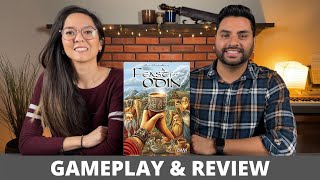
- Deep sandbox with multiple viable strategies
- Norwegians expansion adds meaningful new mechanics and asymmetry
- Strong two-player balance with interesting island/exploration options
- Engaging ROI-based decision making with curve of progression
- High teaching overhead due to the number of rules and interactions
- Table presence and component clutter can be intimidating
- The color/shape interactions can be visually overwhelming at first
- Resource management, exploration, and settlement building in a sandbox/engine-building frame
- Viking era with settlements on modular boards and expansion content
- sandbox/engine-building
- Fields of Arle
- Caverna
- Agricola
Mechanics (from transcript analysis)
- animal_breeding — Animals reproduce when conditions are met; pigs reproduce every round, other animals breed for benefit.
- emigration_and_feeding — Ships emigrate to reduce food requirements; feed your people via banquet tiles and animal yields.
- income_and_scoring — Income is gained each round from tiles and bonuses; final scoring aggregates ships, explorations, sheds, animals, occupations, and remaining silver.
- island_and_exploration_board — Exploration boards provide end-game scoring bonuses and ongoing income; boards flip over across rounds.
- polyomino_tiles — Tiles come in varied irregular shapes and colors, creating a color-tiled hierarchy that guides placement.
- ship_building_and_pillaging — Build ships or acquire them to raid or pillage for points and resources; ships may come with ores.
- tile_forging_and_forgeable_tiles — Forgeable tiles at certain spaces can be created from ore, expanding your pool of tiles.
- tile_placement — Polyomino tiles are placed on personal boards to reduce negative points and to gain income.
- tile_upgrading — Tiles upgrade across color tiers (orange -> red -> green -> blue) without changing size, enabling higher values.
- worker_placement — Players place Vikings on action spaces to gain resources, draw weapons, or trigger effects.
Video topics + discussion points
Quotes (from this video)
- this game is a sandbox of sorts
- I really adore this game for a variety of reasons
- the Norwegians expansion elevates the game for us
- it's a mess, it's a table hog, there's a lot going on
- it's probably my magnum opus