Become the new emperor of Rome in this strategic worker placement game set in 44 BC, Rome. Each turn, you will build structures in different provinces assigned to you through a rotating board. Balance war, politics, trade, and religion while scheming against your rival players.
In Age of Rome, each player is assigned a hero with their respective player board, then are given secret quests and starting resources of Denarii, Followers, Scheme tokens, Legions, and Votes. Then they spend nine rounds competing on a rotating board to earn Glory points.
Each round consists of four phases:
1) Scheme phase: An Event card is revealed and turn order is determined; players activate Schemes in turn order.
2) Building phase: Players build structures in turn order.
3) Action phase: Players take actions by placing Followers in turn order.
4) Income phase: Players receive Income and the Provinces board is adjusted.
Players can earn Glory points in various ways. They may build structures, place Followers to vote and win a majority, send Legions to conquer regions, trade or collect items, or even build a Pantheon. Completed secret quests also earn Glory points. After the 9th round, the game ends. The final score is determined and the player with the most Glory points is declared the new Emperor of Rome.

- half decent game
- interesting little Euro game
- event deck is problematic
- random effects benefit one player and hurt another
- short game with limited rounds to recover
Mechanics (from transcript analysis)
Video topics + discussion points
Quotes (from this video)
- it's not even a game it's just like a story
- why is it there this is the game about inventions and this is basically telling me to make cutesy patterns with tiles
- the bane of my freaking life this horrible game
- I just want to feel like right I can do this I can do this
- just design one good game one good game one good mode
- why can't I tell you
- they just made them a lot worse
- it's a red flag to the game is going to suck
References (from this video)
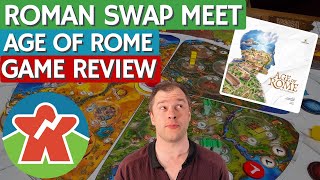
- Rotating board mechanic creates dynamic interaction and strategic tension
- Deluxe components are visually striking (acrylic buildings, metal coins, overlays) and present a premium look
- Rulebook is clear with helpful illustrations; solo mode is included and well-presented
- Four-player games tend to shine; every province gets activity each round and the system scales to a lively endgame
- Event deck introduces swingy, random effects that can disproportionately affect outcomes
- Player scaling is imbalanced for 2-3 players; four players is the intended sweet spot
- Playtime overruns advertised duration (60 minutes) and often reaches 90–120 minutes in practice
- Theme is fairly abstract; thematic immersion is light despite strong production values
- Deluxe price point is high; retail versions are slightly downgraded in components
- politics, military, trade, and area control within a rotating district system
- A Roman-themed city-state where four districts provide modular, rotating zones that determine available actions and scoring opportunities across a nine-round game.
- abstract with a cohesive competitive structure rather than a strongly narrative Rome theme
- Tran Tran (Stepan Feld game)
- Restart (Kickstarter upcoming from the same publisher)
Mechanics (from transcript analysis)
- area control / military scoring — Military actions involve controlling provinces or spaces on the map, with scoring tied to sets and stacks.
- event deck (randomizer) and rule-explaining components — A deck of event cards drives round-specific twists and turns the board; introduces swingy effects and variability between games.
- multi-use building actions — Level 1-3 buildings provide escalating actions; higher-level buildings require more workers but unlock stronger effects.
- parthenon/sideboard piece scoring — Players accumulate parthenon pieces on a sideboard that contribute to end-game scoring.
- rotating board / district rotation — Each round the main board rotates to reveal new district alignments; players anticipate who will benefit next and plan around the upcoming layout.
- scheme tokens / player interaction — Scheme tokens allow players to impede opponents or block bonuses, creating direct antagonism.
- Set collection / card-driven scoring — Trade cards and Quest cards provide points and potential special abilities when used or collected.
- worker placement on district buildings — Players place workers on built buildings to trigger specific actions (military, politics, trade, etc.).
Video topics + discussion points
Quotes (from this video)
- this rotating board which essentially you plug it up with this like little disc in the middle and it revolves around nice and easily
- this game shines at its best with four
- I think this is a pretty solid debut from this company but not quite solid enough that I can recommend it for everybody
- the event deck is swingy
- the board is an instagrammer wet dream
- the theme is also a little bit on the abstracted side
- I would rather take the extreme of explaining things too much than not explaining things enough
References (from this video)
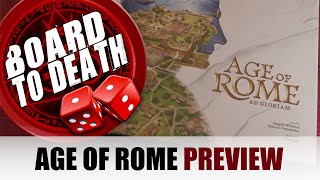
- Rich tactical depth with multiple scoring avenues
- Strong theme integration and dynamic moving board
- Opportunities to undermine opponents via schemes and politics
- Varied routes to endgame glory and medal abilities
- High component quality and visual appeal (even in pre-production form)
- High complexity and learning curve
- Potential downtime due to heavy rulebook and analysis
- Longer playtime and larger table footprint
- Political intrigue, military power, religious monuments
- Ancient Rome, empire-building
- Array
Mechanics (from transcript analysis)
- building tile placement — players add level-based buildings in provinces, paying costs to earn glory and increase population.
- coliseum glory — placing followers in the coliseum grants glory points when activated during the turn order sequence.
- end-of-round and final scoring — rounds are divided into four phases with specific actions and scoring; final scoring includes multiple categories.
- feud markers and scheme actions — activating schemes moves feud markers and triggers effects that affect opponents.
- milestones and follower management — milestones generate followers; the milestone track descends to ease later advancement.
- pantheon/medals — pantheon pieces are placed and medals grant unique abilities for the leading player.
- trade cards and denarius economy — draw and manage trade cards, trade them for cash (denarius), and form sets for endgame glory.
- votes and senate — political actions involve voting mechanics and vault management tied to end-of-round scoring.
- worker placement — players place followers on province spaces to perform actions and gain bonuses.
Video topics + discussion points
Quotes (from this video)
- the stunning visual quality of the game gets you hyped
- i'm almost tempted to write a review of it instead of a preview
- age of rome is so good
References (from this video)
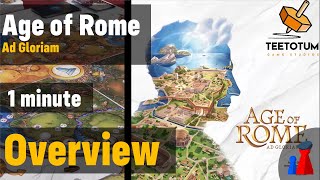
- Multiple buildings each offering a unique action and different ways to score Glory
- Rotating province board adds variability and strategic depth
- Scheme actions provide strategic choices to gain advantages and hinder opponents
- Coliseum interactions create decisive scoring opportunities
- Clear progression toward Glory points and a definitive win condition
- Modular board and event-driven changes promote replayability and planning adaptation
- Complex rules due to many building types and interactions
- Reliance on random event cards can shift strategy unpredictably
- Board rotation can complicate early planning and slow the pace in new play sessions
- Political strategy and empire-building focused on influence, infrastructure, and glory across a contested Roman landscape.
- Ancient Rome, partitioned into four rotating provinces (quadrants) with a central Coliseum motif that anchors scoring opportunities.
- historical simulation with modular board mechanics where control over provinces and buildings drives scoring.
Mechanics (from transcript analysis)
- Area control / zone-based placement — Players place followers in the currently operable province to claim actions, activate buildings, and position for Glory point opportunities.
- Building actions — Five distinct building types each unlock a unique action and contribute to Glory scoring; choosing which buildings to develop creates divergent strategic paths.
- Construction and follower placement — Players construct new buildings and place followers on buildings or in the Coliseum to access actions and influence scoring.
- Glory point economy — Actions and buildings reward Glory points; accumulating Glory is the path to winning the game, with points tracked across rounds.
- Random event cards timing — Event cards drive round-to-round variability, shaping which provinces are active and which strategies are optimal in any given turn.
- Rotating board quadrants — Each round starts with a quadrants/board rotation dictated by a random event card, forcing players to adapt plans as the map's relevance shifts.
- Scheme actions — Special scheme actions offer short-term advantages and bonuses, and can also impede or disrupt opponents when deployed effectively.
Video topics + discussion points
Quotes (from this video)
- There are five different types of buildings, each offering a different action and a different way to score Glory points.
- Scheme actions to gain advantages and bonuses and impede their opponents.
- Quadrants rotate on every round as dictated by a random event card.
References (from this video)
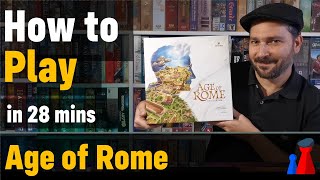
- Stunning production quality
- Innovative rotating board mechanic
- Comprehensive setup and rule presentation in the video
- Political power, provincial management, empire-building
- Ancient Rome with rotating four-quadrant province board
- Historical/abstract
Mechanics (from transcript analysis)
- Building levels and scoring — Construct level-based buildings in your Province, gaining Glory and population benefits.
- Follower placement and action selection — Players place followers on buildings or the Coliseum to perform actions and score Glory.
- Milestones and follower generation — Reach milestones to gain followers and unlock scoring opportunities.
- Region scoring and tie rules — Score Battle Regions based on legions and banners, with tie-breakers favoring medals.
- Resource management (dinari, trade cards, Pantheon) — Manage currency, trade cards, and Pantheon pieces to gain points via sets and foundations.
- Rotating board with provinces — A four-quadrant province board rotates each round according to event cards to determine where players act.
- Scheme actions and feud markers — Players execute aggressive scheme actions against opponents using markers and card effects.
- Voting and Senate column — Place votes to form majorities in the Senate, earning Glory with bonuses for medals.
Video topics + discussion points
Quotes (from this video)
- The game has a board depicting four Province quadron which rotates on every round as dictated by a random event card on every round
- The game uses a very Innovative mechanism of a rotating board which serves you the province in which you can operate during a round
- The rotating Province board will be rotating and players will be always operating in the province that is moved in their selected area of the main board
- The game is played over nine rounds