In Aqua Garden, you're the owner of an aquarium and want to stock its six tanks with a variety of sea life, but you have a limited amount of funds and only one employee on hand to place the fish in the tanks. Do your best to outshine the other aquariums in town!
A game lasts 3-4 rounds depending on the number of players. You have your own aquarium board with six tanks, and a shared player board has sea creatures placed at random on its perimeter. Seaweed and coral tokens are placed on the separate sea board, along with five random sea creatures.
During a round, whoever is farthest back on the perimeter of the shared board takes the next turn, moving their owner as many spaces as they want to an empty space, then taking the action of that space. If you stop on an advertising space, you receive funds based on what's currently in your tanks. If you stop on a sea creature space, you take them all, move your single employee 1-3 spaces clockwise on your aquarium board, then place the creatures in one or both tanks adjacent to the employee. (If the employee passes the feeding event card you were randomly dealt at the start of the game, then you receive funds from the bank based on how well the creatures in the two tanks next to the feeding event card match that card.)
Each tank has only 4 units of oxygen available, so you can't add creatures to a tank that would consume more oxygen than this. You can add one seaweed to each tank, however, to increase the available oxygen to 6. You must also observe other placement restrictions, such as keeping sharks separate from fish and sea turtles. Additionally, you can pay to purchase creatures, seaweed, and coral from the sea board.
If during your turn, the contents of one or more of your tanks matches one of the four randomized milestones on display, you mark the highest empty space on that milestone with a token. The first player to achieve each milestone receives a related creature that they can place in any tank.
If you've circled the board, you wait for other players to finish, then start a new round, with players moving out in the order that they arrived. After the game ends, players score points for the milestones achieved, funds remaining, order in which they finished, and the sets of creatures they've collected in each tank.
Aqua Garden includes manta rays, remoras, and flapjack octopuses that can be added to play to create new scoring opportunities.

- most straightforward and accessible of the three
- clear core loop centered on gathering fish and filling exhibits
- replayability concerns relative to the other two games
- decision space is somewhat narrow compared to Dino Garden
- aquatic life management and exhibition scoring
- Aquatic park habitat; collecting fish to exhibit
- clean, accessible engine focused on expansion of exhibits and milestones
- Dino Garden
Mechanics (from transcript analysis)
- milestones — achieve specific fish in tanks to earn points and extra tokens
- resource/tank management — balance tank capacity with fish needs and additional tokens to enhance scoring
- Rondelle movement — move a worker around a circular track to place exhibits and collect resources
- set collection / exhibit placement — gather fish tokens and place them into personal tanks to score
Video topics + discussion points
Quotes (from this video)
- Sky Garden is my favorite of the three
- Aqua Garden is my least favorite here
- milestone board significantly more
- dino garden had a decent amount of juggling
References (from this video)
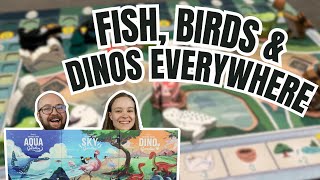
- Core gameplay is fun and approachable
- Compact puzzle with accessible scoring and pace
- Lacks the depth and added mechanics seen in the later two games
- Birds and water life organized in habitats with tile-drafting play
- Aqua/aviary habitat concept combining birds and aquatic elements in a garden-like park
- Light, approachable puzzle with a gentle thematic framing
- Azul
Mechanics (from transcript analysis)
- Area expansion via habitats — Upgrade spaces (lake/forest/etc.) to increase capacity for placements
- Event cards and scoring — Movement over event spaces yields income; end-game scoring via specific sets
- tile drafting — Draft tiles to place in habitat spaces; last player has special placement considerations
Video topics + discussion points
Quotes (from this video)
- I felt like this had fewer choices in what I had to place in the different spaces than these other two.
- The core gameplay loop is fun here, but the additions that these two games have make it for me into like a cozy... a fun puzzle game.
- Sky Garden you have more ways to alter the area in itself
- I think right now for me sky garden is my favorite as well
- It has meat.
- the meat mechanism
References (from this video)

Mechanics (from transcript analysis)
Video topics + discussion points
Quotes (from this video)
- Stefan Feld at this point puts out a lot of games. A lot of them are a ton of fun and some of them are like, Hey, I'd rather play other games you've put out.
- I absolutely adore it. It's a cooperative and competitive tile laying game.
- Like I had fun playing it. I really enjoyed it. Instinctively, I want to give it a four out of five.
- I definitely enjoyed playing it. Give it a 3.5 out of five. We have Timeless Journeys.
- Calypso, great game. Highly recommend it.
References (from this video)

- Accessible and family-friendly
- Beautiful components and cute theme
- May be too light for euro-hungry players
- Re-release with new art has caused some debate
- Aquatic ecology and animal compatibility
- Aquarium-building with life forms
- Light, family-friendly theme
- Calico
- Parks
Mechanics (from transcript analysis)
- Pattern building / area influence — Construct tanks with animals that fit oxygen needs and interactions.
- Resource management — Balance oxygen and tank capacity to maximize points.
Video topics + discussion points
Quotes (from this video)
- This is Mind Management, the best hidden movement game I’ve played in a long time.
- The central mechanism of ruby on that around that mala… it’s simple but deliciously clever.
- This is Aridia. I love this game from the first playthrough.
- This is a game system that’s incredibly versatile and has staying power—Marvel United.
References (from this video)

Mechanics (from transcript analysis)
Video topics + discussion points
Quotes (from this video)
- There's so many games, it's hard to keep up.
- I finally got to a point where I've been unable to keep up.
- I could turn this into an art.
- There's a lot of crowdfunding content coming up for the next few weeks.
- I wanted to like Spell Legends so much, but there are things about it that I do like, yet busy work holds it back.
References (from this video)

- Innovative time-track mechanism that adds tempo and tension
- Vibrant, appealing component design that enhances thematic immersion
- Multiple scoring avenues via fish variety encourage strategic planning
- Early production artwork and final components still unclear in video; potential for production changes
- Aquaculture and aquarium management with a time-track mechanic
- Aquarium building with a central board featuring multiple aquariums and colorful fish components
- Bright, exploratory, and component-driven with a light documentary feel about aquatic life
- Other time-track games with expressive components
- Aquarium-themed strategy titles
Mechanics (from transcript analysis)
- area scoring by fish types — points are earned based on the composition of fish types across six aquariums
- Time track — players can advance the central time track to take actions; farther advancement accelerates or opens new options
- worker placement / pawns on a board — a pawn moves around the board to place fish and influence aquarium setup
Video topics + discussion points
Quotes (from this video)
- I love games that have time tracks.
- the components in this game look great.
- I am a sucker for creative use of components.
- folding the corners over as you are playing the game.
- this one is suddenly a game that I am very interested in.