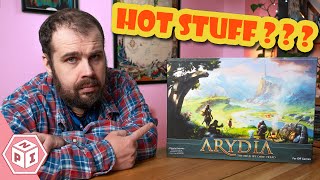
Arydia: The Paths We Dare Tread is an open world, campaign-based, co-operative, fantasy-based, "green legacy" role-playing board game. The game of Arydia is built on four design pillars: Exploration, Progression, Combat, and Role-playing.
Exploration — Arydia is an open world to explore as you wish. Make your way across the world map, discovering new locations, interacting with memorable characters, fighting vicious monsters, and scavenging long-lost treasures. The world pulls you in through detailed descriptions and vivid artwork for each place you visit. Every location is unique, not randomized, and is built piece by piece as you explore.
Progression — Arydia is played as a campaign over the course of a number of game sessions; you start each session right where you left off! As you play, the game keeps track of your actions and decisions. Your characters will grow in power, collecting new items, weapons, and skills. NPCs and locations will change, depending on how you interact with them. All of this progression is done using a simple, but powerful, index system, which allows for quick and easy set-up and tear down.
Combat — Many of the locations you'll visit in Arydia are hostile, so you'll need your weapons, skills, and co-operation to overcome the challenges you encounter! Arydia features a tactical, co-operative combat system. Enemies are controlled by game cards and dice, while you and your companions work together to defeat them.
Role-playing — Take on the roles of a wide cast of characters as you encounter them throughout your journeys. Step into the shoes of a disgruntled shop owner, sniffling brat, or a poorly-dressed bandit leader. The incentive-based role-play system encourages you to engage in dramatic storytelling, without being intrusive.
As for being a "green legacy" game, publisher Far Off Games notes that Arydia features all the hallmarks of a legacy game — packages to open, hidden information, progression, discovery, exploration, all the while wrapping it in high-quality components — but allows you to reset the game when you have completed it so that you can start again or pass it on to someone else.
- Ridiculously lavish physical presentation and premium components that create a strong sense of immersion.
- Roleplay prompts generate memorable, often funny, interactions and keep the table engaged.
- Campaign-in-a-box concept is appealing for fans of CRPGs and tabletop RPGs who want a self-contained experience.
- The production scale and visual design deliver a striking product that stands out on a shelf or table.
- Accessible entry point for a CRPG-inspired experience with clear, simple combat actions once you are through the tutorial.
- The learn-as-you-play tutorial is painfully long and poorly structured, turning onboarding into communal instruction rather than active play.
- The game struggles with scalability for larger player counts due to components and reference visibility issues during combat.
- The main narrative is lightweight and feels like a string of disconnected quest vignette moments, lacking a strong overarching arc or stakes.
- The heavy emphasis on physical components and 'unboxing' cycles can feel like a production gimmick at the expense of play time.
- The pricing is steep (noted at £240) and this raises accessibility concerns for many potential buyers.
- The game's aesthetic and marketing positioning as a 'green legacy' product can feel at odds with the amount of plastic and complex reset procedures.
- Campaign-in-a-box RPG experience that aims to capture the mood and mechanics of classic CRPGs and the sense of adventure through roleplay prompts, modular storytelling, and highly tactile physical components.
- A fantasy CRPG-inspired world where exiles gather in villages, undertake quests, and explore a changing map full of events and encounters.
- episodic vignettes with loose connective tissue between quests; a memoir-like tone of personal journeys within a dynamically evolving world.
- Gloomhaven
- Sleeping Gods
- Oathsworn
- Kinfire
- Earthborne Rangers
- Fate Forge
Mechanics (from transcript analysis)
- Advent calendars and premium components — The box is packed with pre-painted miniatures, exclusive tokens, and advent calendar inspired surprises. The unboxing and reveal moments are touted as a core joy, driving excitement and a sense of premium production but also contributing to cost and potential component management challenges.
- Adventure Mode and Combat Mode nested on the same map — Exploration can trigger events and foes on the same physical map. When combat begins, players use the same spatial grid with dice, item cards, and class-specific abilities to resolve fights. The system emphasizes collaboration as players chain actions and coordinate damage lines to maximize effectiveness.
- Dynamic map state changes and persistent evolution — Maps and encounters can change state in response to events (for example meteor impacts). Old map states can be superseded by new versions, creating a sense of progress and consequence. This is a strong conceptual hook but adds complexity in rule interpretation and memory load.
- Grid-based combat with attack patterns and combo points — Combat uses a grid to track damage and positioning. Attacks have patterns that can interact with terrain, with optional mini-actions and a resource called combo points that power stronger abilities. The system is smooth in execution but can become mechanically predictable as games scale.
- Physical dashboards, inventory slots, and item placement — Each chosen path unlocks a dashboard with inventory slots that players physically insert items into, echoing CRPG inventory screens. This tactile approach reinforces the fantasy of equipping gear and seeing your character come together in real time, at the cost of added physical space and component manipulation.
- Roleplay prompts and catch-all dialogue mechanic — A central interaction system where one player adopts a character and the others can ask questions based on bolded prompt keywords. When questions touch content outside the prompt, the responding player must improvise a response such as 'Hmm, that seems to fall outside my recollection,' which preserves the illusion of in-universe dialogue and creates memorable roleplay moments.
- World Exploration via hex-map with Travel Deck — Movement on a modular hex grid, drawing from a Travel Deck to determine terrain and events between locations. This deck evolves as you play, adding or removing cards based on prior encounters, which keeps exploration feeling fresh but also introduces bookkeeping and pacing considerations.
Video topics + discussion points
Quotes (from this video)
- Everything Arydia gets right is distilled in this one ridiculous mechanism.
- The gist of Arydia, like many board games of its type, is that it wants to be an RPG campaign in a box.
- Pokémon. It wants to be Pokémon.
- Arydia worships at the altar of silly.
- This game is £240.
- WHY? Why did you do this?!!
- I'm not going to lie, never going to get tired of doing that.
- It's impressive, how much of that it manages to pull off without enormous amounts of faff.