Collection Status
Your Rating
Description
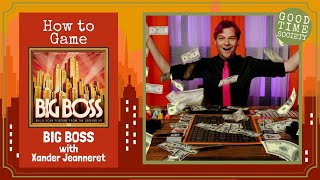
Big Boss is a game of founding companies, expanding existing companies, taking over smaller companies and share buying. The game is explicitly based on the Sid Sackson classic Acquire and shares many similarities to that game though mergers are not as prevalent or crucial in Big Boss. The main differences between the two games include the three dimensional aspect of Big Boss, and the existence of a strong monetary incentive to expand companies that you do not control.
Year Published
1994
Transcript Analysis
Browse transcript mentions, sentiments, pros/cons, mechanics, topics, quotes, and references.
Total mentions: 2
This page: 2
Sentiment:
pos 2 ·
mix 0 ·
neu 0 ·
neg 0
Showing 1–2 of 2
Video SOvXcUvHyg0
Unknown Channel rules teach at 0:00 sentiment: positive
video_pk 5128 · mention_pk 15211
Click to watch at 0:00
Overall sentiment (raw)
positive
Pros
- Engaging and thematic blend of building, expansion, and mergers in a compact play space.
- Clear escalation through card types (industry/level) and the incremental tower mechanic that adds strategic depth.
- High player interaction via mergers and the race to fund and upgrade companies, with a tangible payoff each turn.
Cons
- Rules can be complex and somewhat brutal, with a noted rule reference indicating that endgame decisions are nuanced (see page 10 of the rules).
- Random card draw can heavily influence turn options and pacing, potentially slowing or speeding the game depending on the industry/level cards drawn.
Thematic elements
- Corporate finance, stock market manipulation, mergers and acquisitions, strategic bidding and expansion.
- A satirical corporate board room and city-building board where players simulate founding, expanding, and merging companies to accumulate wealth.
- Rule-driven instructional with a light narrative framing of becoming the wealthiest mogul through strategic company growth and mergers.
Comparison games
none
Mechanics (from transcript analysis)
- Buying shares — During the buy step, a player may purchase up to two shares in any founded companies, paying the current share price for each share purchased.
- Discard and draw — Played cards are discarded to a public face-up discard pile. If a card is played from the hand, a new card from the industry deck is drawn to replenish row spaces.
- Earning step — After founding or expanding a company, the active player earns money equal to the new share price of that company on that turn.
- End condition — The game ends when all building pieces are placed or all players pass. Final scoring includes cash, the value of shares and towers, plus value of any remaining cards in hand.
- Founding and expanding companies — Players place buildings and HQs by using industry or level cards to found new companies or to expand existing ones on vacant spaces of the board.
- mergers — When a building piece is placed adjacent to two companies, those companies merge. The acquiring company is the one with the higher share price, and ownership transfers accordingly.
- Radio towers — A radio tower can be purchased and placed on a company. The first tower costs 15 million, the second 30 million. Each tower counts as three shares and occupies the top of the HQ; towers cannot be sold.
- Share price management — A company’s share price is updated based on the level of buildings placed during the turn. The total level on the spaces contributed that turn determines the new share price increment.
Video topics + discussion points
No key topics recorded for this video.
Quotes (from this video)
- it's Big Boss
- the basics of Big Boss
- fund a company it's fun you'll succeed I promise
- money not dollars cuz we could play this anywhere
- brutal see page 10 of the rules for more details
References (from this video)
No references stored for this video.
Video c6whWG6Tc20
Board Game Buys general_discussion at 11:43 sentiment: positive
video_pk 2824 · mention_pk 8263
Click to watch at 11:43
Overall sentiment (raw)
positive
Pros
- classic Kramer pedigree
- simple economic core
Cons
- depends on player count; balance shifts with numbers
Thematic elements
- Kramer’s economic game design with acquisition dynamics
- economic power games with gang/merchant flavor
- classic economic strategy
Comparison games
none
Mechanics (from transcript analysis)
- economic negotiation — players negotiate and pursue acquisition-style objectives
- multi-player interaction — player choices influence others and market conditions
Video topics + discussion points
No key topics recorded for this video.
Quotes (from this video)
- I think this game is really cool
- this is a very simple kind of family weight puzzly game
- it's a very fantastic game
- the rules are absolutely horrendous
- I really love this game and I've played it a few times now and I think the balance is fine
- Luke from the Broken Meeple thinks this game is really imbalanced
- the row system where the positioning of your characters is important
- one of the best two-player games I've played in some time
References (from this video)
No references stored for this video.
Transcript Navigation
Showing 1–2 of 2