Blue Moon City - the board game - picks up where the two-player game, (Blue Moon), ended: the reconstruction of the destroyed city of Blue Moon. The board, illustrated by Franz Vohwinkel as well as many well-known American fantasy artists, consists of 21 large building tiles, which show building plans on one side and the buildings in their reconstructed glory on the other. As in the 2-player game, the game includes 3 large molded plastic dragons.
At the start of the game, the board tiles all show their building plan sides. The object of the game is to use cards featuring the races of Blue Moon to help rebuild the city and, at the end, put the large Crystal of the Obelisk in the middle of the city back together. Whenever a building is completely rebuilt, its tile is turned back over to its rebuilt side. The players who helped with a building get crystals and dragon favors, which can be traded in for crystals at certain times.
The player who first manages to add the required number of markers by paying crystals to the Obelisk wins the game. (four markers in a 4-player game, five markers in a 3-player game, and six markers in a 2-player game)
There are two mini-expansions for this game (Blue Moon City: Expansion Tile Sets 1 & 2), each consisting of two tiles that can be added to the main game either separately or combined. The first mini-expansion was included with the Der Knizia Almanach. The second mini-expansion was included in the 6/06 issue of Spielbox.
Rules changes
Original Knizia design--after dragon scales score, ALL players discard scales. This rule was modified by the publisher. [citation needed]
In original printings such as Kosmos and FFG for 4-3-2 players the game uses 15-12-9 dragon scales. In later edtions new publisher CMON changed this to 12-9-7 scales.
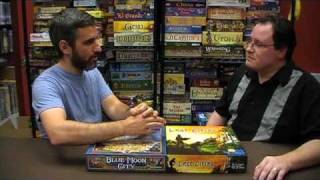
- Beautiful components and artwork; dragon figures and themed pieces are visually appealing
- High production value; cards and tiles are aesthetically pleasing and tactile
- Significant strategic depth, especially with early-build choices and bonuses
- Notable luck element in card draws that can swing outcomes
- Ending can feel abrupt and lacks hidden scoring, which can reduce suspense
- Unlucky draws can severely limit options and progress
- Construction/temple-building with offerings and obelisk influence; dragon interactions as a risk-reward element
- Ancient city with temples, offerings to the obelisk, and dragon-related motifs in a mythic setting
- Abstract strategic planning
- Lost Cities
Mechanics (from transcript analysis)
- card_play — Play cards with special powers that can move pawns, act as wild cards, or enable various actions (e.g., dragons, obelisk donations)
- dragon_and_scales — Dragons allow players to acquire scales used to facilitate additional donations to the obelisk
- offering_to_obelisk — Donations to the obelisk accumulate toward a winning threshold; first player to reach the target wins
- pawn_movement — Pawns move along building tiles and respond to card effects; movement interacts with board bonuses
- tile_placement — Move and place building tiles on the board to contribute to construction according to card values and colors
Video topics + discussion points
Quotes (from this video)
- it's almost like a racing game
- there's a lot of luck in both of them
- the luck seems to even out
- Lost Cities is actually a much simpler game
- easy to pick up
- you can chat over it
- there's no hidden scoring
References (from this video)
- beautiful city-building iteration
- progression toward the center/obelisks
- rule familiarity required for new players
- city construction in a mythic world
- fantasy city builder
- polished Euro-style
- Blue Moon City
Mechanics (from transcript analysis)
- Resource management — cash in crystals to fund city growth and obelisks
- tile placement — build a city by placing tiles with varying bonuses
Video topics + discussion points
Quotes (from this video)
- newest release from fil that isn't a reprint
- it's a racing style game
- spoiler I did really like this one
- this one intrigued me
- the art style in this game is absolutely gorgeous
- Sandbox prison brawler for up to eight players
- complete reworking of Rum and Pirat
- wind tiles will direct your ships
References (from this video)

- Versatile card system
- high replayability with modules
- Occasional confusion with heavy iconography
- City-building, dragon/mythic integration
- Rebuilt city after calamity
- Semi-cooperative with competitive scoring
Mechanics (from transcript analysis)
- card_play — Diverse factions with cards enabling varied strategies.
- race_to_build — Race to complete obelisk/monument objectives.
Video topics + discussion points
Quotes (from this video)
- Harrow County is a very unique game.
- This is Seven Wonders. ... an excellent card drafting game.
- Ticket to Ride is a classic and a staple at many events.
- Root has fans and they are super fans.