Cacao is a tile-placement game that immerses players in the exotic world of the "fruit of the Gods". As the chief of your tribe, you must lead your people to prosperity through the cultivation and trade of cacao — and to do that, you'll need to put them to work in the best way possible.
In the game, each player has an individual deck of square worker tiles, with the number of workers on each side of the tile varying from tile to tile. The playing area starts with only a couple of jungle tiles in play: a cacao field and a small market; two jungle tiles are laid face up, and the remaining jungle tiles stacked as a draw pile.
On a player's turn, he places one of her worker tiles on the board adjacent to one or more jungle tiles already in play, then (if two worker tiles are next to an empty space) adds one of the jungle tiles to the playing area in this space. Her workers then get busy and deliver the results of their effort: If you placed workers next to a cacao field, you receive one or two cacao markers per worker; if they're next to a market, you can choose to sell one cacao marker per worker at the listed price; if next to a well, you receive water; if next to a temple, they stand and look good until the end of the game; and so on. He then refills her hand from her personal deck to three worker tiles.
Once all players have used all of their worker tiles, the game ends. Players score (or lose) points based on their water supply, and each temple rewards whichever players sent the most workers to it. In the end, whoever has collected the most gold wins.
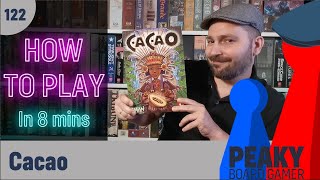
- Modular board setup creates varied, replayable layouts
- Diverse actions via jungle tiles and worker activations
- Strong thematic tie between cacao production, markets, and temple scoring
- Clear endgame scoring with token and temple mechanics
- Rules can be dense and require careful study
- Tile placement space can become tight on the table
- Jungle tile interactions demand good planning to optimize activations
- Cacao cultivation, trading, and temple-based endgame scoring.
- A tropical cacao plantation with a modular board formed by worker tiles and jungle tiles, including temples and market interactions.
- mechanics-driven, tile-placement and resource management embedded in thematic farming/trade
Mechanics (from transcript analysis)
- Market selling — Sell cacao fruits from markets for coins at varying prices.
- penalty/track bonuses — Water track penalties/bonuses influence end-game scoring and token gains.
- Resource management — Manage cacao fruits, coins, sun tokens, sand tokens, and other markers.
- temple scoring — Endgame scoring based on workers attached to temples; tie-breaks based on cacao fruits.
- tile placement and modular board — Players place worker and jungle tiles to create a changing playing area each turn.
- Work replacement — Players place worker tiles to activate actions; tiles determine available actions and future placements.
Video topics + discussion points
Quotes (from this video)
- hi and welcome back to Peaky Boardgamer this is Ektorakos and today i will explain the game
- a game for 2-4 players placed in under hour and it's a game that features
- a simple but interesting work replacement mechanism let's see how the game is played
- the game ends immediately after all players have played all of their worker tiles at this point
- the player with the most coins wins the game
References (from this video)

- agriculture
- colonial
- Carcassonne
Mechanics (from transcript analysis)
Video topics + discussion points
Quotes (from this video)
- Your cards are ordered, you must never change the order of your cards
- If nobody guesses my card I get zero points and if everybody guesses my card I get zero points
- I've got to come up with a clue that's just obscure enough that some people around the table will get it
- Evolution is my absolute favorite game
- It's like a jigsaw but you build it all together - a game can be this
- Social deduction games can get quite loud and aggressive
- I really don't like games which require you as a player to be funny
- I find it so awkward and cringy, to be honest I won't play these games anymore
- There are billions and billions of possible combinations that we could make
- Hand management is a really satisfying part of many many card games