This revised edition of Die Siedler von Catan: Junior includes the new rules of Catan Junior Madagascar.
It plays two to four players, rather than three to four. The new board is printed on both sides. One side for two players (new) and the other side is for 3-4 players.
Changes from earlier versions:
- new board
- 2 gold islands (old: 1)
- 5 life rings on the board (old: market)
- no Harbour tiles (old: 4)
- generally all Tokens (old: cards)
- resource pineapple (old: rum)
- new colours lilac and bright yellow (old: White and yellow/orange)
- parrot as robber (old: pirate)
---
Die Siedler von Catan: Junior is a junior edition of The Settlers of Catan. Players collect and trade resources in order to build things, gain more resources and score points. The first player to build seven warehouses wins.
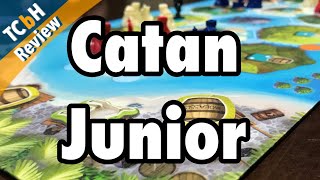
- Accessible for kids and families
- Smart market trading system teaching relative value
- Scales from two to four players
- Language-independent components and rules
- Captures feel of big games while staying approachable
- Non-aggressive, light conflict gameplay
- Vibrant pirate theme and engaging components
- Not as deep or strategic as the original Catan
- Contains some luck elements, which may lessen control for experienced players
- Overall simplified experience compared to the classic game
- Pirate exploration, resource gathering, and light conflict with a party- and family-friendly vibe
- Pirate-themed island adventure with a market-based trading system for young players
- Accessible, child-friendly storytelling with pirate characters and colorful components
- The Settlers of Catan (original)
Mechanics (from transcript analysis)
- building and expansion — Players spend resources to build pirate castles and ships, expanding across the island to claim victory
- Development-card analogue (Coco the parrot) — Face-down development cards with various effects add strategic variety without requiring deep complexity
- Dice-driven resource production — On a turn, all players produce resources for each pirate castle touching an island with the rolled number; a roll of 6 moves a ghost robber and alters production
- Market-based trading — There is a market of resources; players can trade one of their own resources for one on the market, influencing others' options; when the market floods, it is reset
- Robber/ghost mechanic — Rolling a 6 allows moving the robber/ghost to a new island, disrupting production and stealing from the affected player
- Thematic resource types — Resources include wooden materials, gold, molasses, swords, and goats, presented in a bright, thematic way
- Victory condition — First player to build seven pirate castles wins the game
Video topics + discussion points
Quotes (from this video)
- this market is a brilliant system that's good in any right
- it's such an accessible way of displaying relative value
- the best aspects of the original game made in such a way that it is fun and understandable for my five-year-old
- it scales well from two to four
- language independent
- non aggressive gameplay
- my kid and I are down to play Catan Junior any day