Collection Status
Your Rating
Description
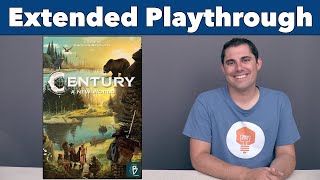
Century: A New World is the third and final installment of the Century series from designer Emerson Matsuuchi.
Century: A New World sends players to the Americas at the dawn of the 16th century. Braving the wilderness, players are forced to explore new lands, trade with local inhabitants, journal their findings, and hunt/gather to survive! The game integrates the compelling and incredibly fun resource trading mechanisms found in the Century series with a worker placement mechanism with a twist!
Century: A New World may be combined with Century: Spice Road or Century: Eastern Wonders or both for all new mixable games.
Year Published
2019
Transcript Analysis
Browse transcript mentions, sentiments, pros/cons, mechanics, topics, quotes, and references.
Total mentions: 3
This page: 3
Sentiment:
pos 3 ·
mix 0 ·
neu 0 ·
neg 0
Showing 1–3 of 3
Video rwsHDOddqoc
The Cardboard Herald convention_report at 0:29 sentiment: positive
video_pk 9502 · mention_pk 28099

Click to watch at 0:29 · YouTube ↗
Overall sentiment (raw)
positive
Pros
- Can be combined with other games in the series
- Borrows well from Spice Road first iteration
- Highly anticipated and most talked about at Origins 2019
Cons
- Likely not the best in series
Thematic elements
- Spice trade
Comparison games
- Century: Spice Road
- Century (series)
Mechanics (from transcript analysis)
Mechanics unknown.
Video topics + discussion points
No key topics recorded for this video.
Quotes (from this video)
No quotes stored for this video.
References (from this video)
No references stored for this video.
Video YBIPZpIrgaU
Junkets Games general_discussion at 10:56 sentiment: positive
video_pk 9364 · mention_pk 27576

Click to watch at 10:56 · YouTube ↗
Overall sentiment (raw)
positive
Pros
- accessible entry into worker-placement-like dynamics
- engaging engine-building via contracts
Cons
- two-player play can feel short; depth varies with player count
Thematic elements
- trade, upgrading spices, contracts
- ancient world with spice economies and new world exploration
- engine-building through contracts and upgrades
Comparison games
none
Mechanics (from transcript analysis)
- engine-building via cards — cards give ongoing benefits and influence future actions
- resource upgrading and contracts — upgrade spices and cash in for victory points via contracts with endgame goals
Video topics + discussion points
No key topics recorded for this video.
Quotes (from this video)
- The overall feeling of this game really is that you are growing trees and then removing them and placing leaves down.
- It's one of the few Roll & Write style games where you can negatively impact your opponents.
- You are spending money to make money, but machines can give you free actions later on.
- This is essentially a Ticket to Patchwork vibe with a modern, crunchy decision space.
- It's a lightweight game that somehow feels dense because of the interactions.
References (from this video)
No references stored for this video.
Video 2pgUozQdOJE
Jang's It's Games playthrough at 0:00 sentiment: positive
video_pk 482 · mention_pk 1402
Click to watch at 0:00 · YouTube ↗
Overall sentiment (raw)
positive
Pros
- Engaging engine-building with multiple viable strategies
- Strong, tense player interaction through bumping and blocking
- Clear endgame scoring with a variety of bonus incentives
- Solid pacing aided by a refreshable card market
Cons
- High interaction can lead to analysis paralysis for some players
- Iconography and terms may be heavy for new players
- Deck thinning late in the game can speed up play and increase pressure
Thematic elements
- Exploration, trade, and resource management
- Colonial era exploration and settlement across a newly discovered land
- Abstract thematic flavor using resource icons and worker placement
Comparison games
none
Mechanics (from transcript analysis)
- Card market and unlocks — A row of cards is refreshed each round; players unlock new action spaces and incentives via cards.
- Discounts via handshake/basket icons — Certain spots grant discounts, defined by icons such as handshake or basket, affecting worker placement cost.
- Endgame scoring and bonuses — Points come from cards, satchel tokens, compass roses, dreamcatchers, and other bonuses at game end.
- Resource conversion and upgrades — Resources can be converted along a chain (e.g., corn -> meat -> tobacco -> fur) with upgrades opening new actions.
- worker placement — Players place workers on spots to gain resources and trigger bonuses, with bumping/locking interactions.
Video topics + discussion points
No key topics recorded for this video.
Quotes (from this video)
- this card is going to be worth seven points to them at the end of the game
- this gives you four points at the end of the game
- final score of 54
References (from this video)
No references stored for this video.
Transcript Navigation
Showing 1–3 of 3