Box blurb translated from Japanese:
An irregular trick taking game where various individual abilities of persons forming history are tangled together.
Who will use their powers to adequately handle the events of the lands? Who will leave their name behind in The Chronicle?
This is the 2009 release from Kanai Factory.
Recommended suggestions for beginners from the designer Seiji Kanai:
Play with 3 or 4 players. 5 or 6 players make the game more difficult to control.
Until you are familiar with all the cards effects, remove the following History cards from the game: "Dark age" (have evil cards), "Coronation" (use three next history cards) and "Meeting with a dragon" (use two previous history cards).
Use the optional rule "several history cards" and draw 2 history cards per round. Each history card honour rewards is resolved independently.
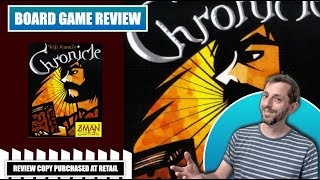
- Beautiful pen-and-ink Japanese-inspired artwork that ties Chronicle to the designer's other titles (Love Letter, Brave Rats re-theme).
- Fresh twist on a familiar trick-taking framework with a healthy dose of chaos that adds interaction and strategic tension.
- Short playtime (~30 minutes) makes it a quick, accessible introducer to trick-taking games.
- Accessible entry point for players new to the genre while still offering meaningful decisions for more experienced players.
- Fits well within the designer's canon, creating cohesion with Love Letter and related games.
- First-time play can be slow due to reading and parsing many card abilities; learning curve centers on understanding card interactions.
- The chaotic nature, while enjoyable for many, may overwhelm players seeking tight, pure strategy.
- The fame tokens and some artwork/graphic design elements feel a bit bland or utilitarian compared to the art quality of the cards themselves.
- intrigue and political maneuvering within a compact, social trick-taking game
- A stylized, artifact-filled world with a love-letter–adjacent thematic vibe and political intrigue of a light, playful kind; artwork and world feel connected to the designer's prior titles like Love Letter and its re-themes.
- expository reviewer commentary with emphasis on card interactions and round-by-round scoring
- Power Grid
- First and Field
- Copy Cat
- Black Friday
- Five Cucumbers
Mechanics (from transcript analysis)
- Fame tokens for scoring — Points are tracked with fame tokens; end-of-round conditions give players opportunities to gain points based on historic criteria.
- Meeting-based rounds and end-of-round card recovery — A round is a trick where players follow suit if possible; at the end, the trick's card is returned and the round ends when a player runs out of cards.
- Trick-taking with action cards — Each card carries an action that can help the player or hinder others; wild cards can win tricks regardless of the declared suit.
- Two decks: history cards and character cards — Character cards determine who is in the meeting; history cards define round conditions and scoring.
- Win condition and round cadence — Play continues across several rounds until a player reaches three fame points; each round uses a different history condition to determine scoring.
Video topics + discussion points
Quotes (from this video)
- Chronicle is a trick taking game.
- It's a fairly chaotic example of the genre but it fits very comfortably with the rest of Can I's canon with Love Letter and R.
- It's a beautiful game, a little chaotic; the strategy maybe is, there's a degree of it, but it's a fun experience, a quick experience and a cheap package to purchase.
- I do recommend Chronicle.
References (from this video)

- high-energy, chaotic progression
- variety improves with more plays
- engaging for players who like evolving rules
- rules can be dense; learning curve
- chaos may overshadow strategy for some
- changeable rules and wild cards altering play
- Traditional trick-taking framework with added chaos
- chaotic but approachable
- Stick Meister
- The Crew
Mechanics (from transcript analysis)
- changeable round rules — Each round introduces a new rule drawn from a deck, altering win conditions or scoring.
- steal/copy mechanics — Cards allow interaction such as stealing or affecting opponents' hands, increasing chaos.
- trick-taking with wilds — Standard trick-taking at core, but with cards that grant special abilities to alter play.
Video topics + discussion points
Quotes (from this video)
- it's a really nice little trick taking game
- beautifully produced lovely artwork
- it's just as beautiful even if it's a little more two-dimensional
- it's a classic simple game of swapping trading swapping with that Central that Central display
References (from this video)
- Engaging balance between taking valuable cards and evading bad tricks
- Contract trick taking games
Mechanics (from transcript analysis)
- trick-taking (point-based) with evasion twists — regular trick-taking logic with emphasis on the value of taken tricks and possible evasion mechanics
Video topics + discussion points
Quotes (from this video)
- i absolutely love cockroach poker
- the big moments and the big swings are quite satisfying
- i find these games hilarious
- i really like the game huh or hein
- watching the value of things change
- the moment when that tower collapses it's exciting
References (from this video)
- Player powers on cards
- Unique abilities per card
- history
- chronicle
- Stick Meister
Mechanics (from transcript analysis)
Video topics + discussion points
Quotes (from this video)
- board games are diverse but card games really could feature anything
- players are all doing this simultaneously and so you want to be the player that stays in the longest
- if you turn over to many matching cards then you end up with nothing
- auction games are are well served by the sort of card game mechanisms
- play very quickly for three to six players
- an excellent excellent game
- take that card games or I think the most combative sort of card games
- totally silly extremely random but essentially we're playing cards to attack other players
- still one of my favorite games
- each card is a floor on a building
- there's a whole genre of what we call take that card games
- you could place bombs or or murderers into these buildings or the police can then take away a murderer
- Seven Wonders was the sort of figurehead for the cloud drafting games
- sushi go has been an enormous hit
- now the figurehead for the genre is probably sushi go
- deck building was created really by the game of Dominion
- there's something delightful about the simplicity of a game like Dominion
- you can teach to people really easily and play very very quickly
- a form of set collection again
- classic tableau builder would be something like San Juan
- this is a fantastic card game
- buying cards laying them out in front of us and they're going to keep generating us money
- this really is one of my favorite genres
- anybody can play these games and not everybody can play them well
- I love speed games I think it's a fantastic category of card games
- trick-taking games very very straightforward in their basic format
- the basic mechanism can be turned into all these different games
- all tweak it slightly in different ways
- my top ten card game mechanisms
- hopefully I've given you a broad picture of the world of card games
References (from this video)
- Love Letter
- 8 Epochs
Mechanics (from transcript analysis)
Video topics + discussion points
Quotes (from this video)
- Formula D is really the epitome of roll and move games in the modern era
- Settlers of Catan which was perhaps the most significant euro game that really sparked this whole new wave of modern board games
- Yahtzee has become a mechanic in its own right
- epitomises dice games really and how far they've come
- this is a bit of a tricky one to learn, it's well worth the effort
- ridiculously more fun than it should be
- playing with children it's fantastical
- absolutely brilliant
- this is my top 10 different ways to use dice in wooden board games
References (from this video)
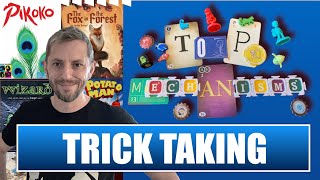
- Rich interplay of card powers and evolving objectives
- Rules can be complex; requires setup and bookkeeping
- A card game with powers on many cards; allies and objectives drive scoring
- Mechanics-forward with modular round objectives
- Honshu
- Shavate?
Mechanics (from transcript analysis)
- allies and objectives — Allies are placed in front of players; rounds feature evolving objectives
- card-powered abilities — Most cards have a power that activates when played, especially off-suit plays
Video topics + discussion points
Quotes (from this video)
- trick-taking games are the most ancient form of card games dating back to the 10th century in China
- this is a top 10 style of trick-taking games top 10 different mechanisms used in trick-taking games and specifically in modern trick-taking games
- the first half of the game players reveal a card in an attempt to win a central revealed card
- bidding is a way to add a layer of strategy and prediction to the trick-taking format
- the most famous and popular example is the four player game teach you which is played in two teams of two