After the great Chicago Fire of 1871, the brave men and women of Chicago sought to rebuild their once-great city, and rebuild it they did. Over the next 60 years Chicago experienced an economic golden age, making such great progress that it hosted The World's Columbian Exposition in 1893, followed not long after by a celebration of its Century of Progress at The World's Fair in 1933.
Many of the household brands we've come to know and love today had their start in Chicago during this time period; Oscar Mayer, Kraft, Quaker Oats, Nabisco, Swift & Co, Armour & Co, Schwinn Bicycles, Charles Schwab, and many others made a home here in this tall, bold slugger.
In City of the Big Shoulders players take on the roles of entrepreneurs and investors seeking to rebuild Chicago into a city fit for the world stage. In this unique merger of 18xx-style stock manipulation mechanics with euro-style gameplay, players start companies, trade in shares, hire employees, equip their factories, produce goods and sell them to be delivered to homes across the midwest.
Although City of the Big Shoulders features a large amount of strategic depth and rewarding gameplay, it does so in a shorter timeline than is typical of most heavy economic games. Players play just five rounds (also known as decades) in about two and a half hours. Each decade consists of five unique phases: A stock phase where players can buy and sell stock; a building phase where players rebuild the city of Chicago, placing action spaces on the board; an action phase where companies send their partners to make deals across Chicago; an Operating Phase where companies buy resources, produce goods, and ship them out of Chicago; and finally a cleanup phase where the board is set up for the following decade. At the end of the fifth decade, the game ends. Players then exchange shares that they have purchased over the course of the game for cash, are rewarded for any of the public goals they have accomplished over the five decades of play, and tally their money to determine who is Chicago's greatest resident.
—description from the publisher
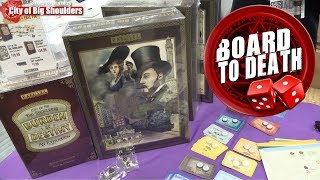
- Deep, heavy euro with high replayability due to variable building placements
- Strong thematic integration with Chicago’s industrial era
- Interactive economy and space control via buildings and payments to others
- High complexity and length; not ideal for casual players
- urban growth, entrepreneurship, and stock-market-inspired investment
- Chicago, early 20th-century industrial development
- economic simulation with variable development each game
- 1846
Mechanics (from transcript analysis)
- Building phase / action-space creation — Each round you select one building card to place; one is discarded and one is kept for future use, creating new action spaces.
- Resource production and sale — Companies produce goods from resources, which can be sold for money with bonuses and multipliers.
- Stock market / share phase — Players buy and manage shares; share prices climb over time and can be bought, sold, or traded.
- Variable turn order — Turn order shifts based on share activity, typically cycling clockwise.
- worker placement — Workers are placed on spaces owned by government, the bank, or other players, triggering actions and payments.
Video topics + discussion points
Quotes (from this video)
- it's a heavy euro
- this is important for a couple reasons one it means the game completely develops differently every time you play the game it's a completely different game
- these become action spaces so on the next round
- the expansion adds five new companies they're all little wacky so they have special rules attached to them
- the base game comes with ten companies in it
References (from this video)

- rich depth and numerous interacting systems
- extremely long play time (over five hours with teach)
- difficult to teach and pace; not as accessible
- corporate expansion, dividends
- Chicago, industrial economy
- economic simulation with heavy euro-style depth
Mechanics (from transcript analysis)
- dividends/stock mechanic — ownership and payout structure influences scoring and player advantage
- economic engine building — players invest in companies, drive production, and vie for dividends
- multifaction/action economy — many interacting systems create a dense decision space
Video topics + discussion points
Quotes (from this video)
- There is a lot going on here, way more than I can summarize in a short clip like this
- this took us over five hours to play with a teach, and that's unforgivable
- an older Martin Wallace game, paint-by-numbers and ultra generic
- it's not my favorite of the racing genre
- five minutes to play and it's just a different Unique Style game
- the core system is brilliant and it keeps you engaged throughout