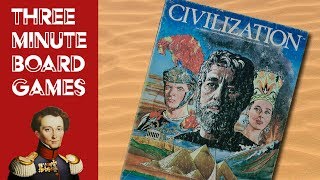
Civilization is a game of skill for 2 to 7 players. It covers the development of ancient civilizations from the invention of agriculture c. 8000 B.C. to the emergence of Rome around the middle of the third century B.C. Each player leads a nation of peoples over a map board of the Eastern Mediterranean and Near East as they attempt to carve a niche for themselves and their culture.
Although battles and territorial strategy are important, this is not a war game because it is not won by battle or conquest. Instead, the object of play is to gain a level of overall advancement involving cultural, economic, and political factors so that such conflicts that do arise are a result of rivalry and land shortage rather than a desire to eliminate other players. Nomad and farmer, warrior and merchant, artisan and citizen all have an essential part to play in the development of civilization. It is the player who most effectively changes emphasis between these various outlooks who will achieve the best balance and win.
(from the Introduction to the Avalon Hill edition rulebook)
This game has a huge following and is widely regarded as one of the best games about ancient civilizations. Each player takes on the role of leader of an ancient civilization, such as the Illyrians or Babylonians. Your task is to guide your people through the ages by expanding your empire and using its proceeds to finance new technological advances, such as Literacy, Metalworking, or Law. The advancements help your civilization better cope with its problems as well as help bring new advancements.
Civilization is widely thought to be the first game ever to incorporate a "technology tree," allowing players to gain certain items and abilities only after particular other items were obtained. This influential mechanism has been adopted by countless other board games, card games, and computer games.

- Strong Euro-style design heritage
- Ambitious civilization-building scope
- Complexity may challenge new players
- Civilization building with dice placement
- Global civ-building with historical vibe
- Grand strategy feel with civilization progression
- Civ-like Euros
Mechanics (from transcript analysis)
- dice placement — Dice rolled to activate actions or allocate resources with placement mechanics.
- engine-building / city-building — Players develop their civilizations through actions that improve long-term capabilities.
Video topics + discussion points
Quotes (from this video)
- we have only 20 minutes to research and buy games
- you will be able to write in the comments which game we should buy
- it's accessible and not that expensive
- it looks like a lot of fun
- real time betting
- it's a betting game where the horses run and you're betting in real time
References (from this video)

- Historical
- Civilization building
Mechanics (from transcript analysis)
Video topics + discussion points
Quotes (from this video)
- moments during board games that formulate memories that you'll never forget
- there's just something for everyone
- it's all about the people
- the board gaming space has allowed me to just have so many incredible fun moments that i'll never forget
- it chose us via christy
- we're gonna have it at jeff's parents basement everybody's coming
- agricola sucks and everybody else seems to love it
- arnak is severely overrated
- i don't think gloomhaven should be number one on the list anymore
- humans are not good at rating things
- my nine is different than your nine
References (from this video)
- Epic, grand scope that feels coherent and focused on the ancient world
- High drama and swings due to disasters and mismanagement
- Relatively clear core rules for a heavy euro-style game
- No player elimination keeps everyone engaged longer
- Deep strategic potential and rewarding come-from-behind plays
- Stays thematically tight to the ancient setting without ballooning into unrelated eras
- Very long playtime and heavy complexity
- Hard to master; requires multiple sessions to optimize
- Requires 3-7 players to realize the full experience; solo play not officially supported
- Potential downtime between turns and combat resolution can slow pacing
- Civilization-building, empire management, technology development
- Ancient world circa 4000 BCE across the Fertile Crescent and Mediterranean
- Epic, grand, swingy due to disasters and mismanagement
- Twilight Imperium 4
- Civilization: A New Dawn
Mechanics (from transcript analysis)
- area movement and region control — Players move units across regions; up to 5 units per turn; combat occurs after moves.
- city development and population limits — Cities have population limits; expanding and reducing population affects control and scoring.
- combat and reinforcement — Combat is resolved after all moves; players alternate removing units; can reinforce via neighboring regions.
- economic taxation and population — Taxation levels determine population growth and ability to maintain cities.
- multi-path victory and non-elimination — Victory is determined by points; typical play avoids elimination, keeping all players engaged.
- random events and disasters — Disasters and epidemics hit players; mismanagement leads to swings in fortunes.
- set collection — Players collect sets of trade goods and technology cards to score points.
- technology cards and scoring — Technology cards drive scoring and unlocks; players track progress on a scoring marker.
- trading and discounts — Trade cards can be traded in groups of three; discounts are applied via card interactions.
Video topics + discussion points
Quotes (from this video)
- The single best thing about the game is the dramatic swings and changes that can occur via disasters and mismanagement
- It's easy to build a large civilization but very hard to keep one for long
- The winner of this game is the player who moves to the end of the scoring track first
- Points are scored primarily by technology cards
References (from this video)
- Majestic, historic scope
- strong six-player interaction through trade
- classic eurogame heritage
- long playtime and heavy commitment
- potentially chaotic with disasters
- trade, disasters, empire expansion
- historical empire-building on a world scale
- grand, long-form strategic simulation
Mechanics (from transcript analysis)
- disaster_events — random disasters that disrupt plans and increase chaos
- resource_management — managing multiple resources (iron, gold, cloth, grain, etc.)
- Trading — resource exchange between players to shape economies
Video topics + discussion points
Quotes (from this video)
- the trading element really comes into its own
- there's something undeniably majestic about the game
- six is the magic number for it
- it's a hell of a lot easier to get six people together that it is to get eight