The election of the Aztec High Priest is imminent. In order to prove their value and merit, the contenders engage in a race for prestige to win the favor of the gods. Will you be able to make the most beautiful sculptures of feathered snakes (called Cóatl) to stand out and gain access to the coveted title of High Priest?
In Cóatl, players work to build the most beautiful and valuable serpents. The serpents, or Cóatl, are constructed with a head, a tail, and a number of body tiles, each made from chunky, colorful plastic. On a turn, players will either take tiles from the central board to their personal board, or work to construct one of their Cóatls with the different tiles they've collected.
The game end is triggered when one player finishes their third Cóatl. Players receive points for fulfilling objectives, and the one with the most is named the new High Priest!
•••
L’élection au titre de grand prêtre aztèque est imminente. Afin de prouver leur valeur et leur mérite, les prétendants s’engagent dans une course au prestige pour conquérir la faveur des dieux. Saurez-vous réaliser les plus belles sculptures de serpents à plumes (appelés Cóatl) pour vous démarquer et ainsi accéder au titre tant convoité de grand prêtre aztèque?
Dans Cóatl, les joueurs construisent les plus beaux et précieux serpents à plumes qui soient. Ces reptiles, appelés Cóatl par les Aztèques, sont construits d'une tête, une queue et un certain nombre de pièces de corps en plastique épais et coloré. À tour de rôle, les joueurs prennent les pièces du plateau central et les transposent sur leur plateau personnel afin d'assembler stratégiquement des Cóatls en fonction des couleurs édictées par leurs cartes d'objectifs.
La partie se termine lorsqu'un joueur complète son troisième Cóatl. Les joueurs reçoivent des points pour la réalisation d'objectifs et celui qui en a cumulé le plus est déclaré grand prêtre aztèque!
•••
In der aztekischen Mythologie ist der Schöpfergott Quetzalcoatl als Gott des Windes, des Himmels und der Erde allgegenwärtig. Gefiederten Schlangen, Cóatl genannt, schmücken antike Tempelanlagen in ganz Mexiko.
Erschafft die aufwändigsten und elegantesten Skulpturen geflügelter Schlangen, auch Cóatl genannt, damit einer von euch zum neuen Hohepriester der Azteken ernannt wird.Während des Spiels erschafft ihr Cóatl, indem ihr Kopf-, Körper- und Schwanzsegmente verbindet, die den Voraussetzungen eurer Prophezeiungskarten entsprechen. Je mehr der Voraussetzungen erfüllt werden, desto mehr Prestigepunkte bringt das fertige Cóatl.
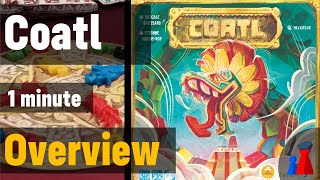
- Thematic Aztec setting with an elegant sculptural motif that ties theme to concrete actions.
- Prophecy cards provide modular, variable scoring modifiers that add strategic depth.
- End-game pacing via completing quarters helps maintain tension and can drive decisive moments.
- Quarters-based scoring offers incremental gratification and a clear progress arc.
- In transcript, inconsistent spelling of terms (coatl/coatals) could lead to momentary confusion about terminology.
- End-game condition can feel fiddly to track for some players, especially with varying component states.
- Interactions among players appear limited beyond shared resources and card attachments, which could reduce social tension for some groups.
- Coatl sculpture-building and prophecy-driven scoring set against Aztec mythos.
- Aztec empire, ancient Mesoamerica with religious rites and ornate artifacts.
- abstract strategy with resource management and score-based progression, focusing on constructing ornate fixtures.
Mechanics (from transcript analysis)
- coatl construction — Players assemble coatls using collected sculpture components, attaching elements they hold and arranging pieces into a completed sculpture.
- prophecy cards — Prophecy cards can be attached to coatls to modify or boost scoring, adding a layer of strategic deck management and timing.
- Resource management — Players manage sculpture components and prophecy cards, balancing acquisition with placement to optimize scores.
- scoring by quarters — Score is tallied per quarter; the game ends when a player completes their third quartile or when there are no body segments left in supply, creating a clear end-game signal.
Video topics + discussion points
Quotes (from this video)
- impress the Aztec gods by carving the
- most elegant coatal sculptures
- their coatals using components in their possession
- cards that will boost the collateral
- scoring the game ends as soon
- as a player completes their third