Cosmic Frog is a game of collection, combat, and theft on a planetary scale. Each player controls a two-mile-tall, immortal, invulnerable frog-like creature that exists solely to gather terrain from the Shards of Aeth, the fragments of a long-ago shattered world. The First Ones seek to use the lands from the Shards to reconstruct the world of Aeth, and your frogs are their terrain harvesters.
At the start of the game, your frogs descend from the Aether, the cosmic sea between the worlds, onto a terrain-rich Shard of Aeth. Once on the Shard, you harvest land and store it in your massive gullet. When your gullet is sufficiently full, you leap into the Aether and disgorge your gullet contents into your inter-dimensional vault for permanent storage, then return to the Shard to collect more land. Although your frogs' collective mission is to gather as much land as possible for the First Ones, your private goal is to prove yourself to be the greatest of their harvesters by delivering to them the most valuable vault. To do this, you have to fill your vault strategically in a manner that both maximizes linear sets of identical lands and maximizes the diversity of lands in your vault at the end of the game.
Throughout the game, you're free to keep to yourself and focus on harvesting at your own pace...or you may attack other frogs and try to take lands directly from their gullets. You may even raid another frog's vault and steal the lands they have gathered if they have been knocked into the dreaded Outer Dimensions. As you are all immortal and invulnerable, no frog is ever wounded or killed — just irritated and inconvenienced.
But don't ever get too comfortable with your carefully crafted plans as the Aether is a chaotic and unstable place. Waves of Aether Flux will prompt you to mutate, and you may have to change your strategy in accordance with your new powers. And Splinters of Aeth, tiny slivers of the old world that swirl madly about in the Aether, will periodically fall from their orbit and crash into the Shard, destroying large areas of terrain and blasting apart the very Shard itself!
The game ends when the Shard is stripped of all harvestable land or when a Splinter shatters it. When the game ends, the player with the highest valued vault wins, and the frogs move to the next Shard to gather more land for the First Ones...
—description from the publisher

- ambitious theme
- strong fan reception
- potentially complex for weight-focused round
- Isle of Cats
- War of the Ring
Mechanics (from transcript analysis)
- dice/cards/components — dice-driven play with card/board interactions
Video topics + discussion points
Quotes (from this video)
- this here's the wildest game in the wilderness if you're wearing hats and sunglasses best remove them
- Isle of cats is 5.1
- actual weight of cosmic frog is 4.2 lb
- the physical weight of war of the ring is 6.3
- Prodal Club amazing game amazing game
References (from this video)
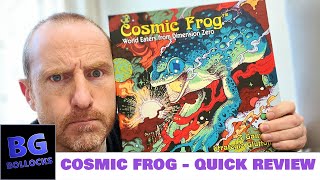
- Unpredictable turn order adds excitement and prevents fixed pacing, increasing engagement and guesswork for opponents.
- Special abilities are varied and dynamically change during the game, keeping play fresh and offering different tactical options each session.
- The theme is unique and bold, delivering a memorable and quotable aesthetic that resonates with players who enjoy offbeat sci-fi whimsy.
- The game can be appealing to fans of heavy-weight, combat-oriented experiences in a setting reminiscent of Cosmic Encounter, with more direct conflict elements.
- Scoring rules and the mechanics behind tallying points are not clearly or consistently explained in the rulebook, often requiring players to perform mental math or use pencil-and-paper spreadsheets.
- Setup is fiddly and time-consuming, requiring careful flipping, sorting, and layering of terrain tiles and land domain pieces before play begins.
- Combat can feel overly random due to dice mechanics, with limited mitigation, which may frustrate players who prefer more deterministic skirmish outcomes.
- The complexity and steep learning curve may deter new players, especially those not already comfortable with heavy tile management and multi-stage scoring systems.
- A wild, batshit-crazy sci-fi fantasy where frogs collect lands, raid vaults, and battle in skirmish combat with varying alien abilities.
- A two-mile-high amphibian navigates a shard and ether landscape, placing terrain tiles on a neoprene mat and feeding a vault to score points.
- Humorous, irreverent, and over-the-top with a strong sense of whimsy and surreal sci-fi flavor.
- Cosmic Encounter
- Cyclades
Mechanics (from transcript analysis)
- combat resolution — Attacks occur when frogs share a space or enter an opponent’s hex; combat is resolved with dice, modified by spent oomph and special abilities.
- ether vs shard action spaces — Two action theaters (shard and ether) provide distinct actions; players can move between them via movement and special actions such as slipstreaming to reposition quickly.
- gullet to vault resource flow — Players move land tiles from their gullet into a vault on their board; the order of transfer (lowest to highest) affects scoring and available slots.
- oomph and special abilities — Oomph is a resource used to take extra actions, boost dice, or activate powerful special abilities drawn from a personal deck that changes during the game.
- raid and outer dimensions — If an opponent’s vault is in an exposed position or in the outer dimensions, you can raid their vault by meeting raid requirements and rolling dice to win and steal tiles.
- scoring by land domains — Points are awarded for collecting land types and aligning similar lands across vaults; complete homogeny or diverse sets yield different point rewards.
- set collection — Players collect landscape tiles and assemble them into their gullet and vault to score points; sets of land types and combinations drive scoring.
- terrain destruction and shard integrity — Destruction effects and fracture tokens can appear, affecting shard integrity and potentially ending the game when the integrity track is filled.
- tile placement / landscape building — Tiles come in highland and lowland variants that must be stacked onto corresponding land domains on the board to form terrain and unlock scoring opportunities.
- turn order via encounter mechanics — Turn order is not a fixed clockwise sequence; a Cosby encounter-style reveal determines who acts next, introducing variability and suspense throughout the round.
Video topics + discussion points
Quotes (from this video)
- The theme is completely batshit crazy.
- This is a weird and kind of wonderful set collection skirmish game.
- The scoring can be a real pain in the ass.
- it's cosmic frog worth your time with bother today and in the future
- If you like Cosmic Encounter, this is the closest game with more combat-oriented play.
References (from this video)
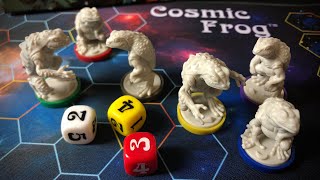
- Striking table presence with bright, thematic robo-frog components
- Engaging solo AI that scales challenge and rewards adaptive play
- Rich synthesis of mutation, aura management, and tactical combat
- Flexible scoring that rewards planning and sequencing of land, vaults, and lines
- Good integration of ether/shard mechanics into strategic decisions
- Solo rules described as a work-in-progress in the video; potential complexity for new players
- Rule density can be daunting; may require repeated plays to grok all interactions
- Some mechanics (like mutations and ether flux) can shift significantly between plays, which may affect balance in early runs
- territory control, resource management, mutation and tactical combat
- A far-future, space-faring shard ecology where robo-frogs vie for territory and resources across shifting ether and land tiles.
- procedural, emergent gameplay with rich thematic flavor
Mechanics (from transcript analysis)
- ability mutation and ether flux — Players mutate or draw new ability cards during ether flux phases, adding strategic variability.
- Combat resolution with dice — Attacks and defenses are resolved via dice, with options to overpower using multiple dice or upgrade dice outcomes.
- line/vault scoring — Scoring is driven by creating lines across vaults or land domains; endgame scoring can hinge on board state and vault fullness.
- movement across ether and leap mechanics — Frogs can leap through the ether, moving between shards and over other frogs to reach targets or escape danger.
- raiding and targeting — Raid mechanics allow stealing from opponents’ vaults or lines, affecting opponents' points and line integrity.
- resource management (oomph, gullet, siphons) — Oomph is spent to perform actions; gullet stores gained resources; siphons restore expenditure and support action cycling.
- targeting and control lines — Certain abilities and targetable hexes influence which lines can be attacked or defended, shaping engagement strategy.
- tile/land placement — Players place and manage land on scattered shards, building lines and controlling resources.
Video topics + discussion points
Quotes (from this video)
- it's a beauty and delight to play
- two mile tall space frogs
- what's not to like about two mile tall space frogs there you go
References (from this video)

- Ridiculous, hilarious, and chaotic in the best way
- Beautiful production and big-table presence
- Rulebook is dense; requires some commitment
- goblins, beasts, and space-fantasy chaos
- Cosmic/absurd space fantasy
- nonsense, exuberant
- Zuvio/Zuvi's (reference to other giant-scale fantasy games)
Mechanics (from transcript analysis)
- area control / interaction — Players clash with large mechanics and crowd interactions.
- Asymmetric abilities — Each player has unique abilities that shift strategy.
Video topics + discussion points
Quotes (from this video)
- Nana is just so freaking cute.
- it's insanely frustrating
- it's a fruitful experience when everything comes together
- I freaking loved it
- Nana is just so freaking cute
- the artwork is stunning, I love card games
- Grand Austria Hotel makes my brain happy
- Sea Salt and Paper is probably one of my most played games at this point
- it's bonkers but fun
References (from this video)
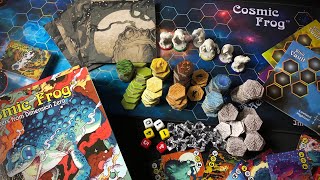
- deep tactical depth with evolving abilities via the deck and shard mechanics
- highly interactive play with direct frog-to-frog interaction (attacks, raids, vault targeting)
- beautiful components and artwork that reward visual appreciation
- clever flow between deck management, oomph economy, and vault construction
- solo rules are in development, with potential for robust expansion
- solo rules are still a work in progress and may require waiting for updates
- learning curve is significant due to multiple interacting systems (shard/ether, vaults, combat, deck manipulation)
- combat resolution can introduce variance via dice and boosts
- abstract strategy with high-thematic artwork of space-faring amphibians and dynamic land-shard mechanics.
- A universe-spanning swamp where giant frogs descend to consume lands, disgorge them into vaults, and compete for dominance across shard and ether regions.
- procedural emergence of tension via shard integrity, fractures, and splinter strikes; story emerges from evolving board state rather than a fixed narrative arc.
Mechanics (from transcript analysis)
- Combat resolution with dice — combat uses dice (white and yellow dice with different outcomes); attackers and defenders roll, with options to boost or roll multiple dice, and boosts affect outcomes. Attacks can push opponents to outer dimensions, with consequences for vaults and tiles.
- deckbuilding / ability cards — each frog obtains ability cards that modify actions, grant special effects, or alter combat; cards may be kept hidden until revealed to surprise opponents in multiplayer.
- end-game triggers — two concurrent end conditions exist: shard integrity reaching a threshold via fractures and tile elimination caused by splinter strikes, which can abruptly end play.
- movement mechanics (leap, slipstream, ether) — movement is constrained by the gullet capacity and tile layout; leap can traverse multiple hexes, slipstream bounces off the ether to land adjacent, including into the ether for strategic positioning.
- resource management (oomph) — oomph currency powers actions, enables extra actions, and can be spent to modify outcomes or movement; recovering oomph restores action potential.
- shard / ether split dynamics — the shard and ether are two zones with unique rules; end conditions can be triggered by shard integrity or splinter strikes that fracture the shard, affecting tile availability and game termination timing.
- tile-laying / land acquisition — players consume land tiles from the shard and disgorge them into their vaults, building patterns across lowlands/highlands to maximize points.
- vault construction / 3D stacking — land tiles disgorged into vaults can be stacked up to three high; lines and patterns in vaults contribute to scoring and strategic blocking.
Video topics + discussion points
Quotes (from this video)
- cosmic frog is kind of like an abstract strategy game it's all about position
- this is a real clever part of the game
- it's a highly interactive game and it is a game where you're attacking other frogs stealing their land that they've already harvested
- you can stack up to three tiles high because maybe i'll get a line of three blue
- shard integrity track
- splinter strike
- the shard has now been split into two
References (from this video)

- thematic, interactive chaos
- asymmetry fuels variety
- very chaotic, may lack depth for some players
- silly, chaotic combat and interaction
- space-themed arena with asymmetric powers
- humorous, party-game vibe
- Root
- Wilderness War
Mechanics (from transcript analysis)
- Area Control — players vie for control of zones with asymmetric abilities
- Asymmetric powers — each player has unique abilities impacting play decisions
Video topics + discussion points
Quotes (from this video)
- this year the Year of 2025
- we are here today this year 2025 to once again revisit our top 50 board games of all time
- Pub Meeple to rank my games
- the troops are either Square tokens or triangle tokens
- it's so mean and it's so like for sure yeah