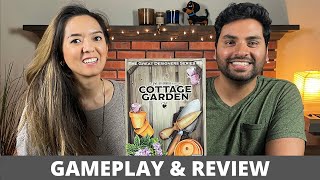
In Cottage Garden, you compete in the art of gardening and are working two beds with a variety of flowers. Whenever no unplanted box is visible on a bed, you have completed it, then you count your points and replace it with a fresh, unplanted bed. You gain points for all of the visible plant pots and planting bells.
In more detail, players select various polyomino tiles of flower beds from a central market grid, depending on the location of the "gardener", then place them on one of their two personal garden boards. Each board has several garden elements that are worth points when not planted over, and these are scored on two different tracks as soon as a garden has been finished. Crossing over a line on each track awards bonus tokens that can fill in empty spaces or give you a better selection of the flower bed tiles. Whenever a garden is finished, you receive a new one to complete. After the gardener completes her fifth lap around the market, the game enters its last round. The player with the most points from their completed gardens at the end of the game wins.
Cottage Garden is the first part of Uwe Rosenberg's puzzle trilogy.
- Beautiful floral theme and elegant presentation
- Clear visualization helps planning and mathing out moves
- Two-player plus expansion into more players in later iterations
- Flipping mechanic on the score tracks can be fiddly
- Prefer solo-board tiling in some cases; a personal preference
- Floral garden design
- Botanical garden construction with two scoring tracks
- dual-board management with core scoring cadence
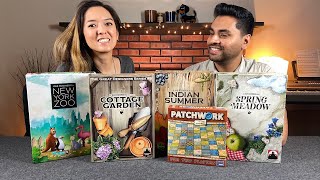
- Spring Meadow
Mechanics (from transcript analysis)
- Dual gardens — Manage two layouts simultaneously for optimal scoring
- Tile placement on a shared plan — Tiles are laid out to optimize both gardens and future turns
- two scoring tracks — Progress on two separate scoring tracks and flip boards as you score
Video topics + discussion points
Quotes (from this video)
- they are all distinct enough to play as different games and that was the question that we were asking ourselves before we started the series
- Patchwork this game is sort of legendary you know like it's all like everybody's best games for two players lists
- it's the most recent release aside from new york zoo
- the marmots are really cute
- you can steal other people's tiles
- New York Zoo is the best theme
References (from this video)

Mechanics (from transcript analysis)
Video topics + discussion points
Quotes (from this video)
- It's incredibly exhausting and in terms of buying games well that's what Essen is designed for
- I had an amazing time at Essen Spiel and I've spent this entire week since thinking about how I'm going to do it better next year
- the atmosphere is what you go for
References (from this video)
- Two-player friendly with clear pace
- Casual, accessible tile-laying with satisfying decisions
- Polished components and wheelbarrow mechanic adds charm
- Fits well as a thematic progression from Patchwork
- Replayable with garden flipping mechanic and different gardens
- Less depth than Patchwork for some players
- Endgame can be stingy; placing big pieces late is hard
- Some pieces can be tricky to fit and the board can feel cramped
- Cross tile can create awkward placement not worth the effort
- Garden design and tile placement with garden management and scoring via pots and cloches; beehives add end-game bonuses.
- A cottage garden setting with flower beds, pots, and cloches in a shared garden-laying puzzle.
- Light, peaceful, family-friendly tile-laying with a warm, rural theme; a gentle progression through garden beds.
- Patchwork
Mechanics (from transcript analysis)
- Bees/End-game tokens — First to complete a garden gets a beehive token; interaction with end-game scoring.
- Cat token management — Cats serve as flexible placement aids and scoring modifiers; you may hold a limited number and use them proactively.
- Cloche/Pots scoring — Cloche icons and pot tokens contribute to end-of-round scoring with specific counting rules.
- End-game constraints — When final round is triggered, gardens with fewer than three tiles are discarded and negative scoring applies for each extra turn.
- Garden flipping — Completed gardens flip to a darker side and exchange with supply, changing scoring opportunities.
- Refill with wheelbarrow reservoir — Tile refill is constrained by the wheelbarrow buffer and column/row availability, creating forward planning.
- Resource tokens (cats and pots) — Cats can be spent to refill and fill holes; pots generate immediate scoring when placed.
- Row/Column selection via gardener die — The gardener die moves around the board; you pick tiles from the row or column where the die sits.
- Tile placement (polyomino) — Place irregular tiles into two gardens, paying attention to fit and scoring symbols.
Video topics + discussion points
Quotes (from this video)
- it's a very peaceful game
- it's a neat little design
- it's a two-player game that plays fast
- this is not bad it's not good but it's not bad
- it's an easy-going casual game
- the wheelbarrow is really nice
- patchwork is two-player only, this can accommodate more players
- it's laid back
- this is a nice big piece and it has a pot on it
References (from this video)

- Beautiful production with charming components and theme
- Relaxed, accessible for families and casual players
- Clear, straightforward decisions with some strategic depth
- Engaging tessellation/tile-laying mechanic
- Works well with 1-4 players and under an hour
- Limited player interaction compared to Patchwork
- First edition printing had some errors (stickers provided to fix)
- Less engine-building tension than some Rosenberg titles
- Florals and garden design with a charming cottage atmosphere
- A tessellated garden-patch puzzle where players fill flower beds with tiles to form patterns and optimize scoring
- Relaxed, puzzle-forward, family-friendly
- Patchwork
Mechanics (from transcript analysis)
- decision_planning — Players balance immediate gains against potential bonuses when moving cubes toward 20 points.
- dice_mechanic — The gardener die movement determines which tiles are available next and triggers refills.
- end_game_trigger — Game ends after six laps of the wheelbarrow track.
- pattern_building — Create tessellated patterns to complete flower beds and maximize scoring opportunities.
- resource_tracking — Track points via two color-coded tracks: orange (flower pots) and blue (plant covers).
- tile_laying — Place tiles onto personal flower beds by selecting from a row or column near the gardener die.
- token_actions — Cat tokens refill columns or fill spaces on your board, with no direct point value.
Video topics + discussion points
Quotes (from this video)
- it's a lovely production
- Cottage Garden is a very good, simple sort of light family-style game with a lovely theme
- I love that tessellation tile laying thing of fitting little Tetris style pieces together
- it's not a particularly thinky sort of game
- There aren't loads and loads of decisions to get stuck into; it's a relaxed, easygoing ride
References (from this video)

- Beautiful components and coherent design
- Pleasant family-friendly gateway feel with depth
- Patchwork
Mechanics (from transcript analysis)
- Tile-laying — players plant tiles to fill their garden, optimizing patterns and scoring.
Video topics + discussion points
Quotes (from this video)
- We're going to be playing Root live via TTS tabletop simulator with two other people who are previous tournament winners of Root.
- This is not sponsored at all this is just kind of a big shout out.
- Let's break down those barriers, let's get those games played.
- Tricarion is one of my favorite games of all time.
- Patchwork is the classic two-player puzzle game.
- We were sent the newest box which we're going to be reviewing as well as a second box.
- Put the word unlock in there, that way we know you want to be part of this.
References (from this video)

- accessible for non-gamers and families
- artwork is appealing
- not as exciting as Patchwork for some players
- floral tiling and garden design
- garden polyomino placement
- family-friendly garden-building vibe
- Patchwork
Mechanics (from transcript analysis)
- polyomino_placement — placing differently shaped tiles to fill a garden plan
Video topics + discussion points
Quotes (from this video)
- Junk Art might be my favorite dexterity game of all time
- the system is very clever... the way that you select the Domino's and the way that they fit together
- Pandemic Iberia just takes basic Pandemic puts it in olden times and has a bit more theme to it
- When I Dream is a brilliant party game
- Captain Sonar adds a big hit of a game this is a big group game
References (from this video)

- Innovative tiling mechanics
- Aesthetically pleasing
- Might be similar to Patchwork to some players
- Polyomino tiling / tessellation
- Garden/patchwork theme
- Strategic, family-friendly
Mechanics (from transcript analysis)
- Tessellation — Tetra-style pieces placed to tessellate on the board.
- tile placement — Place tiles to create patterns and maximize scoring.
Video topics + discussion points
Quotes (from this video)
- there's going to be a lot of publishers from all around the world
- King Domino look great, and I'm always happy to visit the Yellow booth
- I'll definitely be visiting the Zach Verlag booth because they have a big range of interesting games
References (from this video)

- Relaxing and non-confrontational
- Accessible to families and newcomers
- Good two-to-four player play balance
- May feel light for experienced gamers
- Theme may be less inspiring to some players
- gardening and floral design
- abstract garden puzzle
- procedural puzzle with calm, relaxing feel
- Patchwork
Mechanics (from transcript analysis)
- pattern completion — matching pieces to complete required patterns for scoring
- Resource management — choosing from available pieces and flower pots to optimize scoring
- tile placement — placing tetromino-like pieces to shape flower beds
Video topics + discussion points
Quotes (from this video)
- Cottage Garden is a great game to play with your parents.
- it's not a game I would generally used to excite people about board games especially with younger people
- HMS Dolores differs from normal prisoners dilemma by introducing first pick
- Picasso makes a simple Twist on classic drawing games
- it's a nice change of pace and there's no waiting for the other team to take their turn
References (from this video)

- Elegant, tactile components and clear rules
- Solid two-player and multiplayer appeal
- Fiddly setup mentioned in the discussion
- floral, tile-placement, strategy
- garden-themed patchwork and tiling
- calm, aesthetically pleasing
- Patchwork
- Baron Park
Mechanics (from transcript analysis)
- polyomino tiling — Place tiles to fill patterns and score.
- Resource management — Manage actions and tiles to optimize garden layout.
Video topics + discussion points
Quotes (from this video)
- everything I say on my channel is completely true
- it's the most hard tiring business trip of any that I've ever done
- Patchwork is brilliant
- Baron Park could not be simpler
- my favourite game is evolution
- I'm working on a drafting game card drafting game... it's working but some testers disagree
- I've really enjoyed Evolution and its various versions
References (from this video)

- extends the Patchwork feel to more players
- great family-friendly option
- longer playtime than Patchwork
- garden production and patchwork-like planning
- garden design in an abstract sense
- strategic tile placement
- Patchwork
Mechanics (from transcript analysis)
- drafting — select action tiles for future rounds
- Tile-laying — players place action tiles to cultivate a garden
Video topics + discussion points
Quotes (from this video)
- I love the game Patchwork, a brilliant tile-laying game
- if Cottage Garden becomes something like that, then that's fantastic news for all of us
- the main Crux of the game is serving customers
- I love the artwork, it's a totally new style again
- Rattus is coming back after a while, out of print with all the expansions and a new expansion
- this big tin here I've been looking forward to this one for a long time because Sushi Go is just a magnificent game
- Skull King, a trick-taking dice game
- adults version of Code Names Not Safe for Work
- Evolution Junior, it's called Evolution the Beginning is only going to be available at Target for its first year