Collection Status
Your Rating
Description
Crypt is a small-box set collection game with a unique dice placement mechanic for 1 to 4 players.
Place your servant dice on treasure cards, choosing any value on each die. Choosing a higher value can ward off your opponents, but it also increases the odds that your servant will become exhausted. After everyone has placed their servant dice, everyone rolls. If you roll less than your chosen value, you lose the die.
Sets of treasure can be pawned off to collectors that offer bonus coins and special abilities. The player with the most valuable collection wins!
—description from the designer
Year Published
2018
Transcript Analysis
Browse transcript mentions, sentiments, pros/cons, mechanics, topics, quotes, and references.
Total mentions: 1
This page: 1
Sentiment:
pos 0 ·
mix 1 ·
neu 0 ·
neg 0
Showing 1–1 of 1
Video 2871h9HAndk
Cardboard Herald game_review at 0:14 sentiment: mixed
video_pk 9048 · mention_pk 26695
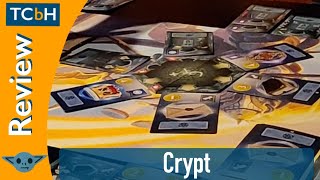
Click to watch at 0:14
Overall sentiment (raw)
mixed
Pros
- Innovative dice bidding mechanism that creates tension between immediate gains and longer-term planning
- Tight, tactical decisions where every action matters and round-to-round planning pays off
- Balanced immediacy versus long-term goals, resulting in a smart, tense core loop
Cons
- Low variability after several plays; the game can become predictable
- Articulation of card types and effects may be opaque to new players without a thorough teach
- May not satisfy players seeking a heavy thematic experience or deep engine-building
Thematic elements
- dice bidding, resource control, risk versus reward, and social interaction as cards are claimed and stolen.
- Fantasy/medieval crypt and tomb setting with dungeon-crawl vibes, where power and jewels drive conflict among rivals.
- abstract
Comparison games
- Other dice-bidding or set-collection titles with similar tempo and risk mechanics
Mechanics (from transcript analysis)
- card type diversity and scoring channels — Score cards are diverse and come in multiple types, with specific interactions depending on which card type is active. This multipath design encourages players to adapt their strategy to the evolving card pool.
- dice bidding — Players place dice values as bids on cards. The same value can be placed on multiple cards during a turn, and values can be modified between rounds to calibrate risk and influence opponents. If a bid is successful, the bid die returns to the player's pool with no immediate penalty, but it cannot be replaced this round, creating a resource-scarcity dynamic that shapes future decisions.
- endgame timing and scoring clusters — Endgame scoring clusters determine who wins, and players must time their bids to maximize late-round scoring opportunities, rather than exhausting all resources too early.
- hidden information and reveal strategy — Some card effects or points may be held in reserve and revealed later, rewarding players who manage information thoughtfully and read opponents’ risk tolerance.
- resource exhaustion — Some dice become exhausted after use, reducing the number of dice available in subsequent rounds. Exhaustion creates a cascading effect where early-round decisions constrain future options, adding depth to planning and tempo.
- risk management and pressure — High-value servants can lead to stronger round outcomes but increase the risk of overreaching and triggering counter-moves from opponents. Players must weigh the benefits of claiming a powerful card against the danger of giving opponents more leverage.
- round pacing and tempo — The structure emphasizes a tight tempo where each round builds on the previous one. The pacing rewards careful sequencing of bids and efficient use of dice, while still allowing moments of bold risk-taking.
- set/collection of points and activated abilities — At various points in the game, players reveal points on cards to unlock additional abilities or to increase scoring potential. This creates a layered payoff where players must balance immediate scoring with the risk of exposing stronger effects later.
- steal/deny interactions — Opponents can respond by taking or denying access to coveted cards, creating social friction and strategic tension. This adds a friction layer beyond solitary optimization.
- two-sided scoring cards — Each card has two faces, representing different scoring opportunities or abilities. Depending on which face is active, players gain points or trigger special effects. The system encourages long-term planning and situational decision-making as the board state evolves across rounds.
- variants and promos — Promotional editions and online variants introduce new cards and scoring options, expanding the game’s strategic envelope and extending its replayability beyond the base set.
Video topics + discussion points
No key topics recorded for this video.
Quotes (from this video)
- Crypt at its core is an innovative game
- utilizing dice as bidding tokens
- balance of immediacy versus long-term goals makes the overall structure of the game feel very smart
- it's not all luck it's not all strategy
- pressing your luck and pressure on opponents to misstep
- the balance between risk and reward keeps the game tense
- you'll see everything the game has to offer after a few plays
- promos expand what the base game can do without overhauling the core
- the mechanic is elegant in its simplicity yet rich in payoff
- design choice that rewards careful planning while leaving room for bold plays
- the social layer is where the game shines against more solitaire bidding experiences
- the pacing and card variety make a strong first impression
References (from this video)
No references stored for this video.
Transcript Navigation
Showing 1–1 of 1