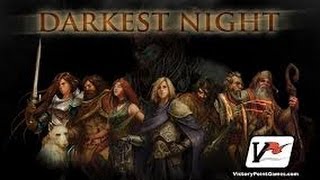
Darkest Night, by designer Jeremy Lennert, is a fully-cooperative board game for one to four players (up to six with variants), set in a kingdom broken under a necromancer’s shadow. Each player takes on the role of one of the kingdom’s last heroes (nine playable characters), each with a unique set of special abilities, just as they hatch a plan to save the realm.
Searching the kingdom provides new powers and equipment to strengthen you and your party, as well as the keys that can unlock the holy relics and defeat the necromancer. You can acquire many powerful abilities—unique to each hero—that can help to fight the undead, elude the necromancer’s forces, accelerate your searches for items and artifacts, and more. The knight is a brave and powerful warrior; the prince can rally and inspire the people; the scholar excels at locating and restoring the treasures of the past.
But ravenous undead roam the realm, and as the necromancer continues to build his power base, he blights the land and his army steadily grows. As the game wears on, the necromancer becomes more and more powerful, creating blights more quickly and effectively. If an area becomes too blighted, it gets overrun—and the monastery receives the spillover. And if the monastery is ever overrun, the necromancer wins and the kingdom is swallowed in darkness!
Before the monastery falls, it's up to you and your party to defeat the necromancer in one of two ways: If you can gather three holy relics and bring them all back to the monastery, you can perform a powerful ritual to break the necromancer’s power and scour the land of the undead. Alternatively, you can try to defeat the necromancer in direct combat—but be warned, he will readily sacrifice his minions to save himself.
Can you save the kingdom from darkness? Do you have the courage, the cunning and the will to withstand the necromancer and his forces? Strategize, plan and bring out the best of your abilities to end our Darkest Night!
Game Data:
Complexity: 4.5 on a 9 scale
Solitaire Suitability: 9 on a 9 scale
Scale: Each unit represents a Hero, the Necromancer or blights in a guerilla war over a small kingdom. Each round represents approximately several days to a week.
- Massive variability due to expansions and large pool of powers.
- Quest deck adds sub-objectives and thematic flavor.
- Open-world feel with multiple objectives and strategies.
- Expansions add more blights, artifacts, and map content.
- Card backs differ between expansions (a minor aesthetic issue).
- Not a deep rules tutorial in the video; relies on other videos for rules.
- Cooperative exploration and escalation against a spreading darkness, balancing relic collection, power-ups, and blight management.
- Kingdom under the shadow of the necromancer, with a monastery as a safe haven, and locations like castle, ruins, swamp, forests, and mountains to explore.
- Open-world, quest-driven with sub-quests and evolving threats.
Mechanics (from transcript analysis)
- Blight tracking and dark influence — Blights and the darkness track threaten the monastery and can cause a loss if not managed.
- cooperative play — Players work together to defeat the necromancer.
- Event deck — Event cards introduce challenges and narrative moments.
- Exploration and search actions — Search locations to obtain keys, powers, artifacts, and other resources.
- Holy relics and ritual — Collect relics and perform a holy ritual to win when conditions are met.
- Modular map and locations — Different locations (castle, ruins, swamp, etc.) affect available actions and resources.
- Power-up system — Characters gain powers, with an epiphany mechanic allowing choice-based upgrades.
- Quest deck and sub-quests — Quests have durations and rewards or punishments based on success.
- Variable player setup — Multiple characters with distinct powers and stats; mismatched combos add replayability.
Video topics + discussion points
Quotes (from this video)
- There's tons of game here. And we've got a whole set of blights.
- Really like it. It's really neat. Adds a great lot of flavor because it means that you've got an objective, but you've got these subobjectives.
- Open world games that you play where there's these little sub quests to go on.
- It's a team game. You're working together.
- We only need one relic to win.
- There are four holy relics on the on the board. We only need one and defeat the ne necromancer to win.
- If we collect three of holy relics and make it back to the monastery, then we can as a team perform a holy ritual that will cleanse the land of the necromancer.
References (from this video)
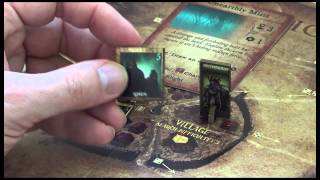
- Tense tension from the darkness track and stealth mechanics.
- Dynamic action economy with clear hero positioning choices.
- Treasure maps and power cards create meaningful, evolving options.
- Tactics in combat add strategic depth beyond simple luck.
- Some events can be punishing or unpredictable, creating variance.
- End-of-turn management can feel fiddly for newcomers.
- Card-driven randomness can overshadow player skill in long runs.
- Dark fantasy teamwork under threat, balancing stealth and bold action to thwart creeping evil.
- A haunted kingdom where heroes operate in a nocturnal, peril-filled landscape to fend off a rising necromancer and forsaken blights.
- Procedural, scenario-driven with episodic threats (blights, cultists, necromancer) and location-based challenges.
Mechanics (from transcript analysis)
- Combat dice pools and tactics — Combat uses dice, with one tactic permitted per combat to modify outcomes; higher dice results improve success odds.
- Darkness track and blights — A darkness track advances with necromancer activity; blights spawn in locations, hastening game pace.
- Elude vs. fight — Players can choose to elude or fight foes; elude often requires multiple dice and can incur secrecy changes.
- end-of-turn effects — Certain threats or status effects apply at the end of a turn, influencing subsequent decisions.
- Event/deck management — Events and blights are drawn from decks, with possible ability to refresh or shuffle decks mid-game.
- Movement and action economy — Each hero turn yields limited actions with power cards affecting movement, with secrecy bonuses for moving.
- Secrecy/visibility — Hero secrecy levels determine how easily the necromancer or enemies detect them.
Video topics + discussion points
Quotes (from this video)
- Let's get cracking with our darkest knives.
- we elude with four dice.
- we've just made it. We've defeated this blight.
- the necromancer is going to create a blight in the village.
- desecration, the location doesn't really matter.