The first cities on the Rhine emerged from Roman outposts protecting the border with Germania. As the governor of one of these cities, your task is to develop it in the best possible way, while also defending it against the Germanic tribes. Empress Agrippina and her son Nero will inspect your actions and honor the most successful governor.
In 'Discordia', you develop your city by building farms, barracks, defenses, harbors, and markets, and by trading with ships. Use your seamen, soldiers, merchants, and farmers profitably, fulfill decrees, and secure privileges — acting carefully at all times so that your city grows neither too fast nor too slow. Will you have the best-developed city at the end of the fourth year, or will you manage to impress the empress before then and win the game early?
—description from the publisher
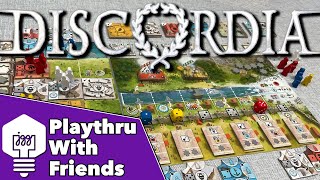
- Innovative flip between primary/secondary actions as the game progresses (early game primary actions become less central later)
- Two-player mode provides distinct strategic depth with Maximus dynamics
- Color flexibility via gray wilds enables powerful late-game combos
- Decrees and development tracks create tangible goals and race dynamics
- Engaging thread of playthrough with teaching moments and live analysis
- Heavy bookkeeping and tracking can be fiddly for some players
- Balance can feel volatile with different player counts and lot of moving parts
- Random dice results and bag-drawn workers can create uneven pacing between turns
- city-building, worker/resource management, expansion and defense
- Roman era, Roman Empire context with Germanic invasion threats
- playthrough commentary with live teaching and discussion
- Concordia
- Piano
Mechanics (from transcript analysis)
- barbarian invasion/defense — each year the Germanic hordes threaten buildings; defense strength is tied to your deployed barracks and other defenses.
- dice drafting / dice action selection — players roll dice and place them on board spots matching pip values; dice determine available main and secondary actions, and the Maximus player shifts turn order.
- dice manipulation / manipulators — each player has a limited number of manipulators to adjust a die by +/-1 (no wrap from 6 to 1) at end of year refresh.
- expedition and deployments — spend stars and deploy workers to activate actions, unlock expeditions, and place towers/ports; gray tiles allow color-flexible deployment.
- infrastructure tracks and decrees — developing infrastructure and completing decree-related tracks unlock bonuses and victory pathways; decrees become a race element.
- privileges and endgame scoring through expansion — expansions unlock privilege moves and potential endgame bonuses when players hit thresholds; endgame is triggered by running out of workers or reaching a decree condition.
- tile placement / city foundation — tiles are added to a city board to expand capacity; covering infrastructure icons reduces future worker ingress and triggers effects.
- tower and port interactions — towers and ports influence deployment options and future expansion slots; towers sit above ports and can be upgraded via expending actions.
- wild color tokens (gray) — gray tokens act as wilds, allowing deployment of any color to fill spaces; this drives color flexibility and strategic planning.
Video topics + discussion points
Quotes (from this video)
- but that's not what is going on here
- gray in this game means any color
- these main actions down here deployment actions they just let you select any one tile of that matching color
- that was a really good turn
- GG so obviously the game is over man
- this is a style of game that you don't see too much of but I like a lot