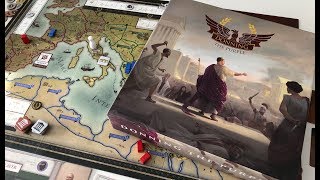
It is the year 193 AD. The Roman Empire is not as great as it once was. Hordes of enemies are crossing the borders, famine spreads throughout the provinces and the political intrigues are tearing the empire apart from within. The previous emperor was killed by his own Praetorian bodyguard and has left a power vacuum that the powerful families in Rome are trying to fill. Are you ready to don the purple yourself and take on the stressful job as emperor? If you fail, the other families are ready to take over at a moment's notice. While they wait for your doom, they won't hesitate to backstab or undermine you as much as they can. However you all have to work together as the fall of the Roman Empire is closing in.
Donning the Purple is an asymmetrical king of the hill game with a bit of worker placement. Each player leads a powerful family in ancient Rome, trying to get the most victory points during 4 rounds. If your family member becomes the emperor and manages to hold the position he can earn lots of points. However he will also become the target of the other players as they will try to dethrone him and become the new emperor themselves.
- Tight positional depth and strategic depth
- Clear rules with engaging solo mechanics
- Strong historical flavor and thematic feel
- Accessible entry point for a deeper strategy game
- Resource management can be punishing in solo play
- Grain price and famine mechanics can create abrupt setbacks
- Event cards can dramatically accelerate loss conditions
- Empire management, territorial control, famine and resource stewardship
- Roman Empire, circa 193 AD, across Europe and North Africa
- historical/strategic with minimal fictional narrative
- Pandemic
Mechanics (from transcript analysis)
- area control / conquest — Move legions and pawns to outnumber provincial defenses and control regions.
- Campaign phase / year progression — Four eras per game; each year includes enemy influx, harvest, actions, and building phases.
- combat resolution — No dice combat; outnumbering removes enemy units; strength bonuses via plots and monuments matter.
- Construction and monuments — Build aqueducts and monuments to gain bonuses and victory points; placement on production lines matters.
- Economy / taxation — Tax regions, leverage estates for coins; grain price affects happiness and food supply.
- Event and forum cards — Draw event cards each year; forum cards provide lasting action bonuses but reduce available actions.
- Resource management — Balance grain, coins, and happiness; famine affects income and provisioning.
- Senate / political control — Control of the Senate influences scoring and game dynamics; assassination can remove senators.
Video topics + discussion points
Quotes (from this video)
- there's not really a story here it's more of a you know a strategy game
- the best way to a populations heart is through their stomachs
- plot cards are very very powerful
- it's quick it's nice and quick this game is easy to get through the rules are pretty straightforward
References (from this video)

- engaging solo puzzle loop with clear objectives
- deterministic combat gives visible planning paths
- varied plot cards and event cards add strategic depth
- aqueducts and monuments provide impactful bonuses
- happiness tracking creates meaningful tension around feeding the empire
- rewarding outcomes like glory dice after battles
- steep learning curve and dense rules for solo mode
- long setup and board state complexity can be daunting
- some event/plot cards feel underpowered or overpowered relative to others
- downtime between actions can slow the turn flow
- balance concerns in the solo scenario due to random events
- Political intrigue, famine management, succession risk, and empire building
- Ancient Rome, four-year imperial governance
- Deterministic, puzzle-like campaign of rule by the Emperor
Mechanics (from transcript analysis)
- area-control — control provinces and capitals to generate VP and deny opponents space
- builder_and_production — build aqueducts and estates to improve production, happiness, and VP
- combat_resolution — deterministic combat based on relative strength; no dice in regular battles
- hand-management — plot cards and events influence actions and outcomes each round
- happiness_and_famine — feed provinces to maintain happiness; famine and grain price affect prosperity
- heir_and_succession — manage an heir to avoid death when stamina runs out
- resource-management — manage grain, money, and stamina to perform actions and sustain the empire
Video topics + discussion points
Quotes (from this video)
- The board state just gradually worsens and gets crazier.
- it's a deterministic combat where if you move into a space where you're the more powerful force then you automatically win
- you get to roll glory dice for having defeated the enemy in this way
- money is awesome in this game
- the people become happier if you feed all the Roman provinces