Collection Status
Your Rating
Description
Anyone can herd sheep, but have you ever herded dragons?
In Dragonkeepers, you compete against each other as magicians. Two stacks of cards form the "Magic Book", which indicates which and how many dragons can be herded. With each card taken, this information changes, but luckily you can cast spells and return your cards to the Magic Book to change it in your favor and score! But which of your dragons can you spare to cast spells?
Year Published
2023
Transcript Analysis
Browse transcript mentions, sentiments, pros/cons, mechanics, topics, quotes, and references.
Total mentions: 1
This page: 1
Sentiment:
pos 1 ·
mix 0 ·
neu 0 ·
neg 0
Showing 1–1 of 1
Video SVV0dgdAW9w
Peaky Boardgamer rules teach at 0:00 sentiment: positive
video_pk 6903 · mention_pk 20460
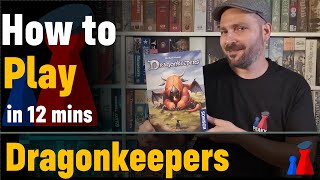
Click to watch at 0:00
Overall sentiment (raw)
positive
Pros
- Fast and approachable core game (about 20 minutes), making it good for lighter ngid sessions
- Clear objective: collect dragon cards to form sets and score through amulets, pearls, and bonuses
- Variable chest powers and different dragon colors add strategic variety and replayability
- Strong visual identity inferred from Michael Menzel’s artwork (as noted in the intro), which can enhance appeal
Cons
- Book mechanic can feel fiddly or complex for new players due to on-the-fly set modification and multiple interaction rules
- Endgame can be triggered by non-active players, which may surprise or frustrate some groups
- Blocking mechanics and shadows/virtual set restrictions may slow early game or create analysis paralysis in new players
Thematic elements
- Set collection and book-building with dragon types and amulets as the primary scoring mechanism
- Fantasy world featuring dragons, amulets, and a magic book that shapes the game state
- Procedural and tactical card-based play where players modify the objective via a magical book and race to complete amulets
Comparison games
none
Mechanics (from transcript analysis)
- Amulets, pearls, and eggs — Amulet pieces and pearl tiles are collected as bonuses; pearls come in colors with different VP values; eggs score points at game end and can be flipped for big points in certain conditions.
- Blocking and stacking — When a fourth stack of a dragon type is created, the middle dragon type becomes blocked; this limits what sets can be formed subsequently, adding strategic pressure.
- Book-driven set modification — The magic book dictates which dragon sets are active; players can alter required sets by playing cards, affecting strategies and possible bonuses.
- card drafting / hand management — On a turn, a player draws up to three face-up cards from the supply, replenishing spaces immediately; hand remains secret and has no explicit limit.
- Crystals and chest powers — Crystals can be spent to gain additional cards or to activate chest powers; chest powers provide various ongoing or conditional effects throughout the game.
- endgame trigger — The game ends when a specified number of completed amulets is reached, determined by player count; the end triggers at the end of the current turn.
- set collection — Players form sets of dragon cards by color/type and place them in front of their play area to gain bonuses.
- Shadow dragons (wilds) — Shadow dragons are wild cards that can substitute for any dragon in a set, but sets cannot be composed entirely of Shadow dragons; they stack and interact with other dragons.
- Special powers (mint and others) — Powers such as Dragon Mint, Twilight Flute, Swindle Feather, Prism Ink, and Troll Horn modify set requirements, draw mechanics, or allow cross-turn play, adding depth and variability.
Video topics + discussion points
No key topics recorded for this video.
Quotes (from this video)
- the game is for two to four players and plays in only 20 minutes
- this is a very simple game to play
- you can only form one set in your turn
- end of the game could be triggered from someone who is not the active player
- Michael Menzel who is very popular for his artworks in board games
References (from this video)
No references stored for this video.
Transcript Navigation
Showing 1–1 of 1