Collection Status
Your Rating
Description
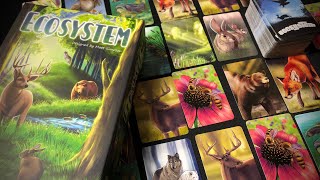
Ecosystem is a card-drafting game in which players choose cards and place them into their play area turn by turn. The cards in a player's grid make up their own personal ecosystem, and at game's end, a player will have twenty cards in their ecosystem, with the game including eleven types of cards. Bears score by being placed next to bees and trout; trout score by being placed next to streams and dragonflies; and streams are compared at the end of the game, with the player who has the largest stream earning points. These are just a few examples of how scoring works in Ecosystem. Don't forget to diversify!
—description from the designer
Year Published
2019
Transcript Analysis
Browse transcript mentions, sentiments, pros/cons, mechanics, topics, quotes, and references.
Total mentions: 4
This page: 4
Sentiment:
pos 3 ·
mix 0 ·
neu 0 ·
neg 1
Showing 1–4 of 4
Video BvKKM9EUWvI
Dice Tower retrospective at 4:23 sentiment: positive
video_pk 13508 · mention_pk 39510

Click to watch at 4:23
Overall sentiment (raw)
positive
Pros
- accessible, educational
Cons
- rushed tension at times
Thematic elements
- biology / ecology
- drafting and ecosystem building
- educational yet competitive
Comparison games
none
Mechanics (from transcript analysis)
- drafting — players draft cards to build ecosystems
Video topics + discussion points
No key topics recorded for this video.
Quotes (from this video)
- One of the greatest experiences I've ever had playing a board game ever.
- It's all about board games, but especially the people who play them.
- This is Look Back, a series that I do where I talk about games that I reviewed one year ago, 5 years ago, 10 years ago, and 20 years ago during this time frame.
References (from this video)
No references stored for this video.
Video yjl88nV7sts
Three Minute Board Games top_5_list at 3:19 sentiment: negative
video_pk 12012 · mention_pk 35177

Click to watch at 3:19
Overall sentiment (raw)
negative
Pros
- family-friendly and quick to teach
- easy to pick up for non-gamers
Cons
- looks uninspired; feels like a tableau of unrelated pictures
- scoring system is complex to learn
Thematic elements
- ecology and interdependence
- a grid-based drafting where ecosystem relations matter
- educational yet lighthearted
Comparison games
none
Mechanics (from transcript analysis)
- card drafting — hand of 10 cards is drafted and placed into a tableau
- grid adjacency scoring — points come from spatial relationships like salmon by rivers and bears by salmon
- tile/area placement — place cards to form a 4x5 grid with adjacency scoring
Video topics + discussion points
No key topics recorded for this video.
Quotes (from this video)
- it's just a simple nine card puzzle game
- it's fine for what it is
- it's not going to be a deep game that holds Brass's attention
- it's actually surprisingly fun
- oh hanami is a great game
- small box games can be great games
References (from this video)
No references stored for this video.
Video VKZo5c2Wx-g
Box of Delights playthrough at 0:07 sentiment: positive
video_pk 8110 · mention_pk 23859
Click to watch at 0:07
Overall sentiment (raw)
positive
Pros
- Easy to learn and teach
- Fast, tidy rounds
- Beautiful, compact components
- Encourages strategic planning around biodiversity
- Solid solo puzzle with dedicated rules
Cons
- Scoring can be dense and requires tracking many conditions
- Complexity may intimidate some players
Thematic elements
- Ecology and biodiversity
- A grid-based ecosystem-building game where players draft animal and habitat cards to form a diverse 5x4 ecosystem.
- Instructional, demonstrative
Comparison games
none
Mechanics (from transcript analysis)
- card drafting — Players draft cards from a hand and pass unused cards to the next player; rounds rotate until the board is filled.
- diversity/adjacency scoring — Scoring is based on the diversity of card types, habitats, and proximity-based bonuses (streams, meadows, etc.).
- tile/card placement — Drafted cards are placed on a 5x4 grid to form an ecosystem; placement interacts with adjacency and habitat rules to score points.
Video topics + discussion points
No key topics recorded for this video.
Quotes (from this video)
- ecosystem combines card drafting with kind of like tile laying you're creating an ecosystem
- the aim of the game is to create a diverse ecosystem score points
- solo rules
- it's a really pretty game and nice little box
- can you beat 60 points
- solo puzzle
References (from this video)
No references stored for this video.
Video gbBZEs9EDtg
Unknown Channel game_review at 0:21 sentiment: positive
video_pk 2051 · mention_pk 5889
Click to watch at 0:21
Overall sentiment (raw)
positive
Pros
- Accessible light drafting experience
- Clear, elegant scoring cards and good artwork
- Interesting ecosystem-gap mechanic that rewards diversity
- Fast-paced and fits well as a filler between heavier games
Cons
- Some may prefer more thematic depth or variability
- Direct comparison to Sushi Go may set a high bar
- Drafting skill heavily influences scoring, which can be punishing for new players
Thematic elements
- Ecology, biodiversity, competition for resources
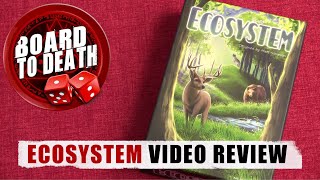
- Players draft ecosystem cards and place them on a 4x5 grid to build a balanced ecosystem.
- analytical/educational
Comparison games
- Sushi Go
Mechanics (from transcript analysis)
- Adjacency and type-based scoring — Points are earned based on the types adjacent to a card and how they sit within the grid's rows and columns, including end-of-round effects.
- card drafting — Players select one card from their hand and pass the remaining cards to the next player, repeating over rounds.
- End-game diversity scoring — Gauges diversity by counting ecosystem gaps and variety of card types to award bonus points.
- grid placement — Selected cards are placed on a 4x5 grid, with placement affecting future scoring via adjacency and rows/columns.
Video topics + discussion points
No key topics recorded for this video.
Quotes (from this video)
- the less of these you have the more diversity bonus points you'll make
- this one scores a 7.5 out of 10
References (from this video)
No references stored for this video.
Transcript Navigation
Showing 1–4 of 4