In Edo, players represent daimyo in mid-second millennium Japan who are trying to serve their shogun by using their samurai to construct castles, markets and houses in Tokyo and surrounding areas.
At the start of Edo – which won "best evening-length game" in the 2010 Hippodice Game Design competition under the name Altiplano – each player has five samurai tokens, seven houses, one market and three square action cards, each of which has four possible actions on it. One card, for example, allows a player to:
Collect rice (up to four bundles depending on the number of samurai applied to the action),
Collect $5 (per samurai),
Collect wood (up to four, with one samurai on the action and one in the forest for each wood you want), or
Build (up to two buildings, with two samurai on the card and one in the desired city, along with the required resources)
Each turn, the players simultaneously choose which actions they want to take with their three cards and in which order, programming those actions on their player cards, similar to the planning phase in Dirk Henn's Wallenstein and Shogun. Players then take actions in turn order, moving samurai on the board as needed (paying $1 per space moved) in order to complete actions (to the forest for wood, the rice fields for rice, cities to build, and so on). Before a player can move samurai, however, he must use an action to place them on the game board; some actions allow free movement, and others allow a player to recruit additional samurai beyond the initial five.
One other action allows you to recruit additional action cards from an array on the side of the game board, thereby giving you four (or more) cards from which to choose for the rest of the game.
Building in cities costs resources and gives you points as well as money; as more players build in a city, the funds are split among all present, with those first in the city receiving a larger share. Players can also receive points or buy stone by dealing with a traveling merchant.
Once at least one player has twelve points, the game finishes at the end of the round, with players scoring endgame bonuses for money in hand and other things. The player with the most points wins.
Edo includes separate game boards for 2-3 players and for 4 players.

- presents a clever programming-like puzzle
- strong theme of historical governance and building
- a little opaque at first due to abstracted mapping of actions
- some may prefer more direct euro-action flow
- urban development and governance via programming-like actions
- medieval Edo period city
- heavily thematic with a strategic puzzle core
- Kanban
Mechanics (from transcript analysis)
- meeple/action allocation — place meeples to determine how many times you perform actions.
- secret action orientation (programming style) — cards have two sides; you orient actions facing down and reveal together.
- Simultaneous action selection — players choose three actions each round and reveal in unison.
Video topics + discussion points
Quotes (from this video)
- it's a brain burn—it can cause analysis, but in a good way.
- i love the Mancala-like mechanism in games
- there is potentially you can play with a hidden traitor mechanic in this game
- the heart of the game is in that auction, it feels like auction in a palace
- it's extremely tense
References (from this video)
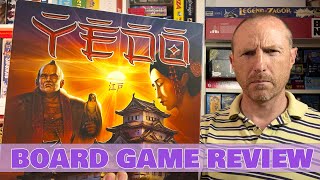
- Gorgeous, colorful, and attractive board with vibrant artwork
- Huge range of options and strategic depth
- Turns are quick with limited downtime
- Nice synergy between different areas on the board
- Too long (11 rounds; around four hours)
- Disruption by other players slows or halts momentum
- Mission card payoffs are feeble, with meaningful points mostly in high-difficulty cards
- Game length and obstacles hinder flow and engagement
- Political intrigue, resource control, and power through auctions and district management
- Feudal Japan, city of Edo during the shogunate with districts such as Gates, Harbor, Castle, Red Light, etc.
- Strategic, indirect competition via auctions, missions, and district control
- Lords of Waterdeep
- Francis Drake
Mechanics (from transcript analysis)
- Auction — Bidding to win action cards, bonus cards, weapons, annexes, geisha, and mission cards; disrupts opponents' plans
- event cards — Reveal events after weapon removal; events are generally harsh and can constrain options
- mission cards — Complete varied objectives to gain resources and victory points; mission payoff varies by card type
- Resource management — Acquire resources through auctions and board actions to fulfill missions
- Watch patrol/arrest mechanics — Watch patrol moves around the board to arrest in-district disciples; arrest consequences include prison or return to play
- worker placement — Place workers on a central board to take district actions; rounds are designed to be short and snappy
Video topics + discussion points
Quotes (from this video)
- so edo is an auction worker placement game
- edo is an auction worker placement game this game is split into seven phases
- the first phase is the prep phase
- 11 rounds is far too long
- it's going to take you about four hours
- the payoffs on the mission cards are really really feeble
- the board is like a brick wall that keeps asking you to bang your head against
- probably not