Game description from the publisher:
It is 1926, and the museum's extensive collection of exotic curios and occult artifacts poses a threat to the barriers between our world and the elder evils lurking between dimensions. Gates to the beyond begin to leak open, and terrifying creatures of increasing strength steal through them. Animals, the mad, and those of more susceptible minds are driven to desperation by the supernatural forces the portals unleash. Only a handful of investigators race against time to locate the eldritch symbols necessary to seal the portals forever. Only they can stop the Ancient One beyond from finding its way to Earth and reducing humanity to cinders.
Elder Sign is a fast-paced, cooperative dice game of supernatural intrigue for one to eight players by Richard Launius and Kevin Wilson, the designers of Arkham Horror. Players take the roles of investigators racing against time to stave off the imminent return of the Ancient One. Armed with tools, allies, and occult knowledge, investigators must put their sanity and stamina to the test as they adventure to locate Elder Signs, the eldritch symbols used to seal away the Ancient Ones and win the game.
To locate Elder Signs, investigators must successfully endure Adventures within the museum and its environs. A countdown mechanism makes an Ancient One appear if the investigators are not quick enough. The investigators must then battle the Ancient One. A clever and thematic dice mechanism pits their exploration against monsters and the sheer difficulty of staying sane and healthy, all within the standard game duration of one to two hours.
- easy to learn
- solid solo experience
- base game can feel light without expansions
- Yatzee-like dice with Arkham flavor
- Arkham Horror-inspired Lovecraftian
- Campaign-lite with expansions
- Arkham Horror: The Card Game
Mechanics (from transcript analysis)
- dice-based encounters — Yahtzee-style dice to resolve encounters
- Expansions — base game plus many expansions
Video topics + discussion points
Quotes (from this video)
- it's always your turn
- one of the best solo deck builders you can get
- this is one of the most impressive solo titles from GMT
- this is such a fantastic puzzle
- a masterpiece of minimalism
- it's such a satisfying card play
References (from this video)
- investigators face ancient threats
- Lovecraftian arcane artifacts
- Arkham Horror
- Eldritch Horror
Mechanics (from transcript analysis)
Video topics + discussion points
Quotes (from this video)
- we pick Canadian board game designers who are real life friends against each other
- this is the board game quiz show
- your final score is 12 out of 20
- you can stop watching and go play a game
References (from this video)

- Strong introduction to the Arkham Horror world
- Relatively low upkeep with a focused solo experience
- Accessible entry point into Lovecraftian co-op themes
- Can become easy with only base content; expansions add difficulty
- Some players may prefer more direct antagonistic opponent rather than a purely dice-driven arc
- Investigators facing cosmic horrors through dice-driven play
- Arkham/Miskatonic University Lovecraftian mythos
- Narrative-driven exploring clues and Elder Signs
- Arkham Horror: The Card Game
- Lovecraftian dice games
Mechanics (from transcript analysis)
- Dice-driven clue collection — Roll dice to gather clues and elder signs to delay or defeat the deity
- Resource gathering and combat against a deity — Manage clues, elder signs and assets to defeat a chosen deity
- Roll-and-challenge against a non-direct opponent — No direct human opponent; the challenge is the deity and procedural events
Video topics + discussion points
Quotes (from this video)
- it's very thematic, basically a gamification of the process of creating a character in DND
- the AI opponent is very smooth and doesn't take a lot of upkeep
- it's one page front and back, that's it very, very simple rules
- this is known as a raw and ripe game and it's a pretty beloved genre
- the universe games come with mini expansion modules that add replayability
- an 18-card masterpiece
- print this right here to turn it into a flip and ride game
References (from this video)

- cooperative game
- host doesn't play cooperative games often
- mediocre game
- Lovecraftian
- cosmic horror
- Elder creatures
Mechanics (from transcript analysis)
Video topics + discussion points
Quotes (from this video)
- I'm very Cutthroat here - I much rather save budget for a new game, save space for new games
- not all games are forever games - sometimes it's totally okay to buy a game with the expectation of playing it for about five years and then not wanting to play it again
- I can still respect I played a lot of Steam, but I just don't want to play it anymore
- there's so much hate on like oh you can't be like dipping your chosen to miniature games - but as adults there's so much hate on that
- when you own a lot of games there's a lot of rules up here and the tough thing is that when there's so many rules up here you need some games that you teach or play later to be a little intuitive
- the difficulty I have with it is that when I explain it to new players it's tough to explain - each player has a different ruleset
- I think that's one of the first games that if it didn't invent that concept at least popularize it
- if the game is going to warrant me having to do separate explanations for everybody, extra effort - it's got to be really damn good and Vast isn't really damn good
References (from this video)
- Easy to teach due to Yahtzee-style dice
- Accessible, lightweight co-op within the Arkham setting
- Lots of character and encounter variety
- Expansions add depth and improve experience
- Solid core loop of rolling dice to solve encounters
- Great companion phone app
- Dice randomness can lead to frustrating spirals
- Low-probability success may rely on luck
- Some players may dislike heavy dice reliance
- Core set might feel lightweight for some players
- Investigating ancient evil and occult horror
- Arkham, Massachusetts; Arkham Museum
- cooperative, scenario-driven encounters
- Arkham Horror
- Arkham Horror: The Card Game
Mechanics (from transcript analysis)
- cooperative win condition — All players win when enough Elder Signs are collected before failure.
- Dice-based action resolution — Players roll dice with symbols and assign results to encounter tasks.
- Encounter decks with gate mechanics — Encounters come from decks; some create gate openings and spawn threats.
- Mythos and Doom track — Mythos cards add Doom, leading to monster appearances and Old One awakenings.
- Variable investigator powers — Each investigator has unique abilities that influence strategy.
Video topics + discussion points
Quotes (from this video)
- Elder Sign is one of the Arkham file games from Fantasy Flight games and it's one of the lighter and more accessible ones
- the core gameplay Loop of rolling dice matching symbols and solving encounter cards is very solid
- it also has a great phone app
- on top of that there's a bunch of good expansions that really improve the overall experience
- but as for the core set alone it's a great lightweight Co-op game for those folk who love Dice and want something lighter than most Arkham games
- the best thing about this game is that simple core Yahtzee based dice system it makes it very easy to teach
- however, if you hate dice you're really gonna hate this game
- Elder Sign: screw this guy hate him
References (from this video)
- Rich thematic flavor with multiplex locations and encounters
- Dynamic player interaction and collaboration with multiple character abilities
- High replay potential through a large pool of encounters and mythos cards
- Rules complexity and heavy bookkeeping can be intimidating for newcomers
- Session length is long and can be draining during multiple turns of negotiation and combat
- Chaos can dominate the experience, leading to a perceived lack of agency at times
- cosmic horror and secret societies seeking to awaken ancient powers
- 1930s global occult investigation with settings spanning Cairo, the pyramids, Antarctica and other mythic locales
- episodic mystery with evolving rumors and adventures
- Arkham Horror (board game)
- Arkham Horror: The Card Game
Mechanics (from transcript analysis)
- Asset/relocation and deck encounter flow — Investigators acquire items, relocate clues, and resolve lore through encounters drawn from various decks.
- cooperative play — Multiple investigators work together to resolve encounters, manage resources, and close gates while avoiding doom.
- dice-based skill tests — Tests are resolved with dice pools; successes shift outcomes and unlock abilities or consequences.
- Eldritch/banes system — Eldrich tokens, corruption, and other tokens influence tests, abilities, and doom progression.
- Gate/doom track and mythos phase — Gates spawn, doom advances, and rumors or mythos events alter the board and threaten investigators.
Video topics + discussion points
Quotes (from this video)
- The Brotherhoods of the Dark Pharaoh.
- Eye of light and eye of darkness.
- We win.
- This is outbreak. So, you're going to spawn a zombie horde.
- Blessed, baby.
References (from this video)
- strong thematic atmosphere
- cooperative teamwork
- short, tense sessions
- rule complexity can be opaque for newcomers
- availability and component quality concerns over time
- cooperative investigation into eldritch forces
- Lovecraftian horror investigations
- story-driven campaign feel with mythos flavor
- Arkham Horror
Mechanics (from transcript analysis)
- cooperative play — players collaborate to survive investigations against eldritch threats
- dice pool/roll-and-allocate — dice are rolled and allocated to perform actions and resolve encounters
Video topics + discussion points
Quotes (from this video)
- probably the greatest party game of all time
- it's a betting racing game
- this is basically one huge massive rondell of a game
- I hate painted miniatures
References (from this video)
- engaging for families and casual groups
- diverse investigations into mythos lore
- mythos theme may not appeal to all players
- cooperative/competitive exploration with difficulty management
- Lovecraftian mythos
- pulp horror adventure
- Dominion
- Founding Fathers
Mechanics (from transcript analysis)
- cooperative/competitive try-to-survive — players cooperate to close gates while competing for elder tokens
Video topics + discussion points
Quotes (from this video)
- The Dietz Foundation is the world's only not-for-profit game company so that we are set up that when we make money in however we make it that our funds and our profits go towards helping education.
- Donations always go directly to the cause, after the PayPal fee, 97 percent goes where it's supposed to go—much more than the 50 or 60 percent you get from most charitable organizations.
- Games are a great way to learn about everything.
- I don't like working for them anymore, I prefer working for myself.
- Education can be wide and varied, and can be by subject matter as well as by the educational goal.
- If you want to learn about civil rights, you can take the game to your home and interact with it in a safe space to think through difficult topics.
References (from this video)
- Weird mechanics
Mechanics (from transcript analysis)
Video topics + discussion points
Quotes (from this video)
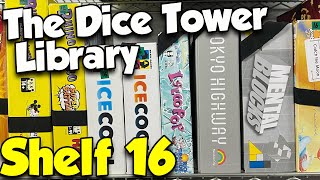
- Shelf 16 is kind of a an odd mix here
- This shelf has twice as many games as most shelves
- one of my favorite two-player games, but it's very difficult to learn and play
- Fantastic abstract strategy game
- Such a classic game and I like it a lot
- I don't know why I like it so much, but I do
- one of the most beautiful dexterity/party games there are
- There are so many games on the shelf
References (from this video)
- Compact, portable dice-based experience with accessible decisions
- Cooperative and fast-paced compared to bigger Eldritch games
- Clear synergy between investigators and streamlined card interactions
- Dice luck can influence outcomes
- Less variety in effects compared to larger Lovecraft titles
- cooperative investigators facing eldritch threats
- Lovecraftian investigations in a compact dice-driven shell
- dice-driven, streamlined handling of Lovecraftian themes
- Arkham Horror
- Eldritch Horror
Mechanics (from transcript analysis)
- cooperative_play — Multiple investigators work together on a shared roster with streamlined cards.
- dice_rolling — Rolling dice to resolve actions and encounters with probabilistic outcomes.
- investigator_roster — A roster of characters with predefined loadouts that guide decisions.
- streamlined_effects — Fewer unique effects compared to larger HP Lovecraft games; more focus on gestalt strategy.
Video topics + discussion points
Quotes (from this video)
- three great ways that they can play with themselves
- terraforming Mars and it's the perfect solo game
- you are responsible for terraforming this entire planet yourself
- you have absolute freedom in order to cultivate the perfect terraforming monstrosity
- Spirit Island is a killer solo game
- elder sign is a fantastic dice game
- the consolidated awesomeness of all of those HP Lovecraft games into a tiny portable dicey shell
References (from this video)
- strong fit for yahtzee fans
- available on phones and tablets for quick play
- derivative of yahtzee's core mechanics
- cooperative dice puzzle with card adjustments
- Arkham horror-inspired investigations
- Yahtzee
Mechanics (from transcript analysis)
- card and dice adjustments — use bonuses and cards to shape dice outcomes
- dice rolling and re-rolling — roll dice to complete challenges with different totals
Video topics + discussion points
Quotes (from this video)
- this is fundamentally the same game as yahtzee
- the biggest single difference is that all players are working off the same set of dice
- it's weirdly like a cross between a dice game of yahtzee and magic the gathering without the deck construction
- it's meanly hard at times and disturbingly unfair
- I would recommend it for people who love probability and love taking risk
- it's so silly and light that you can't take it too seriously
- this is a modern take on yahtzee
- my favorite game directly inspired by yahtzee
- you can roll and you can re-roll up to three times
- you can re-roll as much as you want but one side on each character is a biohazard
- it's on phones it's on tablets you can just pick it up and play it anywhere you want
- 30 dice worth of actions in a four- to six-player game