Emberleaf is a competitive card-dancing and tile-placement board game for 1-5 players.
As a brave Emberling, your mission is to rebuild your home in the heart of an ancient forest. To succeed, you'll explore the wilderness, gather resources, clear dangerous areas, and construct new homes for your kin. Along the way, you'll recruit heroes into your fellowship, each bringing unique skills that will help empower your team. But beware - space in the forest is limited, and other Emberlings have their own plans.
The game features:
Card Dancing: Place hero cards within your moving grid to activate skills and enhance your fellowship. Slide cards to trigger powerful combinations and charge them at the perfect moment for even greater effects.
Tile Placement: Build vibrant villages to address the diverse needs of your villagers.
Engine Building: Recruit heroes to acquire new skills and empower your existing fellowship.
Resource Management: Navigate the forest, clear dangerous areas, and collect essential resources.
Every decision you make shapes the destiny of your people. Can you rise to the challenge, guide your village to prosperity, and win the heart of your fellow Emberlings?
—description from the publisher
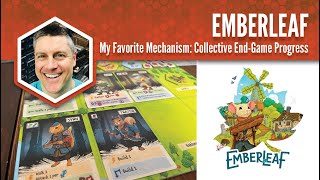
- Card dancing mechanic is clever and satisfying with a tactile, spatial feel
- The progression system (villages and bandits) provides organic and tangible game advancement
- The order-of-operations aspect adds a puzzle-like depth to turns
- Art and character design contribute to intrinsic motivation and appeal
- Two main paths to victory allow flexible strategy and player choice
- No explicit cons were stated in the excerpt; potential complexity for new players may exist due to multiple interacting systems
- village rebuilding and bandit management through evolving player actions
- fantasy village restoration on a cooperative-looking board featuring bandit threats and character crews
- commentary-driven, first-person analysis with emphasis on mechanism and progression
Mechanics (from transcript analysis)
- Bandit combat as shared progress — Fighting bandits advances a shared token on a track; six increments by players collectively trigger a trophy, adding collaborative pressure to progress.
- Card dancing / dynamic card mat — Players hold six character cards on a mat; on their turn they either play a card for an instant ability or shift all cards to the left, triggering abilities when cards are slid off and later rejoin hand.
- Dual-path scoring with balanced tension — Players can pursue villages for points or bandit-related progress, with both paths contributing to the end conditions and trophy opportunities.
- Order-of-operations puzzle through card interactions — Abilities trigger based on the order in which cards slide and actions occur, creating a spatial/operational puzzle as Garrick’s ability interacts with leftward shifts.
- Trophy tokens with top/bottom benefits — When a trophy token is earned, players gain the top (most powerful) benefit, while other players gain the bottom benefit, creating evolving incentives for all players.
- Turn-based progression without rounds — There is no fixed round structure; the game advances through player turns until the six trophy tiles are exhausted and the game ends.
- Two progression tracks for endgame scoring — Players progress by completing villages or by fighting bandits, with a shared track that moves row by row and yields rewards as you reach trophy levels.
Video topics + discussion points
Quotes (from this video)
- there's no round structure in the game
- the order of operations really does matter
- I think my favorite mechanism in the game, even over the card dancing mechanism
- I really like the organic nature of advancing the game here
References (from this video)

- Innovative dancing-card mechanic that creates dynamic sequencing
- Two-ability-per-card design expands strategic space
- Open-handed play for family-friendly interaction
- Complex for first-time players due to multiple interlocking effects
- Subtlety of timing may require careful teaching
- growth, balance, and seasonal engine-building
- tableau-building landscape with a nature-forward fantasy theme
- mutating engine through dancing cards
- Everddale Duo
- Finsspan
Mechanics (from transcript analysis)
- dance/shift mechanic — on your turn you can shift cards on your mat to re-activate abilities
- hand-management with placement — position cards on your map to control activations and timing
- Multi-use cards — each card often has two activation modes or recurring effects
- tableau building — build and optimize a tableau with shifting cards for recurring abilities
Video topics + discussion points
Quotes (from this video)
- In the world of Vantage, nobody cares that I'm trans. I'm merely a passer by chatting with the Denizens, playing games, and participating in trials.
- Dispatch is eight scenarios. It's a little bit like a superhero animated TV show where you are making story choices.
- Inkorn is a deck builder in the style of Slay the Spire, but it adds a lot of things that aren't in Slay the Spire without overly complicating the game.
- Here Lies is a cooperative mystery solving game that does a brilliant thing with limited communication and limited information where one player has all the answers.
References (from this video)

- Engaging two-player experience
- Interesting thematic flavor
- Limited player count may reduce replayability for some groups
- Nature and forest spirits
- Two-player strategic duel with mythical forest themes
- Direct two-player duel with thematic flavor
Mechanics (from transcript analysis)
- two-player competitive play — Head-to-head engagement with shared resources and strategic tension.
Video topics + discussion points
Quotes (from this video)
- Origin Story and Vantage again this past weekend and they are so so great.
- It was the best game of Flip Seven that I've ever had.
- I played Dave the Diver for about an hour last night and had a lot of fun with it.
- I've played Point Salad, but I have not played Point City.
- I run a board gaming club at my school in which I have been playing Obsession and Brass Lancashire.
References (from this video)

- Distinctive visual identity
- Smart card interactions and unique twists
- Theme may not click for everyone
- Possibly heavy for casual players
- Card-driven engine-building with a strong thematic backdrop
- Fantasy forest with mystical creatures and a shifting risk-reward engine
- Story-lite with puzzle-forward progression
- Resarcana
Mechanics (from transcript analysis)
- Card-driven engine-building — Cards trigger abilities and unlock future options as the tableau grows.
- Tableau growth with evolving interactions — As cards are added, new synergies emerge and scoring opportunities shift.
Video topics + discussion points
Quotes (from this video)
- Would you say that the main message behind this game is that only suckers take the bus?
- It's a masterpiece of a game.
- This is a big game actually. A roll and write, Tend.
- Aridia is a masterpiece of a game.
References (from this video)
- Stylish visuals and distinctive look
- Tight, puzzle-like play that rewards planning
- Some players may find the look off-putting
- Not universally accessible due to rules density
- Action-driven card play with a focus on building a tableau
- Compact card-driven engine with a darker, fantasy mood
- Story-light with a tactical puzzle element
- Resarcana
Mechanics (from transcript analysis)
- Baddies/encounters and cooperative storytelling elements — Foes and cards interact to create ongoing tension and narrative flavor.
- Card-driven tableau building — Players place and trigger cards to build their boards and powers.
Video topics + discussion points
Quotes (from this video)
- Would you say that the main message behind this game is that only suckers take the bus?
- It's a masterpiece of a game.
- This is a big game actually. A roll and write, Tend.
- Aridia is a masterpiece of a game.
References (from this video)
- Brilliant card-play engine-building concept with satisfying combos
- Relatively clear rules and easy initial teach
- Beautiful wood components and tactile build
- Strong late-game payoff as you unlock card slots and engines
- Momentum is slow in the early game, which can feel dull
- Limited direct player interaction for a long stretch
- Long playtime for 3–4 players (about 90–120 minutes)
- Box art and presentation may not appeal to all players
- territory growth through card-driven actions and modules
- anthropomorphic animals operating in forest clearings, building and connecting spaces
- engine-building with modular map and developing chains
- Concordia
Mechanics (from transcript analysis)
- Area movement — move between hex clearings on a map to perform actions and build routes
- Card-driven actions — cards determine actions and can trigger multi-step effects when placed and slid on the board
- engine-building — sliding cards and chaining effects create increasingly powerful actions
- hand management — players hold and choose from a hand of action cards each turn
- trophy/points via danger tiles — combat and risk tiles yield victory points and drive endgame pacing
Video topics + discussion points
Quotes (from this video)
- The card play of this game was a lot of fun.
- I wish the momentum would pick up.
- This is a really clever card game.
- The art on this box is absolutely stunning.
References (from this video)

- Unique dancing-card mechanic adds spatial and sequencing depth
- Adorable art and strong card design that convey personality
- Character-centric abilities and tableau-building
- Whimsical fantasy world inhabited by anthropomorphic animals with magical abilities
- Charming, light-hearted
Mechanics (from transcript analysis)
- dancing cards — On a player's turn, cards can be shifted or danced to trigger new abilities; creates a spatial sequencing element and a new type of trigger.
- on-mat ongoing abilities — Some abilities stay active while a card remains on the player's mat, providing persistent effects.
- tableau-building — Players construct and manipulate a personal tableau of cards to optimize actions and outcomes.
Video topics + discussion points
Quotes (from this video)
- The dancing cards mechanism in this game, which I think is one of the standout mechanisms, which is whenever you choose on your turn to instead of playing a card to to dance to shift your cards over, that's this arrow right here. That's when you get this ability.
- I'm really excited to play Emberleaf again thanks largely due to this amazing card design.
- The Mandalorian faction pack focuses on neutrality on the track; they don't want to have the force with them, they want it in the middle.
- We haven't seen all the cards yet, there are a number of cards both in the deck and even the bases that want you to be in that neutral position.
- I look forward to playing again to explore this faction pack against the other factions.
- It's a card shedding game, which in general I like card shedding games, but it has a neat neat little tweak...