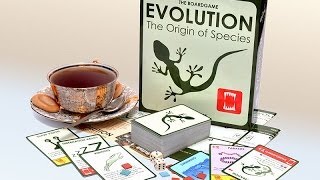
In Evolution: The Origin of Species, players do the work of nature, putting animals into play and evolving them trait by trait to help them survive and thrive. Each player starts with a hand of six cards that feature an animal on the back and one or two traits on the front.
Each round consists of four phases. During Development, players take turns playing one card from their hand either as an animal (face-down) or as a trait on one of their existing animals (face-up and tucked under the animal). Traits include Carnivorous, Camouflage, Sharp Vision, Swimming, Poisonous and Communication; if a card has two traits, the player chooses which trait the animal acquires, hiding the other trait under the animal. Once a player passes during this phase, he can no longer play cards.
During Food Bank Determination, a player rolls 1-2 dice (possibly adding two to the total) to determine the amount of food available for the round.
During Feeding, players take turns acquiring one food cube and "feeding" one of their animals. Some traits give animals special abilities that can be used during Feeding or at other points during the game. Animals can also be carnivorous, allowing them to attack one other animal to feed – although that animal might have a defense like High Body Weight or Tail Loss that allows it to survive. An animal can't take more food than it needs unless it has fat tissue, which allows it to store food for future rounds.
During Extinction and Draw, any animal not fully fed dies; the owner takes that animal and all traits and stacks them in his personal discard pile. Each player then receives new cards in hand equal to one plus the number of live animals that player has.
When the deck runs out, the players conduct one final round, then score points. Each live animal is worth 2 VP, and each trait on a live animal worth 1 VP; some traits (Carnivorous and Parasite) provide bonus VPs, but make it tougher to keep an animal alive. The player with the most VPs wins.
By combining two sets of Evolution, you can have up to eight players in a game.

- Accessible to families and children
- Engaging with scalable strategies
- Strong awards and recognition in Russia and Europe
- survival, adaptation, natural selection
- Evolutionary simulation with animals across habitats
- educational, strategic
- Japanese Castle
- Zombie
- Kingdoms of Crusaders
- The Enigma of Leonardo
- Shinobi
- Potion Explosion
- Confetti
Mechanics (from transcript analysis)
- Ability drafting / customization — Assign different abilities to animals to improve survival chances.
- End-game scoring via victory points — Gain victory points as populations thrive and survive.
- Expansion-driven asymmetry — Expansions introduce new abilities and strategies.
- population management — Create animals and manage population to maximize survival against hunger and predators.
- Predator-prey interaction — Opponents can attack each other's populations via predator dynamics.
Video topics + discussion points
Quotes (from this video)
- Evolution has earned awards in Russia and Europe; nominated for Toy Award in Nuremberg this year
- our best seller this game has very many awards in Russia and in Europe
- there is an expansion for the game time to fly with new abilities and new strategies
References (from this video)
- Engaging evolution-themed mechanics that are approachable and thematic
- Family-friendly and relatively quick to teach
- Interesting interaction through feeding and parasite dynamics
- Clear phase structure helps pacing and accessibility
- Nice balance of luck and strategy, with variability across plays
- Notable luck element due to card draws and dice rolls
- Some cards appear stronger than others, affecting balance
- Strategic depth may be limited for heavier sentient gamers
- Survival through trait acquisition, defense, predation, and parasitic interactions.
- Players evolve species within a simplified ecosystem, competing for resources and survival.
- Trait-driven evolution with competitive player interaction and occasional parasitism mechanics.
Mechanics (from transcript analysis)
- Card play / hand management — Players play trait and action cards from their hand into their species field, including paired 'between two species' cards.
- Dice-based food determination — A die roll determines the amount of food available in a given phase, introducing randomness.
- End-game scoring — Surviving species score points based on a base value plus trait bonuses; deck depletion triggers final scoring.
- Fat tissue storage — Fat tokens can be stored on species for future turns, enabling survival through lean rounds.
- Pair cards — Some cards must be played between two species, creating interactive placement requirements.
- Parasite interaction — Parasite cards can be played to influence other players' species, adding direct interaction and risk.
- Phase-based gameplay — Turns cycle through Development, Determine Food, Feed, and Extinction phases with specific actions in each.
- Resource tokens (food and fat) — Tokens represent food and fat storage; used to feed can expand survivability across rounds.
- Trait-based abilities — Cards grant abilities such as protection, carnivory, or parasite interactions that affect other players' species.
Video topics + discussion points
Quotes (from this video)
- In evolution players are creating new species and trying to keep them alive and safe from other players
- It's a really nice game but it's more luck based in strategy
- the exciting part is when you roll the diet to see how much food will be available
- if you like nature and habitat games but are looking for something lighter and familyfriendly you should check out Evolution we give it a 75% survival rate