A century from now all that remains of Earth is the detritus that humanity left behind. The races of a neighboring solar system have a penchant for artifacts left behind by extinct races. In Excavation Earth, you lead one of these races of alien explorers on their quest to excavate rare human artifacts and curate the ultimate art collection to sell off.
Excavation Earth is divided into three rounds, each of which starts with players drafting a hand of multi-use cards that will be used to perform actions. Players then take quick turns playing actions that allow them to move their explorers around the world map, excavate for artifacts, and deploy traders to bazaars and influencers to affect prices and wheel and deal on the black market.
The artifacts you dig up can be either sold to the bazaars housed on one of the aliens' ships that landed on Earth or added to a collection that will be sold off as a coherent art collection to museums back home. Excavation Earth ends after three rounds and the player who makes the most money during the game wins.
Excavation Earth includes a solo mode by Nick Shaw and Dávid Turczi.
—description from the publisher
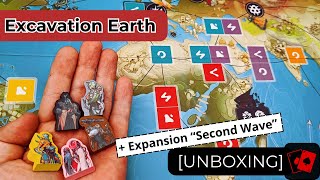
- Intriguing alien archaeology theme with artifacts and exploration
- High-quality wooden components with tactile tokens
- Strong art direction and appealing cover art
- Inserts and board organization feel well thought-out
- Expansion content adds depth (two new factions, modules)
- Excellent value when bought on sale (base game plus expansion)
- Setup is notably large and can be unwieldy on camera
- Solo mode appears complex and may require two-handed setup or learning curve
- Some rule text is language-dependent in the base deck
- Posterior organization of components may require custom fitting back into the box
- Archaeology, artifact collection, faction-driven competition
- Alien archaeologists explore a post-human Earth to recover human artifacts.
- Strategic exploration with modular factions and endgame scoring via a Mother Ship phase
Mechanics (from transcript analysis)
- Action selection from reference cards — Players choose actions from a fixed set of actions printed on reference cards to drive their turns.
- Artifact/token drafting and placement — Artifacts and tokens are drafted and placed on the board to generate resources and score points.
- Faction boards with unique abilities — Each faction has its own board and distinct abilities that shape strategy; expansion adds more factions.
- Modular expansions content — Expansion modules add new factions, cards, and objectives; vanilla play is recommended first.
- Mother Ship phase — A special end-of-turn phase that influences scoring and game progression.
- Solo mode with enemy/clones — A dedicated solo mode uses enemy figures to simulate opposition and challenge.
Video topics + discussion points
Quotes (from this video)
- this is how the game looks like very cool I like it that they show actually the entire game I think there's some cool like wooden components in here so I'm looking forward to taking a look at that
- it's a really big setup
- I really like the idea and the theme of the game
- I am looking forward to checking this game out
- The solo mode looks pretty complex, so I might need to play two-handed first to check out how the game plays
- I hope that the solo mode delivers
- I really like the cover art
References (from this video)

- Engaging artifact collection system with regional market dynamics
- Clear, thematic core loop combining exploration, trading, and gallery collection
- Dynamic demand and profile of buyers adding strategic depth
- Visible endgame scoring through galleries and command centers
- Can be quite complex; learning curve may be steep for new players
- Some fiddly interactions (smuggling, multiple market actions) could slow early play
- Specific regional color interactions may require careful tracking
- artifact collection, market dynamics, and cross-species trade
- Earth in a post-human era where alien archaeologists excavate artifacts and trade them in alien markets
- strategic resource management with a thematic veneer of archaeology and interstellar commerce
Mechanics (from transcript analysis)
- Action card system — Main cards have a color tied to a region and a symbol corresponding to markets; they also provide fuel for travel
- Cargo Holds and Hidden Compartments — Artifacts go to cargo holds or a hidden hold for smuggling; samples can be taken and guarded by crew members
- Envoy/Command Center/Income — Promoted traders move to command centers as envoys; command centers provide ongoing income and have interactions with ability tiles
- Excavate/Artifact Acquisition — Enter a dig site with an explorer, discard a region-matching action card to excavate; multiple artifacts can be taken if a second explorer is in the region
- Market & Queue Dynamics — Markets have queues of buyers by region; demand shifts as new buyers join or leave the front; popularity affects payouts
- Smuggle and Black Market — Smuggling requires a black market site presence and a matching market icon; artifacts can be sold or acquired from black market stacks with credit costs and region considerations
- Survey/Forecast and Preparation — Surveyor forecasts guide which regions will gain artifacts next round; a survey action allows manipulation and initiative token management
- Travel/Movement — Discard an action card to move up to three steps for explorers (can be split among multiple explorers) or discard a travel card for 2–4 movement
Video topics + discussion points
Quotes (from this video)
- Excavation Earth players take on the role of alien archaeologists in a non-inhabited Earth
- The equilibrium of the demand for artifacts can change rapidly
- There is a hidden compartment in your cargo hold to keep smuggled artifacts
- White buyers from the supply are wild buyers meaning that they're interested in any color of artifacts
- In the first round the player with the most cube in a particular command center gains 5 credits
References (from this video)

- Rich, multi-layered economic engine with many interaction points
- Clear, satisfying scoring through gallery samples and market activity
- Distinct asymmetric abilities add variety and replayability
- Solid base rules foundation for expansion integration
- Rule complexity may be challenging for new players
- Some components and rules may be abstract or dense for beginners
- Archaeology meets economic trading in a market-driven, artifact-focused economy.
- Earth in a grim post-human future where aliens excavate human artifacts to sell them for money.
- Competitive strategy with asymmetric factions, gallery scoring, and market-driven outcomes.
Mechanics (from transcript analysis)
- Card-driven actions — Players use a hand of action and travel cards to perform moves, excavations, and marketplace actions.
- Market trading / buyer interaction — Place traders in markets and manage buyers to sell artifacts for credits.
- resource/hand management — Discard cards to perform actions and manage artifacts/samples for scoring.
- Set collection / gallery scoring — Artifacts collected are placed into a color-coded gallery to score points based on rows/columns.
- Staffing / asymmetry and scoring — Asymmetric faction abilities affect where you can excavate and how you score, with end-round scoring.
- Worker placement / exploration — Move explorers around the board to dig sites and markets to access artifacts and action opportunities.
Video topics + discussion points
Quotes (from this video)
- this game is an economic game
- the earth is no longer inhabited by humans
- they're gonna learn about us
- we're going to give a brief overview of those rules
- everybody has their own asymmetric ability as well
- there will be a link to the kickstarter campaign down below