Welcome to Alula, a mysterious continent with ever-changing geography, shaped after the rhythm of the seasons. Beyond the Sea of Mists lies the mysterious continent of Alula. Roam across the land in search of its secrets, meet its inhabitants and list its wonders in order to gain more fame than your opponents.
Throughout a game of Faraway, you will play a row of 8 cards in front of you, from left to right. These cards represent the regions you will come across while exploring the lands. Characters on these cards will grant you victory points if you later fulfil the conditions they demand. At the end of the game, you walk back the same way, scoring cards in the opposite order you played them. There lies the heart of the gameplay. Throughout the game, the cards you play will serve both to set new objectives, and to meet the ones you played previously.
Each turn, you play a card from a hand of 3. Then you pick a new card from a face-up river. As play is simultaneous in Faraway, you must take into account a clever priority system in all of your choices – being last to pick a card leaves you with fewer options and often less profitable choices for the next turns.
—description from the publisher
Related Microbadges

- Short playtime (under an hour) and accommodates 2-6 players
- Clear phase structure and relatively approachable rules
- Deep scoring interactions via prerequisites and Sanctuary cards
- Relies on careful tracking of multiple prerequisites and scoring conditions
- Complex scoring sequences can be challenging for new players
- Thematic elements may be light for players seeking a strongly thematic narrative
- Exploration, tableau-building, and sanctuary-driven scoring in a mythical setting
- Fantasy world of regions and sanctuaries explored over eight rounds
- Thematic but mechanically driven with emphasis on card interactions and scoring prerequisites
Mechanics (from transcript analysis)
- End-of-round replenishment — At the end of each round, new region cards are dealt to the middle deck to replenish options
- Phase structure — Game consists of eight rounds with three phases: exploring, sanctuary discovery, and final scoring
- Resource-based scoring and icons — Cards feature resource icons (e.g., Chimera, stones) that influence scoring potential
- Sanctuary acquisition — If the revealed region card is higher than the previous round, players gain Sanctuary cards and possibly extra rewards for clue icons
- Scoring with prerequisites — Many cards provide points only if prerequisites (stones, icons, etc.) are satisfied by the player's current play area
- Secret card draft / tableau placement — Each round players secretly select a region card to place in their leftmost empty region slot of their Tableau, then reveal simultaneously
- Simultaneous reveal and order-based scoring — Region cards are revealed one at a time from right to left to score and check prerequisites
Video topics + discussion points
Quotes (from this video)
- this little game is for two to six players and plays in under an hour it will certainly burn your brain but in the most delightful and relaxing way
- Shuffle the region and Sanctuary cards and form two separate face down stacks at one side of the table
- let's start by saying that each player will play cards on a personal Tableau
References (from this video)
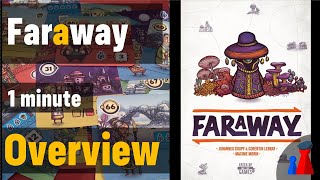
- Eight-round structure provides clear pacing
- Multiple scoring avenues via objectives and prerequisites
- Inclusion of sanctuary cards adds additional scoring flexibility
- Relies on flipping cards for scoring, which may affect transparency during play
- Prerequisites can add complexity and potential confusion for new players
- Limited information available from the transcript about game depth
- Unknown
- Unknown
- instructional
Mechanics (from transcript analysis)
- card tableau building — Players add a region or sanctuary card to a personal tableau each round.
- end-of-round and end-of-game scoring — Scoring occurs after the eighth round and determines the winner.
- objectives-based scoring — Scoring depends on whether cards meet predefined objectives.
- prerequisite-based scoring — Some cards score only if prerequisites are met by the end of scoring.
- revealing for scoring — Region cards are flipped and revealed from right to left during scoring.
Video topics + discussion points
Quotes (from this video)
- farway is played over a series of eight rounds
- cards have a scoring potential based on objectives
- some of these cards have prerequisites so that their scoring is effectuated at the end of the eighth round
- all players will have a row of eight region cards which they flip facing downwards and scoring commences
- the player with the most victory points will win