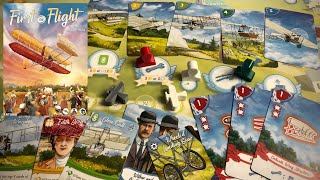
First in Flight is a push-your-luck, deck-building game about the race to early flight. Players take on the roles of the Wright Brothers, Samuel Langley, and other flight pioneers, racing to build and pilot the “flyers” that preceded modern airplanes.
Each player’s flyer design is represented by a deck of cards that they can steadily improve and refine, and which may include unknown design flaws that threaten their success.
Flying is a blackjack-style challenge to test a design, break new records, and gain experience -- hopefully without crashing. Then, players head back to the workshop to refine their flyers and improve their chances on future flights. There are dozens of available technologies, pilot skills, and friends in the field available for players to customize their own play style and strategy.

- excellent push your luck mechanic
- strong strategy layer
- time track mechanism creates tension
- great balance of mechanics
- aviation
- Wright Brothers
- history
- flight
Mechanics (from transcript analysis)
Video topics + discussion points
Quotes (from this video)
- This is my most played game of the year
- It is the perfect engine builder
- absolutely adore this game
- one that instantly I fell really hard for it
- would absolutely watch Oathsworn the HBO series
- the story and the setting is that rich
- for me the epitome of what a thematic game can be
- every click of the clock matters
References (from this video)

- strong historical resonance; research-driven in concept
- potential for engaging teaching moments about early aviation
- biographical/historical industry development
- historical aviation theme centered on the Wright brothers and early flight
- history-informed, research-driven
- Mars Needs Mechanics
- Brew Crafters
Mechanics (from transcript analysis)
Video topics + discussion points
Quotes (from this video)
- this is the shining example that game
- Chronologic is really excellent because just how easy it is to jump into how streamlined it is and how thematic it is
- the river takes care of the math of balancing
- there's a very straight math to the game where the lowest value gem is worth one Victory point
- the aging could work in a cheese context and there are a lot of interesting aging ideas
- the game about Panda and running a board game manufacturing company
- true second editions update for modern design sensibilities and better components
References (from this video)
- high production quality and clear, linen-finished cards with nice inserts
- time track provides a clear incentive to push for a longer flight
- workshop mechanic offers a meaningful way to repair faults and improve scoring potential
- thematic flavor and upgrade/pilot options add some variety
- downtime is excessive due to sequential flight actions; no true simultaneous action phase
- fault cards are often punishing or imbalanced, reducing excitement and agency
- deck management and shuffling become tedious, especially with frequent reshuffles
- no strong catch-up mechanic; busts can stall momentum without compensation
- best pacing appears to be at 2 players; larger groups incur too much downtime
- overall gameplay can feel unsatisfying when you crash early and watch others take turns
- Aviation / early flight aesthetics with pilot characters and upgrade paths.
- Aviation-themed light to mid-weight deck-building push-your-luck game with a four-round structure and a time-tracking progression.
- driven by individual deck-building decisions and competitive advancement on a shared flight track
- Quacks of Quedlinburg
- Coliseum
- Heat
- Living Forest
Mechanics (from transcript analysis)
- action economy and costs — spend coins to draw/keep cards or take more powerful actions; some actions allow taking any space or sharing action opportunities.
- deck-building — players build and refine their personal deck by drawing, buying upgrades, and filtering cards to improve flight distance while avoiding faults.
- end-of-flight scoring — the closest to the end of the four rounds or the flight track threshold determines game end; the farthest flight wins.
- fault cards and workshop repair — fault cards impose penalties; major faults can be repaired at a workshop by spending resources, altering future resilience.
- push-your-luck — players draw from their deck until they hit faults or decide to stop, with busts ending a flight and awarding penalties.
- Time track — a shared time track determines turn order and when players have to wait for others to finish flights, creating downtime and strategic timing pressure.
- upgrades and pilots — pilot cards and upgrade cards provide ongoing abilities and deck manipulation to influence future flights.
Video topics + discussion points
Quotes (from this video)
- this was a big dud for me
- the downtime is just too much
- the flight system just comes to a screeching halt
- it's a miss for me this is first in flight
- I can't understand why that is the case
References (from this video)
- Innovative scoring system that rewards best flight over multiple attempts.
- Accessible gateway into deck-building mechanics for new players.
- Downtime during turns can feel slow.
- Some players may feel the need to optimize too early, reducing excitement.
- Deck-building with push-your-luck elements and race to distance
- Early aviation era; historic flight attempts
- Abstract yet thematically grounded in flight progression
Mechanics (from transcript analysis)
- Best-flight scoring model — Only the best flight score counts for a player's final total, similar to Coliseum-style scoring.
- deck-building — Build and optimize a deck to maximize flight distance and scoring opportunities.
- Push-your-luck style progression — Players decide when to push for a longer flight versus consolidating gains.
Video topics + discussion points
Quotes (from this video)
- Pure dice chucking game where you throw dice into a bowl and try to create pairs.
- It's basically pure luck; you can switch your brain off and just roll.
- There was no card sharing because I actually thought that was the coolest part of Pandemic, and I thought that was a missed opportunity.
- The cool scoring system that you might be familiar with, where only your best flight counts.
- This is a smooth, family-friendly game.
- Rules fit on a single page, which makes it a good introductory deck-building game.
- It could be a great gateway for non-board gamers because of the IP tie-in.
- Pattern Mandala is distinctively different from the original, yet wonderfully elegant.
- I love, love, love this one.
References (from this video)
- historical theme well integrated with mechanics
- educational value paired with engaging gameplay
- lengthier session with multiple rounds
- long-distance flight and record-setting
- early aviation pioneers of the 20th century
- educational and historical with competitive play
Mechanics (from transcript analysis)
- deck_building — build a deck to optimize future flights
- push_your_luck — risk/reward decisions shape flight outcomes
- racing — distance-based competition to set records
Video topics + discussion points
Quotes (from this video)
- For a quick two-player game, it really packs a punch.
- I'm thrilled to see Baron make a comeback with a new addition, allowing even more players to experience this fantastic and elegant game.
- Linko remains one of my favorite card shedding games, and I continue to enjoy it often.
References (from this video)
- enjoyable deck-building feel; beautiful theming
- educational aspects may slow pacing for some players
- flight and exploration of early aircraft
- early aviation pioneers
- educational and historical
- Go (strategic depth reference)
Mechanics (from transcript analysis)
- Deck building — Build a deck to achieve faster flights
- Push Your Luck — Decide when to push further distances versus safer earlier moves
- racing — Compete to achieve the farthest distance
Video topics + discussion points
Quotes (from this video)
- I love showcasing fun and unique non-mainstream games.
- Crazy Corgi is wild, chaotic, and a lot of fun.
- Riverwoods is simply outstanding and could be my top hidden gem of 2025.
- Pandora is a gem with depth and multiple modes that keep sessions exciting.
- Baron is a comeback with a new edition, expanding the player count and interaction.
- Big Shot is one of my all-time favorite games; essential in any collection.
References (from this video)
- clever historical topic with tight, tense decisions
- compact footprint with depth
- unknown to casual players; niche interest in aviation history
- pioneering engineering, flight mechanics
- early aviation era; airframe design history
- educational and historical
- Trio
- Ark Nova
Mechanics (from transcript analysis)
- planning with uncertainty — players gamble on distances while avoiding failures
- Push-your-luck deck-building — deck of flight distances; balancing risks to reach target distance
Video topics + discussion points
Quotes (from this video)
- I choose the idea first and then have to figure out that balance of how to make it work as a game and not and like feel true but not be overly stuck.
- trial and error of like okay how much detail can you work in so it feels true
- it's not that we have some magical knowledge that no one else can have
- one thing that I try to do that and this is not a route that everyone is going to have available to them… if it's a woman they'll be like yeah I've kind of thought about it
- advance I think that's probably your best way of either getting the publisher to feel like they have enough skin in the game
- the default is the status quo
References (from this video)
- Compelling blend of deck-building with a rondelle action system that feels thematic and tactile
- Accessible entry point with a clear solo mode and AI-driven challenge
- Strong thematic tie-ins with Wright brothers and historical aviation figures
- Push-your-luck flight mechanic creates tension and memorable moments
- Progression via upgrades and discoveries keeps the engine feeling fresh across years
- Rules and artwork are still in development in the prototype, with potential tweaks
- Solo rules can be somewhat fiddly or non-obvious without a guide or reference
- Some edge-case interactions around time vs. coins and how AI upgrades resolve can require clarification
- Innovation, risk management, and iterative engineering of flying machines
- Early aviation era; Wright brothers period; historical aviation exploration
- Deck-building meets a rondelle action mechanism; historical figures and aircraft design narrative
Mechanics (from transcript analysis)
- card market and upgrades — a marketplace of upgrades (glide distances and tech cards) and problems; upgrades increase flight distance and sometimes add risks; problems must be repaired
- deck-building — start with a basic starting deck; upgrade your deck by buying cards from a marketplace; manage problems and upgrades to improve glide distance
- End-game and scoring — game ends when year four ends or a 36-meter milestone is reached; trailing players get a final flight; the highest flight distance awards coins and victory points
- push-your-luck test flights — during a test flight you reveal cards one by one, choosing to descend or continue; red stars indicate potential crashes; managing cards and glides determines distance and safety
- resource and time management — coins and time are used to upgrade and perform actions; time can be spent to draw more cards but reduces the number of actions this year
- rondelle action wheel — a central circular track that determines action order and available actions each year; players move their pilots around to pick actions; positioning affects future options and year length
- solo AI opponents — Alberto and Gustav simulate a competing pair with their own flight records and upgrades; their actions depend on a drawn card and simple rules to advance their flights
Video topics + discussion points
Quotes (from this video)
- This is a game about designing building a flying machine
- the nuts and bolts of the game
- it's a beauty it's great fun