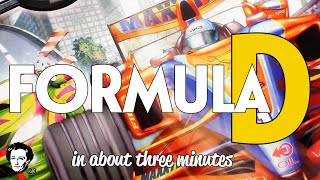
Formula D is a high stakes Formula One type racing game where the players race simulated cars with the hope of crossing the finish line first. This is a re-release of Formula Dé with several changes from the original format. Whilst old tracks can be used with the updated Formula D rules, the new game features boards that have an F1 track and a Street Track on the other side. These street tracks each have a novel inclusion or two to add greater theme -
The game mechanisms are a simple race, get to the finish line first! However, players have to use a significant amount of planning, and rely on quite a bit of luck. Each player manages when to shift gears, with each gear providing a different speed. (For example, 4th gear is a die that rolls random numbers from 7 to 12 for spaces moved.) Each turn, players may move up one gear, stay in that gear, or move down gears. This forces players to match possible rolls with the optimum distance for that turn, and hopefully plan ahead. However, speed is not the only issue! Corners have a "stop" rule that requires players to stop once, twice, or three times on that corner in consecutive turns or face a penalty. This creates an effective speed limit to the corners.
Of course, things do not always go as planned! Players take penalties if they miss their roll, bump into another car, are blocked by other cars, have to brake heavily, or have to downshift several gears. These are taken off of a car’s attributes (Tire health, Brake wear, Transmission Gears, Body, engine, and Suspension). Losing the maximum in any of these categories will result in elimination, or a severe setback for that car. This requires that players manage their car’s health, plan for their best path, and have good luck on their rolls. This high amount of luck gives the game its family appeal, and lets weaker players have a chance at winning once in a while.
However, the fun does not end with a single race! The rules include the ability to customize your cars, use a pre-generated character, add Slipstreaming (Drafting) rules and road debris, and change tire types to modify your distance rolls. There are also variations for a single lap race, or multiple laps with pit stops to repair some of your damage points. In addition, numerous expansion tracks can be purchased to vary the demands on each driver and car. Each track may also have weather effects (rain) that change car handling and die rolls due to skidding on wet track. This opens up the game for rally rules giving championship points over a number of races.
Formula D adds a few items that are not in the original Formula De: There is the added excitement of illegal racing in the streets of big cities - anything goes! This adds custom cars, nitro acceleration, drifting in the curves, dirty tricks, gun battles, and trash on the road to add more variation. A basic change is the use of a "Dashboard" with movable pegs to manage your car’s attributes instead of the paper forms from Formula De. There are also two sets of pre-painted cars; a Formula 1 set and the Street Race set of stock cars. The street cars come with "Character" profiles to give a bit of role-playing to the game. Finally, the old category of "Fuel" for the car has been renamed Transmission Wear to give a better thematic fit to the effect of multiple downshifting.
The popularity of this game has given it a lot of expansions, some simplifications to the rules (See Formula Dé Mini), and a lot of "after market" parts. There are also fan expansions and tracks for the very dedicated player. In many ways, this has become a multiple game system.
- immediate readability; clear winning condition
- tension and excitement in races
- not a deeply thematic experience for some
- mechanics may feel repetitive for long campaigns
- High-speed competition and risk management
- Racing around a stylized race track
- Fast-paced, straightforward racing narrative
- Formula D
Mechanics (from transcript analysis)
- Racing / Push-your-luck decision-making — Players select and resolve actions to advance cars around a track; racing reduces downtime and emphasizes tempo.
Video topics + discussion points
Quotes (from this video)
- every card should work in exactly the same way and the simplest way of doing that is saying that you play the card once you get the benefit and then you discard the card
- it's a streamlined system so every card should work in exactly the same way
- the goal in a game of hive is to surround the queen bee
- you can see it laying out on the map as things get shut off by the other players
- there is something really satisfying and unusual about that experience
- a legacy game once in a while played with my wife
- it's basically a form of set collection... many different variations of sets which create different words
References (from this video)

- classic push racing feel
- looks good even after many years
- rules can be fiddly
- variants add complexity
- high speed, risk, car mechanics
- Formula One-style racing
- reliable racing simulation
Mechanics (from transcript analysis)
- crash_risk — Cornering and crowd interactions introduce potential penalties.
- dice_based_movement — Gear-based dice determine movement amount.
- gear_progression — Shifting gears changes dice size and risk.
Video topics + discussion points
Quotes (from this video)
- Rising Sun is absolutely fantastic.
- La Havre broke the cycle of Agricola clones and gave us something brand new.
- Ra was given a deluxe reprint not that long ago.
- The Voyages of Marco Polo is a dice placement game.
References (from this video)
- Clever dice mechanism that emphasizes risk/reward
- Push your luck aspect is engaging
- Multiple editions and many expansion maps available
- Handles roll and move mechanic very well
- Fun even without Formula One interest
- Roll and move mechanism is out of fashion
- Can take too long with many players
- Formula D mini version better for shorter play
- Race car driving competition
- Formula One racing
- Simulation
Mechanics (from transcript analysis)
- Push Your Luck — Higher gears mean bigger dice but greater risk of damage
- risk management — Must land in specific sections at each corner or take damage
- roll and move — Moving around track based on dice rolls with increasing gear levels
- Variable dice — Progressing from 4-sided to 30-sided dice with special distribution
Video topics + discussion points
Quotes (from this video)
- the artwork is is odd it's a bit ugly and so but in a really sort of cute way i i like it it's got a lot of personality
- there's a lot of drama a lot of tension in there but it's also abstracted that it doesn't feel dark and mean and nasty
- babylonia harks back to that older era where board games were trying to look serious and historical
- it's a strange game in that it's got two different games essentially you know you start out playing one thing and then it switches to something else about halfway through but that switch is not clunky it feels very natural
- ultimately this is a push your luck game uh which is a type of game that i really really enjoy
- the game looks odd it looks like a game for children it's got this weird cartoony artwork but the gameplay is not really like that at all
- this is one i frequently come back to okay a couple of times a year i'll i'll be looking for what should i play there we go if wishes were fishes
- it's really good it's it's hard to explain why it's good but it's really good
- i've talked previously about the fact that i like dice games that don't rely on the yahtzee mechanism and this is one of those
References (from this video)
- Roll-and-move is executed with a satisfying rhythm and tension due to gear-die and wear mechanics.
- Accessible core concept with broad player counts and tracks_variants.
- Nods to nostalgia for classic dice-driven racers while offering modern risk management ideas.
- Miniature cars can be visually hard to read, and the tracks can feel fiddly.
- Lacks a solo mode and the wear/corner rules can add complexity for casual players.
- Large races may feel underwhelming sonically and visually compared to the on-screen drama.
- speed, risk management, overtaking, and cornering
- Formula 1 style racing with dice-driven movement and wear tracking across varied tracks
- tutorial/demo-style explanation with on-board demonstrations
- Steampunk Rally
Mechanics (from transcript analysis)
- cornering risk and stop requirements — Certain corners force stopping or risk wear; stopping in the correct corner type prevents immediate damage.
- gear-based dice selection — Gear positions determine which die you roll; higher gears grant larger dice and faster movement, with a wear system to manage risk.
- roll and move — Players roll the die corresponding to their current gear to determine movement along the track.
- wear tracking — Wear accumulates from corners and overshooting spaces, affecting performance and potentially causing damage.
Video topics + discussion points
Quotes (from this video)
- roll and move: you roll your die and move
- the best thing about this game is it's roll and move done well you got to love it
- Origins all the way back in 1991
- there's something entirely Charming about the risk management and drama in Formula D's dice as gears system
- this is a great family game and could be fun for so many groups
- formula D: engine noises not included
References (from this video)
- excellent tension from timing and gear changes
- highly thematic racing experience
- tablespace and large boards
- can be fiddly for casual players
- risk and reward through gear shifts
- Formula One racing
- simulated race realism
Mechanics (from transcript analysis)
- gear up / down — changing gears to optimize speed and slow down at corners
- roll and move — dice determine movement along a multi-gear track
Video topics + discussion points
Quotes (from this video)
- "a dice placement game"
- "game-breaking special ability"
- "elevate this game above its competition"
- "dexterity game"
- "timer on an app or on a watch"
- "fantastic dexterity game"
- "left for dead the board game"
- "never lost a game"
- "best played with more players of the six seven players"
References (from this video)
- highly approachable as a gateway racing game
- quick to teach and play
- thematic and tactile components
- luck-based elements can dominate in short sessions
- car racing
- real-world racing circuits
- mechanics-first, accessible racing experience
- Monopoly
- Sorry!
Mechanics (from transcript analysis)
- dice-rolling movement — dice determine speed and movement around a track; higher risk, higher reward
Video topics + discussion points
Quotes (from this video)
- it's really quick five minutes to teach and play
- the art is just so clean and the color scheme is so pleasing to the eyes
- you're busy rolling Yahtzee dice but you're attacking each other
- it's a role-playing game
- Lost Cities is a fantastic gateway game
References (from this video)
- Ingenious dice system that mitigates luck by choice
- Engaging racing tension
- Requires careful balance to avoid overpowering choices
Mechanics (from transcript analysis)
- Customizable dice for movement — Players choose dice types/sizes to control speed and risk on a race track.
- Movement on a track — Racing with varying dice outcomes influences position along a route.
Video topics + discussion points
Quotes (from this video)
- Dice are not the answer in a first-time design.
- They are toxic. They destroy your first designs.
- Meaningful interesting decisions… the decisions have to mean something.
- Even if you have all sorts of other unique stuff going on in your game that roll for combat just overwhelms it.
- Monopoly has a bit of both, chaotic, entertaining momentarily but ultimately frustrating.
- Event decks can be devastating to your design if they wipe out progress or resources.
References (from this video)
- ingenious roll and move implementation
- modern execution of classic mechanic
- still recognized as quality game
- racing
- Formula One cars
- track racing
- Monopoly
- Game of Life
Mechanics (from transcript analysis)
Video topics + discussion points
Quotes (from this video)
- Formula D is really the epitome of roll and move games in the modern era
- Settlers of Catan which was perhaps the most significant euro game that really sparked this whole new wave of modern board games
- Yahtzee has become a mechanic in its own right
- epitomises dice games really and how far they've come
- this is a bit of a tricky one to learn, it's well worth the effort
- ridiculously more fun than it should be
- playing with children it's fantastical
- absolutely brilliant
- this is my top 10 different ways to use dice in wooden board games
References (from this video)
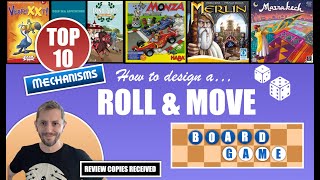
- Great roll and move mechanism not replicated elsewhere
- Simulates real racing effectively
- Push-your-luck and roll and move complement each other nicely
- Creates engaging slow/steady vs high-risk dynamics
- Weighted dice ensure forward progress despite high randomness
- Strategic slowing at corners vs accelerating on straightaways
- Car racing competition
- Formula 1 racing
- simulation
- Monza
Mechanics (from transcript analysis)
- Corner Navigation — Must land within marked region at corners or take damage
- Gear Shifting — Strategic decision about increasing speed with higher gear dice
- Polyhedron Dice Gears — 4-sided die (low gear) through 30-sided die (top gear) with weighted distribution
- Push Your Luck — Risk overshooting corners causing car damage or crash
- roll and move — Gear-based movement with different polyhedral dice for each gear
Video topics + discussion points
Quotes (from this video)
- Where once randomness ruled modern games prioritized player agency designers strived to incorporate meaningful decisions into their games and role and move became a dirty word among the modern tabletop community
- I myself put out a video called dicer not the answer back in 2017 one of my most watched lamenting role and move
- In 2022 i feel like maybe just maybe we've tipped too far in the other direction thrown the baby out with the bath water
- This video is a quest for redemption
- When done well roller move is one of the most intuitive exciting mechanisms out there
- In a pure roll and move game the player rolls a die or spins a spinner and moves their playing piece according to the result
- In talisman you roll the die and then you choose to move clockwise or anticlockwise around the board that one deviation from the purest role of move games the decision to go left or right immediately put talisman head and shoulders above most board games on the market at the time
- Hero quest showcases the strength of the roller move mechanism its elegant simplicity and the excitement of a successful role outrunning an ogre
- It can be really frustrating to lose a long game which you were totally invested in purely because you rolled badly
- Spooky stairs is a great example of a game where the roll and move mechanism itself isn't tampered with but the basic race mechanism is turned on its head by incorporating a chaotic memory mechanism
- This game beautifully highlights the intuitive nature of roll and move as a mechanism
- More than any other on this list this game demonstrates how such a simple mechanism can create agonizing decisions and a hugely interactive variable board game experience I can't recommend this one enough
- Roll and move games don't have to be devoid of meaningful choices
- Formula d has a great roll and move mechanism which i haven't seen replicated in any other game
- Push your luck and roll and move complement each other nicely
- Among hobby gamers roll a move is widely considered something of an untouchable mechanism in 2022 and that's a shame
- Roll and move isn't a cursed mechanism
- Like every mechanism roller move has strengths and weaknesses
- It can be used effectively to create an exciting intuitive system or it can be used ineffectively to create a wildly random experience which feels primitive and unfair
References (from this video)

- Innovative rolling with gear progression
- strong racing feel
- Can be long and points of fatigue may occur
- speed and progression through gears
- racing on a multi-gear racetrack
- racing simulation with escalating risk
- Thunder Alley
Mechanics (from transcript analysis)
- gear-based dice progression — die type progresses as you move through gears (4,6,8,12,20,30 sided dice)
- risk management / resource management — drivers manage speed and wear to optimize lap times
Video topics + discussion points
Quotes (from this video)
- it's a fantastic alternative to Scrabble
- it's not heavy on the awards
- a real simple introductory card drafting game
- this is a fantastic alternative to Scrabble
- the garden is home to an antagonistic Gardener and Panda
References (from this video)

- tactical pacing and tension in a race setting
- engaging for players who enjoy risk-reward decisions
- older design feels dated to some
- real randomness can undermine precise planning
- speed and risk in motorsport
- European-style racing context
- thematic, event-driven racing
- Power Grid
- Dominion
Mechanics (from transcript analysis)
- dice-driven racing — movement is determined by dice, with different gears affecting speed and risk
- multi-stage track and gear changes — players manage gear choices along a modular track for strategic pacing
Video topics + discussion points
Quotes (from this video)
- it's brilliantly incorporated into this.
- the final sprint is at the end of the game and the wind can change everything.
- these are old games like Monopoly and Risk.
- hidden information is always wonderful … so games like Ticket to Ride stay involving while you don't know who the leader is.
- Power Grid has that brilliant turn order mechanism whereby the player who's furthest back gets the advantageous positions in turn order.