In Fresco, players are master painters working to restore a fresco in a Renaissance church.
Each round begins with players deciding what time they would like to wake up for the day. The earlier you wake up, the earlier you will be in turn order, and the better options you will be guaranteed to have. Wake up early too often, however, and your apprentices will become unhappy and stop working as efficiently. They would much rather sleep in!
Then, players decide their actions for the turn, deploying their apprentice work force to various tasks. You'll need to buy paint, mix paint, work on painting the fresco, raise money (which you'll need to buy the aforementioned paint!) by painting portraits, and perhaps even send your apprentices to the opera in order to increase their happiness. Points are scored mostly by painting the fresco, which requires specific combinations of paints, so you'll need to buy and mix your paints wisely, in addition to beating other players to the paints and fresco segments you would like to paint.
Fresco includes several expansion modules, so you can play without expansions for a lighter family game or add in expansions to vary play and increase the decision-making and difficulty, resulting in a very flexible game with a high replay value.
- Beautiful art on the board and components
- Tightly designed core loop with low downtime
- Satisfying combination of market, painting, and order fulfillment
- The rule complexity can be a barrier for new players
- Some may find the art on the graphic layout a bit busy
- Art commissioning; color mixing and market dynamics
- Renaissance-era workshop painting a fresco in a church
- Medium-weight Euro with simultaneous planning
- None explicitly; separate vibe from heavy Euro
Mechanics (from transcript analysis)
- color_paint_mixing — Market and mixing mechanics determine what paints are available and the strength of outcomes.
- simultaneous_action_selection — Players select actions in parallel, influencing market timing and painting progress.
Video topics + discussion points
Quotes (from this video)
- There were eight new pledges to the campaign over the last month and that's just awesome to see
- This third year has been huge for the channel; the studio really changes things
- Annotations can no longer be added to YouTube videos probably forever
- Klingon on close captioning is a neat idea for board gaming channels
- I ended up liking this game quite a bit; it’s a cool core game with strong mechanics
References (from this video)
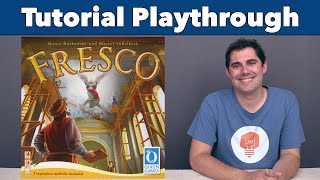
- Intricate yet approachable action economy with meaningful decisions each round
- Color blending and painting tiles create rewarding tactical depth
- Modular components (portraits, bishop requests, special paints) increase variety and replay value
- Rule-teaching through playthrough helps players learn by doing
- Initial rule density can be intimidating for new players
- Mood and wake-up timing create a punishing feedback loop for late risers
- Component management and setup can be time-consuming without care
- Art commissioning, collaborative workshop, resource management, and tactical scoring through painting and bishop interactions.
- A town cathedral where apprentices paint a fresco to decorate the cathedral walls.
- Tutorial-driven, step-by-step demonstration of rules and strategic choices with explicit play-by-play decisions.
Mechanics (from transcript analysis)
- Action economy of apprentices — Up to five or more apprentices can be used per round; planning behind screens determines which actions are taken (paint market, fresco painting, portraits, blending, theater).
- Bishop movement and scoring — A bishop can be moved by paying money; its position provides scoring bonuses based on adjacency and tile painting.
- Endgame triggers and scoring — Endgame occurs when the last two fresco cards are dealt or when six or fewer fresco tiles remain unpainted; final scoring converts money to points and tallies total points.
- Fresco painting actions — Paint tiles and bishop positioning are used to complete fresco tiles for scoring; bishop positioning grants bonuses.
- Mood track and apprentices — Mood changes shift up or down the track, affecting the number of apprentices a player can activate and potential bonuses.
- Paint market and painting tiles — Paint tiles are bought at prices that depend on wake-up time; players collect primary and blended paints to spend on frescoes.
- Portraits module — Optional portraits module adds new painting choices and income opportunities; cards can be taken with single apprentices or more depending on setup.
- Special paints and blends — Blending paints creates special colors (e.g., pink, brown) that interact with tiles and can unlock bonus points.
- Theater module — The theater action increases mood for participating apprentices, altering mood dynamics for subsequent rounds.
- Wake-up time selection — Players choose a wake-up time (five to eight) that drives mood changes and determines market painting prices and turn order.
Video topics + discussion points
Quotes (from this video)
- the earlier you wake up the more money you will spend for each one of the tiles
- we slept in the longest and we can now send two of our apprentices over
- the bishop will then go on to this spot right here so the green planner will get seven points total
- endgame scoring is simple you just take the points you've generated throughout the game and then you take all of your money and you divide your money by 2 and you get one point for each set of 2 money
References (from this video)
- innovative wake-up mechanism tied to action costs
- thematic and accessible auction feel
- strong sense of collaboration and shared goal
- can be lengthy
- teaching curve for new players
- collaboration under time pressure to complete a masterpiece
- Renaissance fresco atelier, painting restoration
- thematic, worker-driven project with tension and reward
- Viticulture
Mechanics (from transcript analysis)
- auction / bidding for turns — turn order is bid for in a thematic, accessible way
- wake-up track / turn order — when workers wake up affects action costs and first pick
- worker placement — standard worker placement to perform actions
Video topics + discussion points
Quotes (from this video)
- the on the table game versus the above the table game were both very good and they were both drawing in different people
- I wrote a 40-page Avalon guide
- luck and skill are two very different axes
- the wake up system of Fresco is definitely the standout
- it has to be fun to lose
- stay humble
References (from this video)
- strong, well-implemented theme that aligns with mechanics
- excellent introduction to planning and turn-by-turn decision making
- scales well with 2-4 players, maintaining tension
- hidden information adds strategic depth
- limited staying power for some players after repeated plays
- color mixing can be challenging for some and relies on a chart
- two-player experience is decent but may feel narrower in depth
- color mixing, pigment economy, and workforce management
- Renaissance workshop focused on painting a cathedral
- thematic integration with worker-driven resource decisions
- Vasco da Gama
Mechanics (from transcript analysis)
- color_mixing — blend paints at the studio using a chart to create more valuable colors and outcomes.
- hidden_information — paints and resources are kept hidden from opponents, adding fog of war to planning.
- market_pricing — paint prices at the market are influenced by timing and demand, linking wake-up timing to cost.
- round_based_action_order — actions are resolved in numerical order after all players place discs for the round.
- wake_up_order_influence — the wake-up time of each player affects turn order and worker mood, shaping costs and options.
- worker_placement — secretly place workers to perform actions; order of execution follows a defined numeric sequence each round.
Video topics + discussion points
Quotes (from this video)
- the earlier they wake up the sooner they will get to take actions throughout the round
- it's an excellent introduction to planning for the next turn
- Fresco is an excellent introduction
- the theme is strong
- you keep your paints hidden
- it's dry and it's mechanical and mathematical
- the theme could be almost anything
- the theme is very thin
References (from this video)
- Strong integration of mood mechanics with market pricing and timing
- Two-phase structure provides meaningful strategic depth without being opaque
- Bishop and cathedral scoring add clear thematic hooks and planning complexity
- Thematic flavor aligns neatly with mechanics (colors, paints, fresco restoration)
- Rules can be dense, and tracking multiple boards may slow lighter sessions
- Early wake-up penalties can feel punishing to newcomers until players gain familiarity
- art restoration and workshop economy
- Renaissance-era chapel fresco restoration
- historical
Mechanics (from transcript analysis)
- Blending paints — A workshop action allows players to blend basic paints into new colors, enabling more efficient fresco restoration and scoring opportunities.
- Cathedrale fresco / bishop scoring — Progress on the cathedral fresco and bishop movements yield endgame scoring bonuses and strategic board control.
- Market / pigment tile drafting — Players acquire pigments by placing on market booths, paying the price shown, and sometimes exchanging or blending pigments to create required colors.
- Mood track / wake-up order — The order in which players wake up affects mood and market costs in the next phase, creating a dynamic turn order and economic tension.
- Two-phase action resolution — First wake-up and mood setup, then planning and executing actions in a defined order, with potential bonuses for early prioritization.
- worker placement — Players place apprentices on action spaces to perform actions such as market purchases, restoration, blending paints, and theater mood boosts.
Video topics + discussion points
Quotes (from this video)
- the idea is is to get the most victory points okay which is kind of original
- the earlier wake up the cheaper it's going to be to go to the market
- this is a really simple game
- the bishop will give you bonus points
- the mood scale affects painting through theatre
- the market action is the heart of the engine
- two phases of the game
- you get up with a certain point and then you will adjust your mood