Galaxy Defenders is a sci-fi cooperative, tactical battle wargame in which 1-5 players fight together against an oncoming alien menace. Each player takes control of one or more agents with unique powers to defend the planet from the alien invasion. Gameplay revolves around a tactical combat system, using custom ten-sided dice. Each player sequentially plays his Agent turn and then one Aliens turn. Players carry out their turns [agent and aliens] in clockwise order until the last player finishes his Aliens turn. Once done, the game passes to the Event phase that will bring the players to the next round. Players may choose up to five agents:
Marine: Coming from U.S. Special Forces, the Marine is an excellent soldier who can manage different combat situations, especially multiple enemies.
Biotech: The Biotech is the most technologically adept agent in service. He can use Nano-Technology to heal wounds or control war drones.
Infiltrator: A deadly and stealthy agent. This lethal specialist prefers hiding in the shadows. She has fast movement and good short-range combat ability.
Sniper: A silent sharpshooter and expert in camouflage and ranged combat. The sniper has average movement and excellent long-range firepower.
Hulk: The Hulk was a successful mercenary and now is one of the best agents; although slow, he enjoys an extraordinary resistance to damage and has high firepower.
There is no "Alien player" in Galaxy Defenders; instead, the aliens are controlled by the game system itself, through an artificial intelligence system based on two types of cards:
Alien cards, which define the behavior of each different alien and detail its skills and combat abilities.
Close Encounter cards, which are used at the beginning of each alien turn to determine which aliens activate.
The combination of a unique AI for each alien species and the uncertainty about alien activation in a turn provides a realistic simulation of the chaos of battle and a sophisticated challenge for the players. Since having more agents brings more alien activations for the aliens, the turn structure allows the level of difficulty to scale dynamically based on the number of agents in play. If agents die during the game, the system "recalibrates" the difficulty to a reasonable and enjoyable level, so you still have a chance to complete the mission.
The battle for Earth will be carried out in a series of twelve missions organized in a completely story-driven campaign. Mission events influence future games in two different ways:
Each mission has multiple endings, and the outcome of any mission will change the flow of the story.
The agents gain experience during the missions. This experience transforms a good soldier into a perfect Galaxy Defender agent with multiple skills, basic and improved tactics, and the ability to use new devices, improved human weapons, and Alien technology.
With the downloadable Galaxy Defenders: Alien Mind variant, you can transform the game into a competitive affair, with one player becoming the alien mastermind and controlling the alien army and the card in play, attempting to thwart each mission undertaken by the Agents. To do this, the alien player completes his own game objectives, obtaining new "alien signals" that can be teleported onto the battlefield. This variant, which allows for play with up to six players, can be used in a single mission or for a whole campaign of Galaxy Defenders. Using Alien Mind may increase the game difficulty and is suggested only for expert players.

- campaign progression with tangible leveling and upgrades between missions
- weapons upgrades and tactical depth via devices and choices
- deck-driven variety for alien spawns and event timing
- solitaire-friendly, with the aliens' AI handled within the same session
- clear, scenario-based setup that scales with the campaign
- creature differentiation can be confusing due to color and artwork flips
- rule complexity may feel heavy for newcomers to cooperative sci-fi games
- deck setup and management steps can be verbose and meticulous
- cooperative sci-fi defense against alien invasion with progression between missions
- Space opera campaign where a lone agent defends against alien Zenos using teleport devices on a battle map.
- campaign-driven storytelling with character leveling and mission-based twists
Mechanics (from transcript analysis)
- Campaign progression — characters level up between missions, gaining new weapons and devices and improving capabilities
- deck-driven encounters — alien deck, event deck, and close-encounter deck determine enemies, events, and timing per scenario
- Dice-based combat — attack rolls use red and blue dice; weapon stats and range influence dice results; ammo tokens limit usage
- equipment and resource management — weapons, sidearms, devices, and ammo tokens are managed and upgraded across missions
- scenario-based setup — each mission provides specific setup steps, including card decks and starting agent location
- solo/AI control — in solo play, a single player manages all alien AI turns to keep aliens active and engaged
Video topics + discussion points
Quotes (from this video)
- This is a campaign game. I'm choosing mission one, which is the introductory mission.
- as you play each mission, your character is going to level up.
- Our objective on mission one is to take out these teleports.
- Join me next time as we start the first turn of Galaxy Defenders Mission One, Clone Encounters.
- The scenario will set up each of the decks in the game, events, close encounter, alien decks
- We're going to start the game in play.
- You start with a Zeno bitter and a spine critter.
- Oh, it matters what color they are as well.
- This is solitaire play, I'm going to control all the aliens.
- Load up our weapon. Galaxy Defender 4 A1 rifle comes with four ammo.
- The Galaxy Defender 4 A1 rifle has three red dice that we roll to attack.
- The sidearm eagle one here has two blue dice and an infinite amount of ammo.
- The scenario will show us exactly where the agent starting area is.
References (from this video)
- Tactical gameplay
- Interesting line of sight mechanics
- Unique enemy types
- Campaign mode with mission variety
- Dice can be very swingy
- Complex rules with many nuanced interactions
- Tactical alien combat
- Sci-fi alien invasion scenario
- Mission-based campaign
Mechanics (from transcript analysis)
- Campaign progression — Missions with branching paths based on success or failure
- Dice-based combat — Rolling red and blue dice for attacks and defense
- Tactical movement — Hex-based movement with line of sight rules
Video topics + discussion points
Quotes (from this video)
- Galaxy Defenders HQ speaking: Return to base immediately with all the rescued scientists
- I love this game so much
References (from this video)

- Strong cooperative emphasis that requires real teamwork and strategic coordination
- Campaign system with persistent upgrades adds lasting value and continuity between missions
- Modular maps and varied missions create high replayability and dynamic problem solving
- Deep tactical options with multiple character specializations (e.g., drone support, healing, and heavy weaponry)
- High engagement and memorable moments fueled by team planning and in-the-mroon actions
- Excitement around upgrading weapons and abilities during play sessions
- Steep learning curve for new players due to many interacting rules and symbols on cards and sheets
- Long play sessions (the featured game ran over three hours) can be demanding for casual sessions
- Rules density can lead to occasional rule-checks or misplays if not all players stay engaged
- As a co-op with a lot of moving parts, individual turns can feel overwhelming in the heat of the moment
- cooperation under pressure, tactical combat against aliens, and mission-driven progression
- Earth is defended from an alien invasion in a near-future sci-fi setting with a Secret Agency and elite soldiers.
- storybook missions linked together in a campaign with persistent upgrades between scenarios
- Trinity system
Mechanics (from transcript analysis)
- ai_activation_and_close_encounters — After each round, aliens activate via close encounter cards, spawning or advancing threats and applying mission-specific effects based on individual alien cards.
- ammo_tokens_and_jamming — Weapon ammunition is tracked with tokens; some dice faces can discard ammo. Jams require spending actions to unjam, adding a tense resource-management layer.
- campaign_and_persistent_upgrades — The campaign system provides persistent character upgrades and weapons that carry over between missions, affecting replay and strategic choices across the campaign.
- cooperative_play — Players work together as a team of elite soldiers to defend Earth, share information, and coordinate actions to complete mission objectives.
- dice_combat — Attack resolution uses red attack dice with symbols that can grant extra hits, ammo costs, or jamming risks; defense dice mitigate damage.
- items_actions_and_weapons — Weapons, items, and upgrades are used as actions; items can grant temporary effects or replenish resources, and weapons can gain synergistic bonuses with character powers.
- leveling_up_and_upgrade_paths — Based on performance, agents may level up by rolling red dice to acquire Galaxy Defender symbols, unlocking stronger capabilities as the campaign progresses.
- line_of_sight_and_range — Combat relies on line of sight across a hex-based map; range and visibility determine which enemies can be targeted.
- modular_maps — The game provides multiple double-sided boards forming different layouts; maps are reconfigured per mission to vary scenarios and objectives.
- movement_points — Character movement is governed by a pool of movement points on each hero’s board, with tactical positioning important for line of sight and cover.
- signals_and_spawns — Signals on the board determine alien spawns and objective pressure; signals move toward the alpha agent and can reveal alien cards when seen.
Video topics + discussion points
Quotes (from this video)
- replay value is huge
- the campaign system and the persistent character upgrades
- the interaction is pretty spectacular
- it's cool to have your own powers like a variable player power in a cooperative game
- everyone's contribution felt substantial to the win
References (from this video)
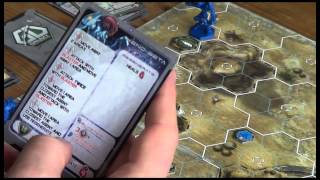
- Tactical upgrade path and choice of basic tactics
- Thematic threat and dynamic alien encounters
- Weather and artifact systems add variability and strategic depth
- Frequent dice jams can hinder progression and feel punishing
- Rule interactions are dense and prone to misinterpretation without careful reference
- Kickstarter-specific cards/variants add complexity not present in base rules
- Cooperative tactical defense against waves of alien foes with upgrade-driven progression
- Space opera in a sci-fi setting where agents defend against alien threats
- Live playthrough commentary with real-time rule clarifications and tactical choices
Mechanics (from transcript analysis)
- Aliens, artifacts and upgrades — Alien enemies are spawned and agents may collect artifacts to upgrade and gain new basic tactics.
- Ammo management and equipment — Ammo tokens constrain firing; running out prevents weapon use unless mitigated by tactics.
- Campaign progression and strategy phase — Artifact rewards, upgrades, and a strategy phase that tunes endgame progression and capabilities.
- Close encounters and danger cards — Close encounter/danger cards add difficulty; the Kickstarter variant expands these with more options.
- Dice-based combat — Red and blue attack/defense dice with shields and lightning bolt icons driving special effects and outcomes on hits or defenses.
- Environmental effects and weather — Weather cards (e.g., EMP storm, Tempest) alter movement, signals, and combat in various ways.
- Terrain, LOS and movement — Hex-based movement with terrain features affecting line of sight and engagement; cover and positioning matter.
- Weapon jams and mitigation — Weapons can jam during play; upgrading and learning weapon skills can ignore jams or reduce their impact.
Video topics + discussion points
Quotes (from this video)
- I got one rules error to clear up and a couple of questions to answer
- these problems are more inherent in the beginning as you go through the game and your agent upgrades then you can learn these these uh weapon skills that allows you to to mitigate those uh those jams
- the kickstarter version you get 14 more cards and an expansion that adds more of these danger cards
- there's a good selection we got a free choice over what we want to do
- we're playing one player so this means teleport one
References (from this video)
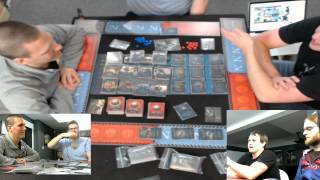
- Solid co-op feel with teamwork emphasis
- If you like co-ops, it scratches that itch well
- Possibly heavy on setup and teach time
- Tactical defense of a star fortress
- Cooperative sci-fi combat against alien threats
- Co-op shooter-in-board-game format
- Descent
- Shadows of Brimstone
- Descent
Mechanics (from transcript analysis)
- Cooperative squad-based fighting — Players combine abilities to defend lanes or fortifications.
Video topics + discussion points
Quotes (from this video)
- it's definitely a well-designed game
- this game feeds you money every turn
- I would totally mix all this in because it's just more items
- the thematic element of this game like it's pretty damn cruel