Game description from the publisher:
For a time, the humans of Sera knew peace...then Emergence Day came. The Locust horde arrived without warning, and countless horrors spilled forth from their underground burrows. The Coalition of Organized Governments (COG) struggled to fend off the subterranean threat, but their defenses were quickly crushed. With billions dead, humans turned their weapons of mass destruction on their own cities to deny the enemy control. Now the long struggle against overwhelming odds approaches one final, desperate stand.
Gears of War: The Board Game, designed by Corey Konieczka, is based on the wildly popular third-person shooter by Epic Games. One to four players take on the roles of COG soldiers cooperating to destroy the Locust horde, and must work together to complete missions against an ingeniously challenging and varied game system. In Gears of War: The Board Game, you’ll relive classic moments from Gears of War and Gears of War 2 – Roadie Run into cover, spray your enemy with blind fire, or rip him in half with your Lancer's chainsaw!
In Gears of War: The Board Game you must fulfill one of seven randomly constructed missions and support your fellow COGs as your team engages an unflinching enemy in furious, white-knuckle firefights! Only through teamwork and communication will you gain a tactical advantage, completing your mission and striking a blow for humanity.
You'll need every soldier you can get if you hope to send the Locust horde back to their holes. Leave no man behind!
ERRATA
- In the Roadblocks mission level 3, use tile 12A instead of 3A.
- In the rules, under Component List, the following three entries are incorrect:
-- 23 Wound/Dropped Weapon Markers, should be 22
-- 12 Grenade Tokens, should be 14
-- 36 Ammo Tokens, should be 44
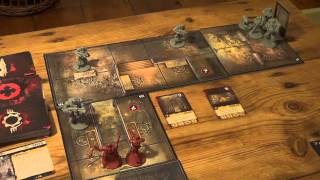
- Strong emphasis on cooperative planning and turn-by-turn tactical decision-making
- Cinematic, high-tension playthrough with vivid narration and dynamic map evolution
- Clear commitment to flavor through in-game terms (Ambush, Follow, Pummel, Emergence, Tickners, etc.)
- Rules density and card interactions can create cognitive load and confusion during live play
- Fast-paced escalation of threats (reinforcements, multiple locust types) may overwhelm newer players
- Cooperative tactical survival against a Locust horde under escalating pressure; mission-based objectives with map exploration.
- Sera, the Locust invasion mapped across modular board tiles with emergent threats and doors that open to new areas.
- Live, turn-by-turn narration driven by card-driven actions and event cards; cinematic pacing via player commentary.
Mechanics (from transcript analysis)
- Card-driven actions — Action cards such as Ambush, Follow, Pommel, and Forced Entry guide tactical options and chain actions between players.
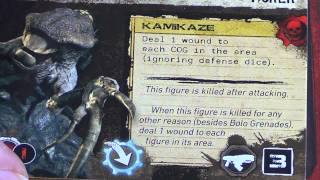
- combat and defense — Engagements involve attack dice versus defense cards, with omens and special effects (e.g., kamikaze attacks) affecting outcome.
- Emergence and location cards — Drew location cards to reveal new map areas and spawn Locusts (A, B, C) at emergence holes; tiles influence enemy setup.
- Exit-based end condition — The objective is to reach the map exit while managing reinforcements and threats; failure triggers ongoing pressure and potential retreat.
- Locust spawning and movement — Locusts (A, B, C) spawn at map exits or emergence holes and advance toward Cog figures with defined movement rules; drones can dive into cover.
- Movement — Characters move through map areas; Augustus draws movement cards to advance across tiles, and their pace is influenced by follow/ambush actions.
- Resource and weapon management — Tokens (grenades, ammo) and weapon cards can be picked up or discarded; certain cards force discards or reshuffle to the box.
Video topics + discussion points
Quotes (from this video)
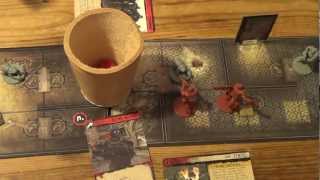
- we're playing gears of war the board game
- reinforcements
- it's not going to be pretty
- we are just two spots away from legging it out of here
- ticker does a kamikaze attack deal one wound to each cog in the area ignoring defense dice
- we're going to run
- we're going to dash for it we're going to run
- ambush i think to follow
- pommel or ambush let's use ambush
- out of his hand we're gonna draw we've got pommel or ambush
References (from this video)

- Immersive cooperative experience with a strong Gears of War theme
- Dynamic AI-driven threats keep tension high and replayability decent
- Map tile progression and door/level mechanics create tactical milestones
- Varied enemy types (Tickers, Boomers, Drones) provide distinct challenges
- Clear narrative through turn-by-turn play and card interactions
- High complexity and significant setup with card/token management
- Requires multiple players to reach optimal strategic depth
- Learning curve for new players can slow early sessions
- Some rules interactions (e.g., guard, explore, and discard effects) can feel fiddly
- cooperative squad-based tactical combat against a Locust threat with a mission-by-mission progression
- Sera during a Locust invasion, urban and dungeon-like map tiles representing corridors, rooms, and map exits
- episodic, mission-driven play with AI-driven enemy behavior and escalating threats
- Gears of War: The Board Game
Mechanics (from transcript analysis)
- AI deck and spawn logic — Locust behavior is governed by an AI deck that draws enemy actions, spawn points, and reinforcement waves, creating evolving threats across turns.
- Card-driven actions — Players use action and event cards to perform moves, guard, explore, attack, or special actions, with timing and hand management shaping the turn order and options.
- dice-based combat resolution — Attack and defense are resolved with dice pools (e.g., three attack dice and one defense die for certain weapons), producing hits, wounds, and blocks that drive damage outcomes.
- Resource and equipment management — Ammo tokens and weapon/equipment availability constrain actions; picking up weapons may not require discarding, but other interactions depend on card/equipment rules.
- Scouting, exploration, and movement options — Exploration allows movement and strategic repositioning; guards and movement cards influence how many areas can be traversed and where to position units for defense.
- Tile-based map and roadblocks — The board uses map tiles to create long corridors, doors, and level-linked areas; progress requires unlocking doors and transitioning to Level 2 or 3 as determined by group choice.
Video topics + discussion points
Quotes (from this video)
- we're playing Gears of War the Board Game
- I'm going to guard with this explore card
- it's a real long Corridor
- Boomers or drones appearing
- proceed to the next stage
- this is it and let's get the AI card for Damon's turn
- it's a fire fight and I'm kind of glad to see this one disappear
References (from this video)
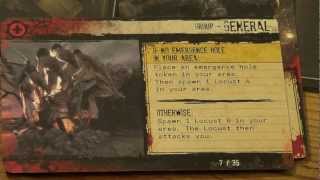
- Dynamic dice-based combat with meaningful cover mechanics
- Engaging AI-driven enemy behavior and escalation
- Exciting moment-to-moment decisions (grenade planning, guard usage)
- Opportunity to pick up dropped weapons after kills
- Occasional misfires and grenades failing to affect targets
- AI card variance can create heavy complexity and demand careful planning
- Wounds vs total health can feel non-intuitive; progress may stall at times
- military sci-fi tactical combat with cover-based mechanics and dice resolution
- War-torn environments in the Gears of War universe; COG vs Locust
- episodic, tactical combat with AI-driven Locust forces and module events
Mechanics (from transcript analysis)
- cover and line of sight — Positions yield cover bonuses; line of sight determines hit opportunities.
- dice pool combat — Attacking uses a pool of attack dice; defenses use defense dice to mitigate damage.
- emergence holes and spawn — Emergence holes in a location spawn Locust units when specific conditions are met.
- Locust AI cards — AI-controlled Locust enemies use cards to determine actions, such as boomer advances, drones, tickers.
- loot and weapon drops — Killing foes may trigger dropping weapons or loot that players can pick up.
- Movement and range — Unit movement on a map with range constraints and terrain considerations.
- order cards and actions — Players draw and resolve order cards to perform actions, often affecting multiple figures.
Video topics + discussion points
Quotes (from this video)
- oh man i think that's an undisputed destruction
- this boomer is torn to pieces
- sometimes you just got away at the odds and take a chance
- we flip this token and there's a potential that it drops a weapon
- that's completely cleared the board
References (from this video)
- Brutal, satisfying combat and co-op play
- Strong theme and production values
- Out of print; secondary market prices high
- Can be difficult to learn and setup
- Brutal, tactical combat with heavy co-op elements
- Industrial-fantasy War-themed dungeon battles
- Cooperative mission-based with miniatures
- Gloomhaven (for scale and campaign emphasis)
- Shadows of Brimstone
Mechanics (from transcript analysis)
- Campaign/module play — Structured scenarios with scenario-specific rules.
- miniatures-based tactical combat — Grid-based fights with cover and positioning.
Video topics + discussion points
Quotes (from this video)
- This game is amazing at creating an emerging narrative.
- I voted this number one adventuring game this year.
- Emerging narratives are just fantastic in Explor It.
- The lore, the art, the setting—the Gothic vibe here is unmatched.
- You can play solo without a DM and still have a deep experience.
- This is one of the best dungeon crawlers you can buy today.
References (from this video)
- Excellent translation of a beloved shooter to board form
- Hard-hitting, tactical, and replayable
- Out of print, price premium on resale
- Some scenes can feel punishing
- Third-person shooter translated to a co-op dungeon crawl
- Gears of War universe
- IP-driven campaign with tactical pacing
- Resident Evil: The Board Game
- Dark Souls: The Card Game
Mechanics (from transcript analysis)
- cooperative tactical combat — One-to-four character control with map-based combat
- Hand management and zone-based tactics — AI and enemy patterns drive attacker behavior
Video topics + discussion points
Quotes (from this video)
- it's such a bizarre game
- this is one of the best translations from video game IPs into board game form
- it's basically like Star Wars themed XCOM
- the closest thing you'll get to a first person shooter in board game form
References (from this video)

- Faithful translation of video game mechanics (cover, tactical movement, shooting) into board game form
- Hand-as-health creates meaningful tension and decisions
- Efficient and varied AI system with quick resolution
- Solid solo and cooperative options, including two-handed play with revival mechanics
- Strong thematic fidelity and a compelling IP translation
- Extremely difficult and brutal; many sessions end in quick defeats
- Steep learning curve and rules are not easy to internalize
- Setup and reset can be fiddly and time-consuming
- Official difficulty adjustment is lacking; no built-in scalable modes
- Occasional abrupt endings in solo play, especially when overwhelmed by AI
- Availability is limited (out of print) and prices can be high
- Cooperative tactical combat against a brutal alien/monstrous threat in a post-human war setting
- Sci-Fi shooter universe adapted from the Gears of War video game IP
- Scenario-driven with cinematic beats; stories unfold differently due to tile layout and AI-driven encounters
- Dungeons & Dragons Adventure System
- The Lord of the Rings (board game)
Mechanics (from transcript analysis)
- AI deck customization — Scenario setup dictates enemies and AI cards; AI cards can chain and stack effects under certain prompts.
- Cover and line-of-sight — Tactical movement with a cover system; line-of-sight rules are initially fiddly and require learning.
- Dice and defense — Defense dice provide mitigations; rolling multiple dice does not always yield multiple successful results.
- Enemy AI phase — Flip AI cards to determine enemy behavior; AI deck is scenario-specific and can trigger multi-card prompts.
- Hand-as-health — Player hand size represents health; discarding cards reduces health and running out of cards equates to death.
- Multi-use action cards — Cards serve as actions, movement, shooting, and can be discarded for special effects in enemy AI phases.
- Solo vs two-handed play — Solo adds extra moves and no need for another miniature; two-handed play allows revival and more tactical depth.
Video topics + discussion points
Quotes (from this video)
- your hand are your actions and your health
- the system here a very very fascinating system
- it's brutal
- the Belly of the Beast scenario is brutal
- I love the system here a lot
- I wish it wasn't so out of print
- it's a video game translation, a brilliant translation from the video game
References (from this video)
- Tactical decision-making under pressure
- Strong thematic flavor with realistic cover and sight rules
- Cooperative play that rewards coordination and planning
- Rule complexity and potential ambiguities during play
- Fiddly setup and occasional board clutter
- Some edge-case rules may require on-the-fly adjudication
- Cooperative, squad-level tactical combat with cover mechanics and card-driven actions.
- The battlefield environments of Sera, during the ongoing war against the Locust Horde.
- Procedural, mission-driven with occasional story beats during play.
Mechanics (from transcript analysis)
- Card-driven actions — Players use action cards to maneuver, ambush, or attack; timing affects outcomes.
- Dice-based Combat with Blanks — Dice determine hits and wounds; blanks introduce risk and require repeated attempts.
- Guard and Guarding Interactions — Certain characters can guard for allies, combining with other players' actions for defense or offense.
- line of sight and cover — Targeting is governed by line-of-sight; cover provides defensive bonuses and influences dice results.
- Move and Attack — Units move across the map and perform attacks within range, balancing distance and aggression.
Video topics + discussion points
Quotes (from this video)
- Augustus gets explore in turn nine, new capabilities opening up the board.
- we really shouldn't have thrown those grenades beyond their range
- we're going to move two areas with advance, one, two
References (from this video)

- Cooperative, action-packed play with varied missions
- AI-driven enemies feel clever and challenging
- Loot and equipment add strategic depth
- Complex setup and rules can be intimidating
- Solitaire experience can feel more like a solo miniatures game than a full group experience
- Cooperative tactical combat with looting and cover
- Gears of War universe; wartime frontier engagements
- Mission-based with AI-driven enemies and scenario progression
Mechanics (from transcript analysis)
- Cooperative play with AI-controlled enemies — Enemy actions are controlled by AI cards; players act in concert against threats
- Deck-driven enemy behavior — AI movement and actions are dictated by a dedicated AI deck
- Hand size equals health — Your hand represents health; losing cards reduces survivability
- Loot, weapons, and cover — Players collect weapons and use cover, with line-of-sight rules shaping combat
Video topics + discussion points
Quotes (from this video)
- it's a pandemic clone once more
- these miniatures they're good Miniatures they're nice good plastic good quality
- you place a fourth so again it's the same limit
- Arkham Horror is a modern classic set in the world of HP Lovecraft
- this is another storytelling game but with a Twist you're playing the part of the Baker Street regulars
- this is the first Cooperative game I ever played and it's a beauty
References (from this video)
- cooperative play with tense, cinematic moments
- dynamic enemy behavior and cover mechanics
- interactive moments with unexpected chain reactions
- rules dense and may overwhelm new players
- board setup and randomness can slow pace
- scaling difficulty requires careful management
- Cooperative tactical combat against Locust forces with wave-based escalation
- Locust-infested battlefield with map-based progression and cover-based combat
- Scenario-driven co-op with scripted events and AI-controlled enemies
Mechanics (from transcript analysis)
- action selection — on a turn choose from moving, attacking, or playing a card with special text
- combat resolution — dice-based attack vs defense with cover modifiers and wound tracking
- enemy AI activation — locust units have predefined AI behavior and activation steps
- hand management — draw up to a set number of cards each turn and manage hand size within a limit
- map exploration — progression triggers reveal of new location cards and reinforcements
- special text cards — cards provide unique effects that can alter turns or outcomes
Video topics + discussion points
Quotes (from this video)
- this ticker must dive into cover here
- pulls off a perfect shot with it's not personal
- the ticker explodes taking every figure in its area with it
- tickers are real crazy locusts
- now I'm hoping this is gonna be a pretty good piece of teamwork here