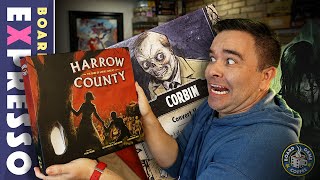
A witch named Hester was hung, burned, and buried under a tree. Some time later, the family of Hester come to Harrow County to destroy it, but standing in their way is eighteen-year-old Emmy who mysteriously has powers of her own.
In the asymmetric combat game Harrow County: The Game of Gothic Conflict, players can play as one of the Protectors, trying to rescue townsfolk, or as one of the family, trying to destroy Harrow County. You can instead play as a third faction that originates from the surprise return of Emmy's twin sister, Kammi, who wants to rule Harrow County. Players activate mason jars to move their haints (undead creatures) around the hex-based board as they try to accomplish their missions. Combat is resolved using a never-before-seen cube tower that's built into the actual box.
Finally, a third player can enter the game: Hester, the dead witch buried under the tree. She controls the roots of the tree and using the cube tower, Hester can infect haints on her roots, which causes a snake to be placed into its ear. That player can still control this haint, but now so can Hester. If Hester comes back to life, then she needs to eat the other legends to gain all her power back to win.
In short, Harrow County is a thematic, tactical game of territory control and enemy elimination to determine the fate of Harrow County.
—description from the publisher
- Strong thematic integration with a gothic comic-book vibe and atmosphere that sells the setting.
- Chapter-based design offers structured progression, pacing, and substantial replay value.
- Distinct faction identities with meaningful, well-developed ability trees.
- Tactile and innovative combat mechanic using the drop-tower and jars that adds a memorable focal point to battles.
- Upgradeable cards and tiered mechanics provide meaningful long-term strategic depth.
- Complexity and asymmetry can be intimidating for newcomers; learning curve is non-trivial.
- Longer session times due to multi-chapter structure and rich interactions.
- Some interactions and rule nuances may require careful bookkeeping or a strong player group to avoid confusion.
- Bag-draw mechanism for the Family faction introduces randomness that may feel unpredictable or frustrating to some players.
- Dark fantasy conflict between two opposing factions as they vie to control key locations, manipulate storms and haints, and shape the fate of the townsfolk.
- Gothic horror setting in Hero County, a cursed rural county teeming with supernatural forces, haunted landscapes, and a looming sense of dread as factions maneuver toward their agendas.
- Chapter-based campaign with evolving characters and powers, drawing inspiration from a linked Harrow County comic-book universe while remaining accessible to players who haven’t read the source material.
Mechanics (from transcript analysis)
- area control and path-building — Players vie for board control by creating or blocking routes, connecting home bases to critical buildings, and shaping the flow of influence across the map.
- asymmetric faction play — Two distinct factions (Protectors and Family) with unique goals, abilities, and victory conditions, creating divergent strategic paths and heavy interaction.
- bag-draw and randomization for Family — Family faction relies on blind tile draws from a bag to determine subsequent actions, injecting risk and adaptive play into their planning.
- chapter progression with new mechanics — Progression through chapters introduces upgrades, new cards, and fresh tactical options, expanding the strategic toolkit and keeping play dynamic.
- dice-based combat via a drop-tower — Engagements are resolved by dropping cubes from a physical tower into jars, turning combat into a tactile, suspenseful event with chance and planning in tension.
- Special character powers — Characters unlock unique abilities that alter play each turn, enabling dramatic shifts in strategy (e.g., Corbin's minion-spawn, Bernice's nails, Malachi's range-based attacks).
- token economy and action jars — Wild tokens and power tiles fuel spawning, movement, and strengthening of units, while action jars provide varied, choice-based actions that shape tempo and momentum.
Video topics + discussion points
Quotes (from this video)
- the creepiest part about Hester is she can take control of your hands by sticking snakes in their ears
- this is pretty damn entertaining
- the game of Gothic conflict is a one to three player asymmetric nightmare that will haunt you in your sleep
- Once you feel you're ready to move on past the first chapter you'll encounter not just new characters with new powers but also new mechanics like upgrade cards