Travel back to Greece in 370 BCE on the island of Kos. Hippocrates has just passed away and that leads to a lot of doubt regarding the durability of his medical activities. As one of his successors, you lead a team of doctors with the goal of perpetuating the treatment of patients in the temple of Asclepios, later known as the first hospital in history. Be the right successor of Hippocrates and increase your reputation, so that patients from all around the Mediterranean will come with the hope of receiving the best treatment ever.
The game lasts four rounds, with each round divided into five phases:
1. Kalosorisma — Each player welcomes up to three patients in their hospital. You need to select your patients carefully as all patients need urgent help, and some may be easier to treat than others, but make sure to help the most in need or you will lose reputation as a doctor.
2. Pliromi — You have to remunerate your doctors or risk their departure.
3. Stratologisi — In this phase, players try to hire new doctors and purchase medicine kits. If a player obtains both, they receive a bonus.
4. Therapeia — Now is the time to treat patients. Players have to carefully puzzle and link the right patients to the right doctors to maximize their assets.
5. Exis — Players count victory and reputation points, and prepare the board for the next round.
Hippocrates combines auction bidding, tile placement, resource management, and more to create an exciting mix that will challenge each player to best manage their patients and try to become Hippocrates' worthy successor.
- Cool diagnosis/potion mechanics
- Strong puzzle core with spatial mapping
- Admin/housekeeping feel can overwhelm the main engine
- Patient care with clinical drafting
- Medical/Potion-purposing hospital
- Euro-style clinical puzzle
Mechanics (from transcript analysis)
- Drafting + resource management — Draft patients and potions to treat them; doctors can combine to cure
Video topics + discussion points
Quotes (from this video)
- this game is the definition of elegance in the game and there's zero bloat
- the engine building part I thought was pretty damn fantastic
- a filler that works; it's smooth and it's fun
- one of the best two-player games out there
- embrace the carnage
- the final product is better than the sum of its parts
References (from this video)
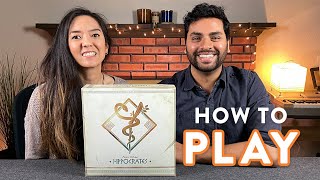
- Immersive ancient medicine setting with a strong thematic flow
- Deep resource and doctor management that interlocks with patient treatment
- Strategic dice manipulation via assistants adds variability
- Large board and modular layout create a tactile, cinematic feel
- Knowledge tiles and contracts provide meaningful choices
- Solo mode included as part of the package
- Clear, instructional video presentation (prototype caveat acknowledged)
- Distinct phase structure (welcome, recruitment, treatment, scoring) gives rhythm
- Prototype status means components and text may change in final copy
- Some rewards/printing shown in video may differ from final rules
- Rule complexity could be daunting for new players
- Video demo occasionally acts as a simplification of deeper systems
- medical practice, patient care, and reputation management in a hospital setting
- Ancient Greece during Hippocrates' era, with physicians treating patients and navigating illness as a medical puzzle
- educational, demonstrative tutorial with prototype considerations
- Googong
- Trois
Mechanics (from transcript analysis)
- Assistants provide dice manipulation — Three types of assistants modify dice outcomes and can serve as wild medicine, expanding tactical options.
- Column-based patient selection — Players select patients from columns adjacent to the rolled dice, weighing immediate rewards and costs.
- contract-based scoring — Doctors have contracts requiring specific medicines to earn points; fulfilling contracts yields scoring rewards.
- Dice-drafting / region dice resolution — Six region dice rolled to determine available columns; numbers map to patient rows, shaping access and costs.
- End-of-round scoring and cascading effects — Treated patients score immediately; unresolved elements influence future rounds through wages and reputation.
- ER and Underworld risk mechanics — Unsuccessful treatments move patients to the emergency room, then potentially to the underworld if not treated.
- Medicine kits and medicine types — Three types of medicines and corresponding kits used to treat patients; kits provide preset combinations.
- Region and knowledge tile economy — Doctors come from six regions; collecting knowledge tiles and managing regional doctors drives strategy.
- Reputation track and variable wages — Player wages depend on reputation; higher reputation reduces costs for hiring doctors.
Video topics + discussion points
Quotes (from this video)
- Hippocrates however is a physician during that time who saw it differently
- this one’s designed by Alan Orban
- this game is played over the course of four rounds
- the heart and soul of the game which is treating our patients
- it’s published by Game Brewer who also did Googong if you’re familiar with that one
- we are going to be hiring other doctors to treat patients
- this is an extremely big board
- the end of four rounds whoever has the most points wins
- prototype so things are subject to change in the final copy
- masdaq is able to treat blue and green medication only
References (from this video)

- Deep strategic decisions
- High-quality components
- Heavy weight for casual players
- Medieval scholarly-medical city-building
- Auction/bidding in a medical-realm with tile placement
- Heavy Euro with strict procedural flow
Mechanics (from transcript analysis)
- Auction / Bidding — Bid for actions to shape your city and resources.
- tile placement — Place tiles to develop districts and capabilities.
Video topics + discussion points
Quotes (from this video)
- let's buckle up, get you some coffee, stay tuned
- we're going to share 20 games from 2022 we missed
- Black History Month—five authors you should know
- we love you family
References (from this video)
- cool spatial puzzle
- interesting doctor-patient synergy
- long drafting process
- fiddly and tediously complex
- overhead reduces enjoyment
- doctor-patient matching and care optimization
- historical medical practice / contract fulfillment
- procedural puzzle with networked targets
Mechanics (from transcript analysis)
- Drafting / selection — choosing patients and doctors to drive scoring
- networking / matching — linking doctors, treatments, and patients to score points
- specialty synergy — combining doctors' specialties to maximize cures
Video topics + discussion points
Quotes (from this video)
- there's no super Superfluous rules there's no fiddliness so it's quite nice and pure
- this one stays true to what hidden role or hidden movement game should be
- I think this one is still my favorite one as one person takes the role of Jack the Ripper
- I absolutely hated this game I did not like anything about it apart from the visuals very stylish and I'm deluxified looking game
- the colorblind-friendly at all and me and my brother are both quite badly colorblind
- not colorblind friendly at all and me and my brother are both quite badly colorblind
- the ketchup mechanism in this game
- one of the nearest misses I've ever played
- therefore it's just not subtle
References (from this video)
- Strong historical theme with high designer pedigree
- Versatile modes (auction, solitaire, tile-placement)
- Images of gameplay aren't shown in the initial materials; may affect initial interest
- medical care, hospital administration and patient flow
- ancient Greece hospital-era tableau
- historical and thematic with varied auction/bidding elements
- thematic euro with auction mechanics
- hospital-theme games
Mechanics (from transcript analysis)
- Auction / Bidding — auction-like mechanics drive decisions around resource allocation and actions
- solitaire mode and tile placement — single-player and tile-placement options augment options for players
Video topics + discussion points
Quotes (from this video)
- I love games that have time tracks.
- the components in this game look great.
- I am a sucker for creative use of components.
- folding the corners over as you are playing the game.
- this one is suddenly a game that I am very interested in.