Pandora's Box has been opened, and Greece's most notorious monsters have escaped.
Horrified: Greek Monsters is a standalone game that features gameplay similar to 2019's Horrified. In this co-operative game, players become avatars of the Greek gods and must work together to re-capture these monsters.
To do that, they must first uncover the monsters' lairs. Medusa, Cerberus, Chimera, and Minotaur are hidden in locations that must be discovered: the Statue Garden, Underworld Door, Chimera's Cave, and Labyrinth. Similar to the myths that inspired the game, uncovering the lairs comes with a cost: Players must discard three color items before the lair token can be flipped over to reveal which monster's hideout they've discovered.
Horrified: Greek Monsters includes six monsters, each with unique abilities, and the more monsters in the game, the harder the challenge, with players needing to use their unique powers to figure out how to defeat each monster.

- Strong thematic integration with Greek myth and monsters
- Layer/lair mechanic adds depth and variable strategy
- Perks and mission items create meaningful choices and power spikes
- Engaging cooperative play with distinct roles for players
- Dynamic monster activation and terror track create tense end-game moments
- High learning curve and occasional rule ambiguity in live play
- Can feel chaotic with multiple players and many mechanics to manage
- Reliance on luck from monster deck and dice can frustrate some players
- Mythic heroism and puzzle-solving under pressure as players defend civilians (Legends) and push back monsters.
- Ancient Greece mythic setting with Greek monsters (Siren, Cerberus, Minotaur) integrated into a cooperative board game framework.
- Cooperative, puzzle-forward with memory and deduction elements layered atop modular monster and lair mechanics.
- Horrified (base game)
- Horrified: American Monsters
- Horrified: Universal Monsters
Mechanics (from transcript analysis)
- Cooperative action economy — Each player has a fixed number of actions per turn to move, collect items, trade, guide legends, or activate abilities.
- Dice-based combat — Monster attacks rely on dice and symbol matching; some symbols trigger movement or special actions.
- Item management and missions — Items are collected to advance missions that defeat monsters; some items unlock doors, runes, or unlock stronger actions.
- Layer tiles (Lair/Labyrinth) mechanic — Layers flip or reveal based on item costs; some layers correspond to specific monsters and unlock new puzzle objectives.
- Legends / Civilians (Legends) management — Legends are guided from adjacent spaces or carried with players; defeating a Legend raises the terror track and provides powerful perk cards.
- Monster phase — After each round of player turns, a monster phase activates the monsters according to monster cards, with movement, attacks, and special powers.
- Perk cards — Perks provide powerful, flexible effects that can be used at any point, influencing movement, combat, or item management.
- Terror track and loss conditions — The terror track rises from monster activity and other events, and a game loss occurs if it reaches the end or if the monster deck is exhausted.
Video topics + discussion points
Quotes (from this video)
- no cap on rent increases
- The Labyrinth is a lie; it’s actually a temple of Illusions
- best of five
- No Cap on God
- the Labyrinth is the lie
- this game is giving Greek mythology
References (from this video)
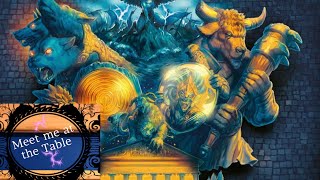
- Thematically rich Greek monsters (Cerberus, Chimera, Minotaur) with unique setups
- Strong cooperative play with helpful hero perks
- Fast-paced play-through once established, varied board setup with layers
- Perk cards scale the gameplay and reward players for progressing
- Flexible two-player setup with meaningful decisions
- Layer tokens can complicate setup and management
- Dice-driven combat can feel punishing or unpredictable at times
- Color variety of blue/green items is confusing at times
- Can be challenging to coordinate Labyrinth advancement across turns
- mythological monsters from Greek folklore (Cerberus, Chimera, Minotaur) in a cooperative board game
- Ancient Greece, underworld and mythic locales
- cooperative chase to seal doors and trap monsters using quest-like objectives
- Horrified base game
- Horrified American Monsters
- Horrified Greek Monsters (this game)
Mechanics (from transcript analysis)
- bag drafting / item placement — A set of items is randomly drawn from a bag and placed on the board to be collected by players.
- cooperative play — Players work together to defeat monsters and complete the Labyrinth objective.
- dice combat / glyphs — Combat uses dice, glyphs and resources; thresholds unlock doors or damage monsters.
- event / encounter cards — Monster cards trigger events and actions that complicate the players' plans.
- Labyrinth building / minotaur labyrinth — A labyrinth must be built and navigated to trap the Minotaur and win the game.
- layer tokens / monster modules — Monsters have layered components revealed at specific locations; progress requires discarding items to unlock doors.
- perks / hero powers — Heroes have unique abilities and perk cards that grant extra actions or special benefits.
- terror track / threat management — A global terror track increases with events; reaching seven or more can cause loss.
Video topics + discussion points
Quotes (from this video)
- I think this is the best one of the series that I've played
- I love the Greek monsters here though my son is reading pereus Jackson and it's all about the Greek mythology
- we just won the game there you have it that was horrified Greek monsters
- the faster you defeat one monster the easier the rest of the game is
- I like the Greek Monsters the most
- oh my gosh that's two misses awesome
- this is the best one of the series that I've played