Collection Status
Your Rating
Description
The Industrial Age is starting to boom. You are in need of more workers for your factories, and you also need more workers to build railroad tracks to expand your railway network. This, in turn, will enable you to deliver the goods from your factories to cities with high demand — but be sure to earmark goods for fulfilling profitable public contracts because when the connection to Trieste is made, your net worth is all that matters.
Imperial Steam is a highly strategic yet accessible economic and logistics game that sees you making difficult decisions as you manage your business's operations while navigating fierce competition to ensure your victory!
—description from the publisher
Year Published
2021
Transcript Analysis
Browse transcript mentions, sentiments, pros/cons, mechanics, topics, quotes, and references.
Total mentions: 3
This page: 3
Sentiment:
pos 3 ·
mix 0 ·
neu 0 ·
neg 0
Showing 1–3 of 3
Video 5BpNM4XYY-k
Rolling Dice and Taking Names game_review at 1:39:32 sentiment: positive
video_pk 4529 · mention_pk 13303
Click to watch at 1:39:32
Overall sentiment (raw)
positive
Pros
- dense strategic decisions
- classic Capstone depth
Cons
- longer playtime
- steep learning curve
Thematic elements
- railways and steam-powered networks
- Industrial-era Europe
- dense euro strategy
Comparison games
- Ragusa
- Kalimala
Mechanics (from transcript analysis)
- track/tile development — build networks and optimize production/points
Video topics + discussion points
No key topics recorded for this video.
Quotes (from this video)
- we are proud members of the old people's club
- taste buds, taste buds, taste buds
- this is going to be a long one
- the fog of war of the cards
- you maximize everything you can every turn
References (from this video)
No references stored for this video.
Video Ar1EE2bAx5I
Rolling Dice and Taking Names general_discussion at 0:13 sentiment: positive
video_pk 2656 · mention_pk 7812
Click to watch at 0:13
Overall sentiment (raw)
positive
Pros
- rich, heavy euro with meaningful decisions
- deep interlocking systems between workers, factories, and contracts
- great production value and thematic coherence
Cons
- setup can be lengthy for first game
- rules complexity may overwhelm new players
Thematic elements
- industrial progress, rail networks, capitalism
- Industrial era Europe, rail expansion and factory economy
- historical/strategic with economic tension
Comparison games
- The King is Dead
Mechanics (from transcript analysis)
- economy / resource management — Goods, money, and production chains drive factory output and endgame scoring via contracts.
- influence tracking — Global influence markers affect access to workers and actions across cities.
- Worker placement / action selection — Eight distinct action types taken each round; setup flows into a sequence of phases that guide actions and economy.
Video topics + discussion points
No key topics recorded for this video.
Quotes (from this video)
- it's a ginger flavored soft drink
- it's a gingerbread cookie drink that's what it is because there's a gingerbread cookie on it
- money is tight in this game
- there are eight phases in a round there are eight rounds in a game
- you can't afford to short suit yourself because you may need all of a sudden marriage cards
- this is one of those games when i read the rules i thought i don't know there's so much going on
- the king is dead… brian boru
- it's a trick-taking card game … you draft two cards
- the production and art are phenomenal
- there's a lot of stuff going on here
References (from this video)
No references stored for this video.
Video 4lJaDQ-pujo
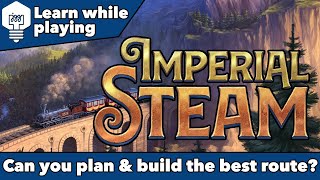
Drunkette's Games rules teach at 0:00 sentiment: positive
video_pk 1112 · mention_pk 3240
Click to watch at 0:00
Overall sentiment (raw)
positive
Pros
- Detailed, step-by-step explanation suitable for new players
- Covers both general flow and round-by-round actions
- Clear demonstrations of complex mechanics like influence, contracts, and deliveries
Cons
- Very dense rules; may be overwhelming for casual players
- Two-player variant adds complexity; streamlines may differ from multi-player
Thematic elements
- Railroad expansion, finance, and production in a historical/industrial setting
- Industrial Central Europe rail network; Wien to Trieste, hub cities, factories, contracts
- Tutorial/Rules explanation with playthrough on a two-player map
Comparison games
none
Mechanics (from transcript analysis)
- Action token placement — Players place action tokens on tiles to perform actions; repeated actions incur influence penalties.
- Contracts and hub cities — Take contracts requiring specific factories; connect to hub cities to gain money and endgame bonuses.
- Delivery to hub cities — Deliver resources from factories to hub cities for money and to increase city influence.
- Factories and production — Convert workers into factories; harvest resources; use factories to deliver goods or store resources.
- Final scoring and Trieste connection — Endgame scoring depends on connections to Trieste and fulfillment of contracts; hub keys provide additional bonuses.
- Income and scoring — Round-by-round income from stations and passenger cars; endgame scoring considers money, influence, resources, and keys.
- Rail network building — Lay tracks connecting cities using resources and effort; bridges/tunnels add costs; network expansion unlocks bonuses.
- Stock market and investors — Sell stocks to investors; stock price and investor penalties influence endgame scoring.
- Worker hiring and training — Hire workers from cities based on influence; training advances workers for more powerful actions.
Video topics + discussion points
No key topics recorded for this video.
Quotes (from this video)
- create a rail network from Wien all the way down to Trieste
- eight rounds
- money is effectively victory points
- delivering wood from your factory to hub cities pays out 70 money
- the most money at the end of the game is how you win
References (from this video)
No references stored for this video.
Transcript Navigation
Showing 1–3 of 3