In Isle of Trains, players are train operators, building trains with the right mix of freight cars needed to complete delivery contracts before your opponents.
Cards are used in multiple ways: they can be built as train cars or buildings supporting your train line, used as currency to pay the cost of building those new train cars and buildings, or used as cargo to load on available train cars.
When loading cargo on an opponent’s train, players receive an immediate benefit or action, but they are also giving their opponent the cargo they just might need to be able to complete a delivery contract and score big!
Balancing the need to upgrade your train, take advantage of benefits from loading other players' trains, and complete delivery contracts first is the key to being the most successful train operator on the Isle of Trains!
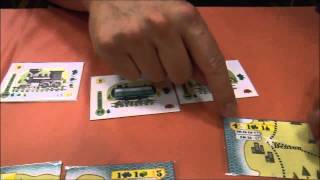
- Clear integration of theme and mechanics (train building, loading, and delivering).
- Dual-use cards create efficient decisions and momentum.
- Player interaction through loading on others' trains adds strategic depth and tempo.
- Contracts with back-side upgrades encourage planning and risk management.
- Straightforward end condition that scales with player count.
- Complexity can be a hurdle for newcomers despite approachable core rules.
- Managing engine weight vs. power requires careful tracking; potential parity issues in player counts.
- Endgame can be influenced by the luck of draw and contract assortment.
- Logistics, trade, and route optimization with multi-use cards.
- Railway operation on a shared network where players build trains and deliver goods to contracts.
- procedural, process-focused with emphasis on engine-building and contract fulfillment.
Mechanics (from transcript analysis)
- action selection — On your turn you choose two actions (build, take, load, deliver) to advance your network.
- Card use as dual-purpose components — Cards serve as both train cars and goods; loading uses the card as the handled good.
- Contract and end-game mechanics — Contracts are placed in the middle; delivering goods fulfills contracts and unlocks secondary contracts on the back; only one front contract can be active; end triggers when a number of middle contract cards are depleted.
- Deck management and draw — Take top card from the draw deck; use cards to build or fulfill contracts.
- end condition and final turns — When middle contracts for players are exhausted, everyone gets a final turn.
- Engine-building and capacity management — Engines have power and weight; adding train cars increases weight and reduces available capacity.
- Load and mutual benefit — Loading goods on another player's train grants you benefits (cards) while contributing to their progress.
Video topics + discussion points
Quotes (from this video)
- "this is of trains and in this game each player is working as a train operator uh trying to build the best train and uh deliver goods uh to uh claim contracts."
- "the engine um has a certain amount of power, uh certain amount of victory points and cost."
- "it's actually beneficial, like I said, to load on somebody else's train because you get the action."
- "the number of players plus two um delivery contract cards are gone from the middle... everybody gets a final turn."