Jerusalem in the 12th Century was a city embroiled in intrigues and power struggles. The Crusader Houses established themselves as the city's rulers, but who would rule over them? Now you must join in the power politics of the holy city, using your resources to control the most important districts and building a castle that towers over your opposition. Prove yourself the most capable Baron, and take your rightful place as the ruler of Jerusalem!
OVERVIEW
The goal for each player is to control the key Sectors of the city: the King, the Church, the Market, the Military, the Nobilty and the Tower of David. This control is achieved gaining the favors of the most important roles of the city (such as the Constable) and by placing Men and Barons into these Sectors. Who owns the most forces gets the Revenue of that area: Men, Gold and Tower-Points. The players can use these new resources to improve their position in the city. At the end of each round the players can rise their Towers building new floors. Also players will have to manage the Special Privileges and bad Events that will take place at end of each Round.
At the end of the game, the player with the highest Tower will be the winner and his family will rule the city!

- part of the demo flow
- buzz in conversations
Mechanics (from transcript analysis)
- demo / marquee title — Showcased as a notable title in the demo flow
Video topics + discussion points
Quotes (from this video)
- there were 85,000 people at gen I don't want to go on
- Gen Con insane
- I'm excited that people were able to get the product because we've seen some of it and it is incredible
- this is like five times the size of Pax
- the lines for Lorcana were insane; they would sleep on the floor to get cards
References (from this video)
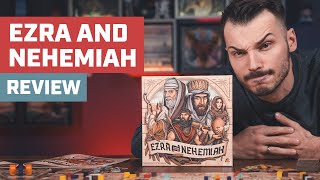
- Elegant card-driven action economy with multi-use cards
- Clear, visual resource flow via rubble and board economy
- Non-direct interaction that remains meaningful and competitive
- Strong teaching potential thanks to a well-structured rulebook
- High replayability and cohesive theme with ancient Jerusalem
- Potential AP (paralysis) due to dense decision space per card
- Longer playtime, especially at higher player counts
- Rulebook can be dense for new players despite strong teaching in practice
- Temple/altar paths can be slow to realize for some groups
- Rebuilding a city through religious and civic acts with resource management
- Ancient Jerusalem, post-disaster reconstruction
- Historical/epic with mythic flavor
- West Kingdom Trilogy
- Great Wall
Mechanics (from transcript analysis)
- Area interaction via walls/gates — Building walls near an opponent’s gate yields mutual resources and shapes available options without direct conflict.
- Card-driven actions — Each round you choose to execute the top or bottom action of a played card; cards have multiple uses and one card is tucked away each week.
- Flag-based action decisions — Three flags (gray, red, blue) on cards offer multi-use actions; players choose which actions to cover or activate, shaping each week.
- Resource management with rubble — Resources are represented by rubble you clean up and reuse to build and upgrade; cleanup converts rubble into usable resources.
- Temple/altar mechanics and Sabbath scoring — Red flags allow sacrifices or temple building; blue flags spread word or scrolls; Sabbath weeks require feeding workers and can grant bonuses.
- Upgrading a personal player board — Players upgrade their boards with new buildings to unlock stronger, more efficient actions.
- Worker placement / action economy — Players place workers on the board to perform actions like building walls, upgrading buildings, trading, or acquiring scrolls.
Video topics + discussion points
Quotes (from this video)
- back in history to ancient Jerusalem and try to rebuild it
- this is not just another Euro game
- it's not direct but anytime I build a wall next to your gate I get resources
- the end is coming and you're like one more turn
- AP paralysis cuz there's a lot of decisions with a single card
- three weeks... you finish the game
- it's fantastic it's fantastic it's a fantastic Euro game