In John Company, players assume the roles of ambitious families attempting to use the British East India Company for personal gain. The game begins in the early eighteenth-century, when the Company has a weak foothold on the subcontinent. Over the course of the game, the Company might grow into the most powerful and insidious corporation in the world or collapse under the weight of its own ambition.
John Company is a game about state-sponsored trade monopoly. Unlike most economic games players often do not control their own firms. Instead, they will collectively guide the Company by securing positions of power, attempting to steer the Company’s fate in ways that benefit their own interests. However, the Company is an unwieldy thing. It is difficult to do anything alone, and players will often need to negotiate with one another. In John Company, most everything is up for negotiation.
Ultimately, this game isn’t about wealth; it’s about reputation. Each turn some of your family members may retire from their Company positions, giving them the opportunity to establish estates. Critically, players do not have full control over when these retirements happen. You will often need to borrow money from other players to make the best use for a chance of retirement. Players also gain victory points by competing in the London Season for prestige and securing fashionable properties.
John Company engages very seriously with its theme. It is meant as a frank portrait of an institution that was as dysfunctional as it was influential. Accordingly, the game wrestles many of the key themes of imperialism and globalization in the eighteenth and nineteenth centuries and how those developments were felt domestically. As such, this game might not be suitable for all players. Please make sure everyone in your group consents to this exploration before playing.
The second edition is extensively revised and is not a reprint.
—description from designer

- innovative solo negotiation system
- strong design work in solo mode
- interesting balance of randomness and control
- heavier game, longer playtime than some groups enjoy
- may be challenging for casual players
- economic strategy and social maneuvering
- historical negotiation and corporate power in a colonial context
- heavy, negotiation-driven play with cube-pool mechanics to influence AI and events
- Negotiation games in general
- Gloomhaven (solo narrative leaning games)
Mechanics (from transcript analysis)
- negotiation and cube-control — players influence the AI and other players using cubes to grant favors or extract benefits
- role variety and negotiation-driven control — different roles interact with asymmetric objectives and shifting power dynamics
Video topics + discussion points
Quotes (from this video)
- there's basically like a little tactical game you have these varied factions that like hugely vary the game
- the solo mode is very complicated I'm super impressed
- this is an amazing one in a small package for a small price
- the story grabbed me and would not let go
- the racing is the smoothest solo racer I've ever played by far
- it's an emotional ending—the most emotional game experience I've had this year
References (from this video)
- Clear and thorough introduction to the 1813 private firm rules and their interaction with base game mechanics
- Practical setup tips and overlay explanations that reduce confusion during play
- Solid coverage of solo play considerations, including risk management and strategic investment
- Highlights how private firms interact with the crown and director formats, offering multiple strategic avenues
- High complexity; multiple overlapping rules and tokens require careful tracking for new players
- Some sections assume familiarity with base John Company concepts, which could be challenging for newcomers
- Solo play adds a layer of abstraction that may not map perfectly to multiplayer experiences
- private firms, governance overlays, colonial trade, corporate strategy, and Sir Robert/ Crown interactions
- British India and naval/colonial commerce in the 18th–early 19th century, with a focus on the East India Company and rival/overlays within governance
- educational let's-play with live setup and rule explanations
- John Company 1710 scenario
Mechanics (from transcript analysis)
- company versus private firm dynamics — the East India Company provides a baseline of victory and risk; private firms offer alternate paths to VP via investments and potential failures
- military and regulatory actions — roles such as Governor General can raise money and deploy regiments; Governor General’s actions can be limited or expanded by overlays
- offices and government overlays — Overlays like Governor General and Director of Trade modify actions (opening orders, monetary flows, transfer of ships/writers) and alter strategic dynamics
- private firms and share value — players can create private firms with a value, shares, and a treasury; the firm’s value can change, affecting per-share victory points and dividends
- ship fitting and trade — players fit ships from shipyards, use treasury to place ships, and trade in designated sea regions; the number of orders filled is tied to ships owned
- solo and AI-driven decisions — in solo play the Crown acts via AI cards; this adds an additional strategic layer to planning, trading, and risk management
- treasury and investment — private firms have a London treasury and can fund investments, paying dividends or retaining funds for strategic moves
Video topics + discussion points
Quotes (from this video)
- 1813 now 1813 introduces deregulation
- deregulation is already passed
- Foundary is useful each time any player purchases a work work shop or regiment you take a pound from the bank
- private firms can trade as well what this means is there's another Revenue stream for us as individuals as players not only are we looking at taking offices and pulling money out of India out of the East India company that way there's an opportunity here for us to trade our private firm
- remember the game ends when the company East IND India Company fails or if the East India Company fails early before we've had a chance to increase
- it's not really hedge against
References (from this video)
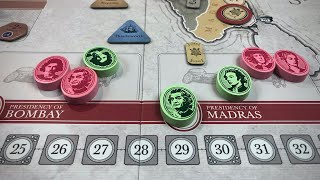
- deep political economy simulation with layered decision making
- rich solo gameplay that reveals strategic entanglements and timing
- strong thematic immersion into imperial governance and corporate manipulation
- high complexity and steep learning curve for new players
- micromanagement of multiple moving parts (offices, ships, wealth, unrest)
- late-game volatility depending on event cards and power dynamics can feel punishing
- political economy, governance, nepotism, imperial expansion, and factional maneuvering among officers and executives.
- 18th-century Indian subcontinent under the influence of the East India Company, with colonial governance and competing factions within the Company territories.
- episodic turn-based decision making with shifting offices, delegations, and crisis events that alter control and wealth.
Mechanics (from transcript analysis)
- financial management — managing treasury, paying dividends, taxes, and costs of operations across regions and offices.
- military deployment — deploying armies, appointing commanders, and engaging in conflicts to defend or conquer regions and enforce policy.
- nepotism and promises — nepotism rules and promise cubes govern where favors and political leverage flow, affecting outcomes and concedes.
- offices and appointments — players acquire and assign political offices (e.g., Director of Trade, Governor, Office Holder) to gain influence, money, and committee control.
- power shifting and transfer — movement of crown writers, officers, and other titles between presidencies to tilt influence and funding toward preferred regions.
- trade and shipping — managing ships, ports, and trade routes; transfers between presidencies affect which regions generate wealth.
- unrest and fatigue — governors can trigger unrest in regions; fatigue and unrest accumulate and influence stability and possible crises.
Video topics + discussion points
Quotes (from this video)
- bearish about this company
- final retirement at the end of term five
- we're on turn four
- it's a close one
- i think we're going to go writer and each again