The epic Egyptian game Kemet is reborn with a new revised edition!
With Kemet: Blood and Sand, immerse yourself in a more realistic Ancient Egypt. Here, Gods are powerful, masters of both the desert and the Nile delta. They challenge each other in violent battles and show no mercy. Get ready to become an Egyptian God, open the gates of your city, and let your troops sing the song of war to please you and claim your dominance as master of Ancient Egypt.
Kemet: Blood and Sand features new art and upgraded gameplay with new approachable rules that go beyond the 1.5 version of Kemet developed with the help of the BGG community. Free from the constraints of existing components, designers Jacques Bariot and Guillaume Montiage go even further in fine-tuning the Kemet experience.
The game also features a redesigned map with a twist, bigger and more detailed figurines, and other surprises.
—description from the publisher
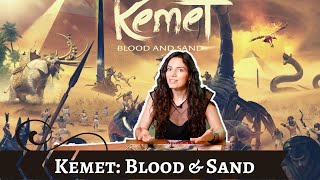
- Fluid and immersive gameplay
- Better iconography and more intuitive rules
- Higher playability and thematic depth
- New art that fits a darker, epic tone
- Potentially longer playtime and steeper learning curve for new players
- Increased complexity compared to base game
- Divine power, battle for godly dominance, pyramid-based strategy
- Ancient Egypt, divine realms and temples
- Epic mythic conflict with tactical combat and city-building
- Kemet
Mechanics (from transcript analysis)
- Area Control — Players compete to control districts via pyramids and military units.
- Card-driven combat — Battle cards and divine intervention cards influence battles.
- Power tile color system — Power tiles (Diamond, Ruby, Sapphire, Onyx) grant color-matched bonuses and unlocks.
- Prayer points resource — Prayer points used to recruit, expand pyramids, and activate abilities.
- Pyramid building and level advancement — Pyramids provide actions and point bonuses; levels determine cost and effects.
- Teleportation via pyramids to obelisks — Teleport units between districts for strategic repositioning.
- Two-phase turns (Day and Night) — Day phase for action tokens; night phase triggers nocturnal powers and new cards.
Video topics + discussion points
Quotes (from this video)
- the bottom line of all this is that the new commence gameplay is definitely more fluid and the total experience is more immersive
- the iconography is better some rules are more intuitive and their playability is higher
- the minutes are bigger and more detailed
- the new art is gorgeous and I personally love the shift to a darker aesthetic that fits the theme of the game more
- overall the additions and the alterations bring the game to the epicness level that it deserves
References (from this video)

- Strong, thematic area-control core with evolving powers via power tiles
- Deterministic (diceless) combat that feels fair and predictable, avoiding random luck spikes
- Flavorful tile sets (red for combat, blue for defense, white for economy, black for tricks) that push varied strategies
- Exciting prospect of rampaging monsters and dynamic board interactions as power tiles are claimed
- Opening turns can be slow as players learn tiles, powers, and interactions
- Early rounds may feel slow or less exciting before powers and pyramids unlock more options
- Relatively high complexity can be daunting for new players, impacting upfront accessibility
- divine cults, temple control, pyramids, ancient beasts, and magical warfare
- mythic Egypt
- mythic, epic, with deterministic combat emphasis
- Galilean moons
- Lords of Helles
Mechanics (from transcript analysis)
- actions_per_turn — Each player has five action disks; players perform actions from different levels of their board, with a design that encourages multi-level planning and resource flow.
- area_control — Players vie for control of key regions on the map; holding these regions yields victory points and ongoing benefits that influence late-game scoring.
- battle_system — The core combat is diceless and deterministic; battles use battle and divine cards, with sword icons, blood drops, shields, and special effects to resolve outcomes in a predictable yet tense manner.
- card_management — Battle and divine cards are drawn and managed throughout the game; card effects interact with actions, movement, and combat to shape outcomes.
- combat_modifiers — Combat is influenced by modifiers such as sword icons, blood drops that cause damage, shields that block effects, and special rules (e.g., green retreats) that shape battles.
- movement_and_ports — Troops can move across the board, with ports enabling faster travel; teleportation between a city and an obelisk is possible for two prayer points, adding mobility options.
- pyramid_construction — Pyramid levels are built progressively; advancing to higher levels costs more prayer points but grants greater control, victory points, and strategic options.
- resource_management — Prayer points are earned via actions and are spent to pay costs for building, upgrading, and triggering special abilities; they are a central pacing resource.
- variable_player_powers — All players begin on equal footing but can acquire and upgrade powers through pyramid tiles, enabling unique strategic trajectories for each player.
Video topics + discussion points
Quotes (from this video)
- Kemet could easily have been just another dull area control game and its bones are just that move troops, fight battles and control spaces
- the four sets in the box each with their own flavor, red is all about fighting, blue about defenses, white improves your economy and black tiles are full of dirty tricks
- the combat system is diceless and solid
- the best thing about this game is rampaging around the board with giant monsters
- opening turns can be pretty slow and dull
- for a similar area control game with evolving powers try Galilean moons
References (from this video)
- Prevents passive turtling through constant aggression
- Deep upgrade system with a lot of strategic variety
- Distinct, memorable faction/creature options
- Steep learning curve and rules complexity
- Can be heavy for casual groups
- Mythic divinities and armies clashing for dominance
- Egyptian mythos in a conflict-driven battlefield
- Fast-paced, aggressive play with a strong upgrade ecosystem
- Risk
Mechanics (from transcript analysis)
- action_pyramid — Turns use a pyramid of actions; players must select one action from each level over five actions.
- area_control — Conquering and controlling regions remains central to scoring.
- combat_cards — Battles are resolved with cards that modify combat outcomes.
- upgrades_and_creatures — A broad array of upgrades (including giant monsters) shapes the map and battles.
Video topics + discussion points
Quotes (from this video)
- this is the game that actually introduced The Legacy concept
- it's layered on top of what's already a better version of risk
- the primary action selection mechanism on your turns you have this pyramid that has different actions
- two-player only game where you and your opponent are actually playing out the historical event of the Cold War
- it's highly asymmetrical and by that I mean the different factions literally play completely differently