Kingmaker simulates the Wars of the Roses, the period of sporadic Civil War in England between 1450 and 1490. Ruled by a weak and mentally unstable king, Henry VI, demoralized by the defeat in France at the end of the Hundred Years War, and encouraged by the ambitions of Richard, Duke of York, and his sons; the country's noble families used their large private armies in attempts to gain control of the throne.
The game is based on the premise that the powerful Noble families used the Lancastrian and Yorkist princes as pawns in a greater struggle to gain control of England. The nobles in a player's faction use their military and political powers to gain control of royal heirs in an effort to crown one and put him or her on the throne. Of course everyone is out to capture and control the last heir alive, so once acquired, an heir needs to be protected.
Kingmaker has been published by several companies, starting with Philmar under their Ariel imprint in 1974, by Avalon Hill in 1976, by Gibsons Games in 1983, and by TM Games in 1988/9. In 2023, Gibsons Games published a new edition, which has its own entry under Kingmaker (2023).
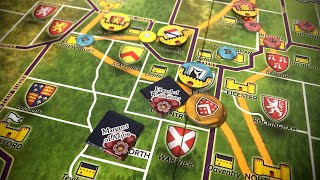
- Rich negotiation depth and dynamic politics between factions
- Integrated siege, battle, and event systems that create tension and strategic choice
- Clear feedback on consequences of actions (executed/noble casualties, offices, prestige)
- Alliances offer cooperative pathways and shared victory conditions
- Complex rules can be hard to learn for new players
- Luck elements from event and plague cards can swing outcomes
- Game length can be lengthy, especially with multiple players
- Noble power politics, conquest, and diplomacy
- Medieval England during a dynastic power struggle
- Historical intrigue with negotiation and shifting control
Mechanics (from transcript analysis)
- Battle in the open — Nobles fight in the field against each other with troops; outcomes depend on troop strength and card effects.
- Besieged locations — Locations under siege are locked for movement and card augmentation while the siege resolves; special tokens track siege status.
- Crown cards — Cards that can be added to Nobles to boost troop counts during attacks or affect resolution and outcomes; limited by location and siege state.
- Noble capture and transfer — Captured Nobles can be ransom’d or executed; offices and titles become vacant and can be reassigned later.
- Parliament and crowning — Post-combat phase where offices are distributed and crowns may be awarded to the most senior Royal Piece; impacts prestige.
- Rally to the cause — Card-based compensation mechanic: for every two cards discarded via combat losses, players draw crowns; provides a reduction-and-draw mechanism to recover from losses.
- Siege resolution — Attackers must match or exceed the defenders' troop count in fortified towns; resolution involves adding Crown cards and potential luck via event cards.
Video topics + discussion points
Quotes (from this video)
- you must have as many troops in your attacking Army as the Defenders as many or more so if I had less than 200 troops here I couldn't attack I just couldn't do it
- this location has an inherent Garrison of 200
- Wheeling and dealing to be had during those times
- remember this is a bit of a negotiation game
- for every two cards discarded this way we draw one card from the crown deck
- it's part of the game it's a big part of the game