Taken from BoardgameNews.com:
The year is 1430, a time of unrest and upheaval in the whole of Europe. Nearly 100 years have passed since the founding of the League of Six – a group of wealthy Lusatian towns that banded together to defend their commercial interests and preserve stability and order in the region.
You have been sent to this embattled land in the role of tax collector. As a young, ambitious aristocrat, you hope to stand out so that you will be given a position in the court of Sigismund.
The tax collector who brings in the most revenue for the king, while simultaneously gaining the support of the estates, has the best chance of finding himself by the side of King Sigismund.
The game consists of six turns representing six years. Each player takes the role of a tax collector visiting one of the six cities. The goods collected are placed in the royal stores or estate stores, thus giving the players influence in the court of King Sigismund. The player who gains the most influence wins.
Expanded by:
League of Six: Loyal Retinue
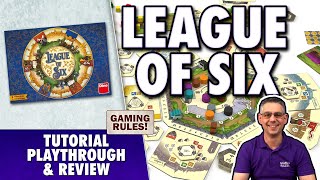
- High player interaction and dynamic bidding that influences table decisions
- Elegant, compact mechanisms that feel meaningful and thematic
- Works well with five players and scales to six with variants
- Rules are fairly dense and learning curve can be steep
- Tracking guards/horse resources can be fiddly in multi-player games
- medieval trade, political intrigue, taxation
- 15th century Europe, six cities forming a league
- historical, tile-based engine with political maneuvering
- Nippon
- Underwater Cities
- Amun-Re
Mechanics (from transcript analysis)
- bidding — players bid resources to select rows and place wagons, involving negotiation and bluffing.
- endgame_scoring_by_symbols — scoring based on symbol dominance on gathered cards.
- round_based_progression — six rounds with six phases each; board state evolves as rounds progress.
- route/movement — wagon movement with guards and horses; bribery mechanics to influence others' choices.
- set_collection — collect goods and symbols from cities to score crowns, arches, and crosses.
- tile_rotation — rotate city tiles to optimize bonuses and end-of-round effects.
Video topics + discussion points
Quotes (from this video)
- I love the bidding mechanism. It's brilliant. It's perfect. It's just as complicated as it needs to be.
- Player interaction in Eurogame, this has got it in here and in here. Absolutely.
- This is a fantastic game.
- The trick of the game comes in