Lorenzo de' Medici, also known as "Lorenzo il Magnifico" (Lorenzo the Magnificent), was one of the most powerful and enthusiastic patrons of the Italian Renaissance.
In Lorenzo il Magnifico, each player takes the role of the head of a noble family in a city during the Italian Renaissance to gain more prestige and fame — that is, victory points (VP) — than anyone else. To do so, you send your family members to different areas of town, where they can obtain many achievements. In one location, they get useful resources; in another development cards that represent newly conquered territories, sponsored buildings, influenced characters, or encouraged ventures; and somewhere else they activate the effects of their cards.
Family members are not identical. At the beginning of each round, you roll three dice to determine their value. You must choose carefully where to send your most valuable family members...
You can gain VP in several ways, and you must also pay attention to your relations with the Church. The game is divided into three periods, each formed by two rounds; at the end of each period, players must show their faith, and whoever hasn't prayed enough will suffer hard penalties. After six rounds, you calculate your final score, and the player with the most VP wins.

- tight, high-variance engine-building with lots of planning depth
- strong thematic resonance and elegant complexity
- learning curve can be steep
- some players may find it too dense
- economic engine-building with a focus on standing and influence
- Renaissance trading and banking simulation
- deep strategic tableau with varied setup across plays
- Gaia Project
- Terra Mystica
Mechanics (from transcript analysis)
- book/resources and innovations — new book-like resources and innovations introduce powerful, randomized effects
- engine-building and tableau — players build a personal engine from actions and cards
- worker placement with high interaction — competition for limited action spaces and strong inter-player dynamics
Video topics + discussion points
Quotes (from this video)
- Age of Innovation feels like it delivers the pinnacle experience of that kind of whole system.
- Twilight Struggle is a borderline masterpiece.
- The arc of Twilight Struggle is so exciting; tension grows across the board.
- This is Mage Knight Ultimate Edition—changing it to cooperative mode is incredible; I’d never go back.
- Eldritch Horror highs are the top board game experiences I’ve had.
- Agricola is the best board game we have ever played and it has stayed at the top for years.
References (from this video)

- Engaging engine-building core that rewards planning and sequencing
- Beautiful art by Clemens Franz that enhances accessibility of a heavy game
- Strong theme integration with interaction via timing and dice
- Multiple viable strategies (production focus, faith/Vatican tension, and card-driven development)
- AP and decision fatigue due to many cards and possible combos
- Dice randomness can frustrate players seeking pure Euro determinism
- Excommunication can create heavy penalties if mismanaged
- New players may face a steep learning curve and load of card evaluation
- Noble families vying for influence and Vatican favor
- Florence, Italy during the Renaissance
- Historical flavor with abstract, engine-building gameplay
- Agricola
- Le Havre
- Rosenberg's other games
Mechanics (from transcript analysis)
- area/territory acquisition — Claim territories that yield points or resources and support engine progression.
- card drafting from towers — Four towers hold cards across four categories; players acquire cards to build their engine.
- dice-driven worker placement — Three dice determine the value of your family members; you place them on action spaces with matching die faces.
- engine-building — Produce resources via a production row and harvest row; chaining effects as you run the engine.
- set collection / ventures — Acquire notable characters, buildings, and ventures to maximize scoring potential.
- Vatican faith track and excommunication — Faith track progression enables Vatican support; excommunication tiles impose ongoing penalties.
Video topics + discussion points
Quotes (from this video)
- this is actually a very very good game
- I love a good brain burning Euro game with a lot of Unique Mechanics
- it's 100% an engine building game
- Randomness you know you can't figure for
- I really really really like that
References (from this video)
- Fresh twist on engine-building via dice-powered worker strength
- High replayability through card powers and track progression
- Strong player agency with meaningful choices each round
- Dice swing can feel chaotic for some players
- Learning curve and engine optimization take time
- engine-building and worker-placement with variable die strength
- Renaissance-era Italian city-states
- historical-economic competition
Mechanics (from transcript analysis)
- dice-driven worker strength — Three dice rolled each round determine the power of each worker color, shaping available actions.
- engine-building via personal display — Acquire cards to improve efficiency and unlock powerful combos on your board.
- resource management and set collection — Gather resources indirectly through card-driven actions and score from completed sets.
- round-based progression with tracks — Climb tracks to gain bonuses and determine end-game scoring opportunities.
Video topics + discussion points
Quotes (from this video)
- I love the sense of urgency when it comes to rushing to these islands and getting them populated as quickly as you can.
- This game is the absolute best of the best. You know, the top 1% of the top 1% of the games that I've played.
- I could not speak more highly of this design.
- The dice-driven twist, the engine-building, the tension—this is why I play board games.
References (from this video)

- Dense, multi-layered combos that emerge from the interplay between houses, leaders, and development cards.
- Deliberate pacing that rewards thoughtful planning and timing of powerful plays.
- Can feel unforgiving; missteps early can restrict later opportunities, making it feel punishing at times.
- Theme can feel dry to some players, though the engine and combo systems carry significant appeal.
- engine-building through layered card powers and societal advancement
- Renaissance Italy with powerful houses, leaders, and a web of political and economic influences.
- historically flavored but primarily mechanical and strategic
Mechanics (from transcript analysis)
- engine_building — Layering of house abilities, leaders, and production that scales as the game progresses.
- hand_management — Careful selection of cards and leaders to unlock powerful combos while contending with competing needs.
- resource_production — Managing a production matrix to fuel actions and purchases, creating interdependent optimization.
- set_collection — Acquiring cards that synergize with existing holdings to maximize scoring opportunities.
Video topics + discussion points
Quotes (from this video)
- it's the game is combos in terms of having cards and trying to figure out the best combination of those cards to produce the most points and what I love about it with and kind of with the combos in it is you know it's like okay this card causes these cards to score this way but then you know if I add this card well that's going to make this and so you can really get into some interesting situations of trying to figure out you know is it better to get rid of this card and take that one
- the payoff is just so concentrated it's like everything just is to this one moment and often times like a game of TWA is one on one of those moments like somebody just really pulled off the connection of everything
- you feel the unbelievable nature of kind of the the combos that you're able to pull off kind of between especially if you were able to come into it with gems built up
- it's not just like oh the game has combos this is the engine of the game; it's the combination of the houses, leaders, and cards that create the big payoff
- the moment in this game you go off on your own journeys and then you get to the final battle and it's a big payoff; it's the feeling of power when you trigger all of these things and get the final blow
References (from this video)

- Tight, unforgiving Euro with deep engine-building
- Rich interaction via action choice and tower access
- Multiple card types create varied strategies
- Leader cards add forward goals and ongoing bonuses
- Two-player playthrough feels tense and strategic
- Theme is notably absent; very dry on flavor
- Decision space is extremely tight; punishing if misplayed
- Contested tower spaces cost coins to enter
- Endgame scoring complexity and Vatican mechanics can be challenging
- Learning curve and setup can be lengthy
- Noble family ascent and social prestige in Renaissance Florence
- Florence, Renaissance
- engine-building and card-driven progression rather than explicit storytelling
- Masters of Renaissance
- Agricola
Mechanics (from transcript analysis)
- Asymmetric starting bonuses — Advanced variant uses asymmetric bonus tiles and leader-driven drafting, affecting early turns and engine development.
- Card drafting and management — Cards fall into four types (Characters, Ventures, Territories, Buildings) with costs, immediate benefits, and persistent effects; endgame points vary by type.
- Dice value management — Each round uses three colored dice plus a beige neutral; players can boost die values with purple servants, and action spaces require a minimum die value.
- Endgame scoring tracks — Scoring runs across multiple tracks (church points, military, territories/buildings/ventures, and resources converted to points).
- Leaders and council privileges — Leader cards grant round/ongoing bonuses; you can discard leaders for council privileges to gain various benefits.
- Vatican reports / excommunication — Rounds two, four, and six include Vatican scoring; spending church points can avoid penalties or trigger excommunication with global scoring effects.
- worker placement — Four workers per player are placed on action spaces; access to some spaces depends on dice values and others cost coins if contested.
Video topics + discussion points
Quotes (from this video)
- it's definitely a dry Euro
- the game is super tight
- this is a classic
- one of the most cut-throat Euro games I played in a long time
- I would like to see more of these, this style of Euro
- this is going to stay in our collection
References (from this video)
- Excellent engine-building
- Thematic yet strategic
- Worker placement with dice-drafting
- Renaissance Italy
Mechanics (from transcript analysis)
- Dice drafting / engine-building — Build an engine by activating actions with dice values and colors
Video topics + discussion points
Quotes (from this video)
- card drafting to the forefront of gaming mechanisms
- it's very difficult but again if you especially love the Lord of the Rings this is one to definitely sink your teeth into
- this really is a family weight game you can play this one with just about anybody
References (from this video)
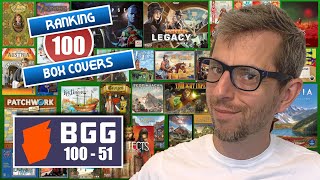
- Artwork by Clement Franz is nice
- Intricate pattern work
- Puke green color
- Strange paisley pattern
- Nondescript character
- Doesn't convey gameplay
- Politics
- Renaissance Italy
- Historical
Mechanics (from transcript analysis)
- auction/bidding — European-style strategy game
Video topics + discussion points
Quotes (from this video)
- The box cover makes a promise to the customer
- Every box cover tells me what I'm going to be doing and how I'm going to be feeling
- This artist is one of the best board game artists working in the industry right now
- This is how you do it
- This cover is a mess
- Striking iconic design
- The box cover is not selling the game