Madeira is an island officially discovered early in the 15th century by Portuguese seafarers. Madeira, the Portuguese word for wood, refers to the dense forest that covered its wild, fertile landscape. This, and its strategic position far into the Atlantic Ocean made the island one of the most significant Portuguese discoveries. Madeira served as a “laboratory” for what would become the Portuguese Empire.
Wheat plantations were the first means for survival on the island. After that, when D. Henrique decided to increase the economy of the Empire, sugar became the core business of Madeira. Once sugar started coming from other places in the world, such as Africa and Brazil, profits from sugar were no longer enough, and production of the very famous Madeira wine became the most important economic product of the island.
Players try to adapt themselves to these constraints, working to find better fields for farming the right goods and for obtaining precious wood, essential for erecting new structures in the cities and for building ships. In turn, the ships are crucial for trading in foreign markets, as well as for taking part in new expeditions to discover other countries.
Madeira has been established just as it was in the original administrative division of the island under 3 captaincies (Funchal, Machico, and Porto Santo), where the ultimate goal is to develop the Island, gaining the most prestige under and for the Portuguese Crown.
The Crown of Portugal has a series of requests regarding expeditions, urbanization, opening trade routes, increasing wealth, and controlling the guilds on the islands. Three times during the game, the players gain prestige for fulfilling certain requests by the Crown. At two other times, the Crown requests that the islands change the focus of their agriculture due to the changes in the world.
Players must carefully choose the correct timing to show their achievements. Too early and you don’t gain as much prestige, too late and you risk someone else stealing the best opportunities. Will you have what it takes to excel in all of these endeavors?
Beware, wheat may become scarce, money is never enough, the population is hungry, and the shadow of piracy looms large….
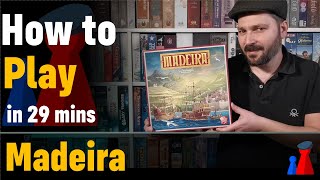
- Deep strategic depth with long-term planning
- Strong theme integration between mechanics and historical setting
- High variability through guild tokens, crown tiles, and random setup
- Clear five-round structure that evolves over the session
- Multiple viable paths to victory via ships, cities, and favors
- Can be intimidating due to dense rules and setup complexity
- Potential downtime with multiple players and heavy decision trees
- Wood/resource management can be punishing if mismanaged or poorly planned
- Resource management, trade, guilds, and crown politics influencing settlement and wealth
- Madeira island during the Age of Exploration, a colonial trading network in the early modern period
- Historical economic simulation with thematic flavor
Mechanics (from transcript analysis)
- Crown requests and scoring tokens — Crown request tiles drive end-game and round-end scoring with variable goals
- Dice drafting/placement — Rolling guild and pirate dice and placing them into buildings to trigger actions and bonuses
- Guild favors and tokens — Special tokens granting one-time or phased bonuses that can be refreshed periodically
- Resource management — Harvesting goods, paying costs with coins and goods, and maintaining supply chains for ships and tokens
- Ship movement and market/colony scoring — Moving ships to market or colonies to gain bonuses or trigger Kings' rewards
- Windmill and river of bonuses — Windmill actions that modify levels and grant coins, bread, or victory points, affecting multiple phases
- worker placement — Assigning workers to city spaces and fields to activate actions and accrue resources
Video topics + discussion points
Quotes (from this video)
- one of the five best games I've ever played
- the game is played in five rounds
- you must use a Die and this Die must be either one of your guilt dyes or one pirate Die
- the player who takes the two crowns in its back will be the first player
- the game is played in five rounds each round consists of the following phases