The Mage Knight board game puts you in control of one of four powerful Mage Knights as you explore (and conquer) a corner of the Mage Knight universe under the control of the Atlantean Empire. Build your army, fill your deck with powerful spells and actions, explore caves and dungeons, and eventually conquer powerful cities controlled by this once-great faction! In competitive scenarios, opposing players may be powerful allies, but only one will be able to claim the land as their own. In cooperative scenarios, the players win or lose as a group. Solo rules are also included.
Combining elements of RPGs, deck-building, and traditional board games the Mage Knight board game captures the rich history of the Mage Knight universe in a self-contained gaming experience.
- Deep, layered tactical decision-making that rewards long-term planning and precise resource management.
- Rich, evocative fantasy setting with meaningful progression through upgrades, tiles, and encounters.
- High replay potential thanks to modular maps, varied encounters, and scalable difficulty through scenario design.
- Steep learning curve and dense rule set that can intimidate newcomers or players new to cooperative/solitaire-style planning.
- Downtime can grow in multiplayer, especially as player turns become complex and halo effects from cards take longer to resolve.
- Reliance on scenario setup accuracy and token placement can lead to mistakes that disrupt balance or early momentum if not careful.
- Heroic conquest and exploration within a dark, mythic world where strategic planning, resource management, and battlefield tactics determine the fate of cities and realms.
- A sprawling fantasy realm of knights, sorcery, and ancient ruins where players explore modular tiles, recruit forces, and confront a rising peril across a contested landscape.
- Scenario-driven campaign with branching outcomes, where each tile reveal and encounter shapes long-term progress, reputation, and power balance.
Mechanics (from transcript analysis)
- Action selection & hand management — Players organize their turns around a hand of action cards that combine with mana management to drive movement, combat, recruitment, and exploration. Card timing and ordering are central, and mismanaging hand size or timing can slow a player's momentum.
- Combat resolution with modifiers — Engagements hinge on attack, defense, armor, and special abilities. Ranged and melee interactions can be swapped under certain conditions, and modifiers from items, terrain, or spells tilt the balance.
- Event-driven encounters and dummy players — Encounter decks and dummy opponents simulate pressure and balance. Choices about card draws and dealer-driven events shape the pace and difficulty of the challenge.
- Mana economy & dice-based effects — Mana from sources fuels actions and spell-like effects. Dice-derived outcomes influence attack power, defense, and special actions, creating a dynamic swing in fights and encounters.
- Modular map exploration — The board is built from variable tiles representing terrain, cities, and dungeons. Exploration reveals new options, unlocks upgrades, and introduces risk as players encounter rampaging enemies and unique threats.
- resource and token management — Various resources (mana, blue/green/red crystals, faction tokens) and terrain-specific bonuses influence turn efficiency, card drafting, and the ability to sustain upgrades over the course of a campaign.
- Scenario-driven objectives and reputation — Reputation and tile-based objectives guide strategic choices. Some actions risk reputation loss, while others unlock new capabilities or access to stronger units and locations.
- Unit recruitment and upgrade paths — Players recruit Guardsmen, peasants, and other units, collect reputation, and upgrade units with items or armor to improve survivability and capability on subsequent turns.
Video topics + discussion points
Quotes (from this video)
- we've explored a heck of a lot of territory
- we've found the green city I'm thinking about either pushing through to this monastery
- but who said major Knight was supposed to be easy
- let's hire some peasants I can always get rid of them later if I don't want them
- okay let's concentrate promised with green mana which gives us the stronger effect plus two that's influenced six
- this is going to provoke these rampaging enemies to attack
- we're going to move into this woods which is going to provoke
- we've got one with the land and lots of attack okay we've got improvisation rage and crystallized
- there's a dungeon safe space you can end your turn here and then as an action you can delve down into the tomb
- we're adjacent and we have a shield token their hand size is one high
References (from this video)

- Epitome of solitary gaming
- Greatest challenge for soloists
- Glory from solving problems
- Magical moments of discovery
- Creating solutions and seeing them play out
- Setup and tear down time
- Lost to #1 on production value
- Would give it up first if forced to choose
- Powerful mage knights exploring and conquering
- Fantasy world exploration
- Epic fantasy adventure
- Hoplomachus
Mechanics (from transcript analysis)
- Deck building — Build deck of action cards
- exploration — Explore depths and face obstacles
- hand management — Combine card effects for explosive combinations
Video topics + discussion points
Quotes (from this video)
- If you ask why I play board games over video games the answer is not just because I prefer the pace of board games but I absolutely love the tactile experience
- Mage Knight is the epitome of solitary gaming
- The design is one that reaches New Heights in storytelling
- A dream to play a pleasure to own and a luxury every time it gets to the table
- More than just legendary in space more than just the re-theme
References (from this video)

- Rich tactical combat with meaningful choices
- High replayability through tile setup and campaign progression
- Coherent narrative arc with persistent character growth
- Epic scale and spectacle with unique units (Guardian Golems)
- Complex rules that can overwhelm new players
- Solo play requires careful tracking of many resources
- High setup and planning time
- Potentially long play sessions
- quest-driven campaign with magical combat, personal growth, and world-saving epics
- Atlantian Empire, a fantasy realm under siege and political intrigue; a knightly order and mage towers
- episodic campaign with alternating scenario setup and narrative narration; persistent hero progression
Mechanics (from transcript analysis)
- Campaign persistence with reputation and keeps — Reputation and keep control influence recruitment and strategic options; end-of-round adjustments
- character progression and leveling — Mage Knight levels up by gaining fame, choosing new skills, and keeping rewards across scenarios
- Combat resolution with armor, wounds, and blocking — Attacks deal wounds that are mitigated by armor and blocking; damage can spill into hand cards
- Mana/die-based action economy — Mana dice and crystals power actions and spells; color-coded mana affects card effects and spell offers
- Modular tile map and exploration — Seven countryside tiles combined with cores to form unique maps; exploring reveals new sites and rewards
- Resource management: crystals, fame, and artifacts — Crystals can be spent or saved; fame powers upgrades and keeps; artifacts grant ongoing bonuses
Video topics + discussion points
Quotes (from this video)
- Hello everyone and welcome to the One-Stop Co-op Shop
- this is the world into which you returned after months of imprisonment
- there's so many options right off the get-go I love it
- I love this game
References (from this video)
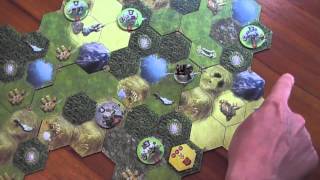
- Rich, tactical combat with meaningful decisions
- Deep dungeon exploration and loot progression
- Strong thematic integration around fame and upgrade cycles
- High complexity and long play sessions
- Wound management can clog hand and slow turns
- Steep learning curve for new players
- Fame and power through exploration and combat
- Fantasy medieval world with exploration of tiles, monasteries, dungeons, tombs
- Open-world, campaign-style, dungeon-crawl progression
Mechanics (from transcript analysis)
- combat resolution — Phase-based combat: ranged attack, block, and damage; armor reduces attack strength; wounds gained on unblocked hits.
- Deck-building / loot mechanics — Gaining artifacts and upgrades through dungeon rewards; some cards become one-time use.
- Exploration / dungeon crawling — Entering dungeons, fighting monsters, obtaining rewards, and triggering dungeon effects.
- hand management — Skill cards form the core actions; players manage a hand, discards, and wounds.
- Movement and exploration — Mana-driven movement and tile revealing to explore the map.
- Resource management — Mana, influence, gold, and spell-like effects to recruit, cast spells, and power actions.
Video topics + discussion points
Quotes (from this video)
- first stage of combat is ranged attack
- the first thing you do is reduce the attack strength by your armor
- we've killed this werewolf
- artifact… one time use so if you use this as kind of like an extra powerful effect it says skip the block and damage assignment
- this is a dungeon and this is a spawning ground and like the dungeon these are places where you can go and find monsters
- level five so we take this level token and turn it into a command token
- we're now on Fame 25
- the artifact I drew so all right next time I won't going to make the same mistake
References (from this video)

- Advanced units are distinctly more powerful and desirable
- Unit tracking (armor, hand size, level range) provides clear progression
- Mana system enables diverse capabilities (fire, ice, healing, readying, siege modification)
- Recruitment symbols help thematic tactical decisions (where you can hire)
- Catapults and siege options expand strategic options
- Units have limited uses per round and require mindful timing
- Burning monasteries offers artifacts but harms reputation and risk from purple enemies; units won't help in that fight
- Dungeons are solo affairs with no unit support
- Markets for hiring units do not automatically replenish when you hire; you must wait until next day/night
- Some units are location-locked (only recruitable at specific sites)
- Heroic fantasy, conquest, and magical siege
- Fantasy medieval city-state conquest with dungeon exploration and magical warfare
- Sandbox tactical combat with emergent scenarios using modular unit decks
- Lost Legion expansion
- Mage Knight: Ultimate Edition
Mechanics (from transcript analysis)
- Combat and blocking — Units can Attack or Block; some have Swift requiring double blocks to stop; some require spending mana.
- Cost and resource tracking — Influence is spent to recruit units; armor and hand size affect combat and healing.
- Mana and actions — Mana colors (red, blue, green) power unit abilities like blocking, healing, or readying.
- Market and replenishment — Unit offers are not replenished automatically upon hiring; you must wait until next day/night.
- Monasteries and dungeon effects — Monasteries can be burned for artifacts but reduce reputation; dungeons are solo fights.
- Positioning and recruitment symbols — Recruitment locations (keep, village, mage towers, monasteries) restrict which units can be hired.
- Scenario progression and expansion content — Different decks (Silverback/basic vs Goldback/advanced) provide variety and progression.
- Unit exhaustion and cooldown — Units are spent when activated and must be refreshed at day or night; limited uses per round.
- Unit progression and leveling — Units level up, increasing armor, hand size, and the level range; tokens show current limits.
- Unit recruitment — Hire units with influence costs from separate decks; available slots depend on unit level and day/night phase.
- Wounds and healing — Healing and wound resolution affect unit survivability and scoring; herbalist can heal and ready.
Video topics + discussion points
Quotes (from this video)
- while all units are cool the advanced ones are distinctly more awesome
- these numbers will track your armor your hand size and the level range that you're in
- these units are very, very handy
- burn down a monastery it decreases your reputation by 3