In Magic Mountain, a.k.a. Zauberberg, you want to move the sorcerers' apprentices down the mountain ahead of the witches — but you don't always know how the will-o'-the-wisps will make the figures move.
To set up, place supports on the game board to elevate the starting area, then place six sorcerers' apprentices in the back row and four witches on their designated starting spaces. Add the five colored will-o'-the-wisp marbles to the bag.
On a turn, draw a will-o'-the-wisp, then place it at the top of one of the six starting channels and let it go. If the will-o'-the-wisp hits a figure, the ball will stop. Pick up this figure and move it to the next open colored space on the winding path that matches the color of the will-o'-the-wisp. If you're moving a sorcerers' apprentice, you might want to do it quickly because if the will-o'-the-wisp hits that same figure, you can move it once again! Don't rush moving the witches, though, since you want them to move as little as possible. If a will-o'-the-wisp doesn't hit any figures, then you must move a witch of your choice to the next matching colored space. Once all five will-o'-the-wisps have been drawn, return them to the bag and start again.
If you manage to move four sorcerers' apprentices to the bottom of the mountain before three witches get there, you win! You can adjust the difficulty of the game by requiring more sorcerers' apprentices or fewer witches or both. Alternatively, you can play the game competitively, with each player or team trying to get their group of four figures down the mountain first.
[Admin note: Magic Mountain is listed for 2-6 players, whereas Zauberberg is listed for 1-4 players, but the gameplay seems identical in both releases.]
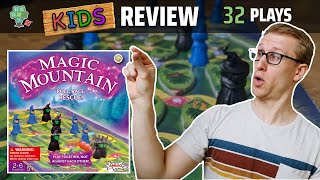
- Broad age appeal, from younger players with guidance to older kids and adults.
- Fresh, novel marble-plinko mechanic that sets it apart from typical kids' games.
- Cooperative play and approachable rules foster participation for younger players.
- Adjustable difficulty and the inclusion of a competitive variant boost replayability.
- High interaction and exciting moments as the marble approaches the bottom.
- Physical balance can drift on non-uniform surfaces, affecting perceived fairness.
- May feel repetitive for older players after many plays.
- Choking hazard: contains five standard marbles; supervision advised with younger children.
- Cooperative learning about probability and path navigation through a physical marble-dropped mechanism.
- A whimsical mountain with students and witches; marbles roll down a plinko-like board toward the bottom.
- Cooperative play with light competitive tension via witches; emphasizes observation of randomness and its consequences.
Mechanics (from transcript analysis)
- Color-matching movement — When the marble lands behind a character, that character is moved along the path to the next matching color space.
- competitive variant — A mode where one team moves witches and another moves students, adding a team-based dynamic.
- cooperative play — Players collaborate to guide marbles to the bottom while avoiding witches reaching the bottom first.
- Difficulty settings — Adjusts win conditions by changing the number of required students and the number of witches.
- Dynamic obstacles — Witches also move and can pull the marble toward the bottom, impacting flow and outcomes.
- Plinko-like marble drop — A marble is dropped from one of six slots at the top and bounces down the board toward color-matched spaces.
- Probabilistic reasoning — Players weigh 50/50 outcomes and how nearby pieces affect the probability distribution along forks.
- Speed-driven risk — Moving quickly can trap the marble behind the same student, influencing subsequent moves.
Video topics + discussion points
Quotes (from this video)
- I'm going to be giving Magic Mountain an 8 out of 10.
- Magic Mountain's plinko-like mechanisms appeal to a wide range of Ages.
- Randomness alone won't make it interesting for adults as evidenced by many classic children's games that rely solely on luck.
- I think it is a very strong kids game.
References (from this video)

- Distinctive mechanic; teaches probability and placement
- Engaging for adults and kids together
- Requires a flat surface for fair drops
- probability, path influence, and marble physics
- Plinko-style marble mountain with witches and students
- quirky, educational
Mechanics (from transcript analysis)
- Path-based movement — Move students down the mountain toward the goal according to marble results
- random marble drop — Draw a marble color and place it into the top and watch it roll down a split path
Video topics + discussion points
Quotes (from this video)
- the work you put in really does payoff
- it's very rewarding in what board games can offer for their learning development as well as just sharing a fun experience together
- not like these games are just for three-year-olds a lot of these games do work well even with older kids
- we're trying to find as many as possible