Barges, freight and profits are what it's all about in Manila, a speculative contest for 3-5 players. Goods shipments, intended for transport along sea routes, are in danger of gathering dust in the warehouses or being lost at sea in a storm. While the players speculate about success and failure, the ultimate fate of the ships will be determined by the dice.
There are four shipments that need to get to Manila - jade, ginseng, silk and nutmeg. A round begins with an initial auction to become harbour master. If you win, you'll be allowed to buy a share of one of the shipments, choose which three shipments you'd like to take down river and how likely they are to make it to their destination in the harbour. If they make it to Manila, their share price will increase. The aim of the game is to bet on the outcome of these shipments, with dice ultimately determining their fate. How many of the three boats will make it and which ones? Would you like to provide insurance against possible failed ships or perhaps you think pirates will snatch a chance to take control? Manila is a fun family game that takes minutes to learn and brings the river boats of the Philippines to life!
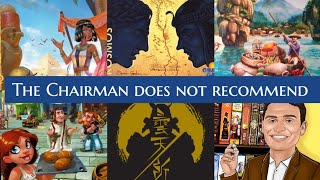
- lovely production and presentation
- cool premise with bid/ownership feel
- extra bells/whistles felt less impactful
- frustration possible from chance-based knock-offs
- auction/betting on naval progression with optional captaincy
- boats racing and bidding on routes across a track
- competitive market-style bidding with direct interaction
- Camel Up
Mechanics (from transcript analysis)
- area/spot bidding on boats — players can sit on boats to claim spoils at the end
- bidding — players place bets on how many boats reach the finish on a given round
- captaincy auction (optional variant) — the winner of an auction can influence ship start positions to improve odds
- commodity stocks mechanism (optional variant) — own shares in company types to gain extra points based on end positions
- Wagering — cash is spent to influence outcomes and potential spoils
Video topics + discussion points
Quotes (from this video)
- Camel Up does this style of game a lot better because I think the investment and the sense of ownership comes through
- I probably give this one about a 5 out of 10 if I was to grade it
- the puzzle itself is pretty lackluster
- an elaborate version of Paper Rock Scissors
References (from this video)

Mechanics (from transcript analysis)
Video topics + discussion points
Quotes (from this video)
- the first time where I thought of the whole idea of form over function where you could not figure out how to play because they just wanted to look so pretty that they didn't actually put on the board how to play.
- It's you move you you you turn over a piece, something shows up in the grid, you move over. There's multiple game plays. It's just such a satisfying, entertaining game.
References (from this video)
- Fast-paced, tense racing dynamic
- Relying on dice can feel random
Mechanics (from transcript analysis)
- Dice-driven race with movement on a track — Movement determined by dice, affecting race position on a shared track.
Video topics + discussion points
Quotes (from this video)
- Dice are not the answer in a first-time design.
- They are toxic. They destroy your first designs.
- Meaningful interesting decisions… the decisions have to mean something.
- Even if you have all sorts of other unique stuff going on in your game that roll for combat just overwhelms it.
- Monopoly has a bit of both, chaotic, entertaining momentarily but ultimately frustrating.
- Event decks can be devastating to your design if they wipe out progress or resources.
References (from this video)
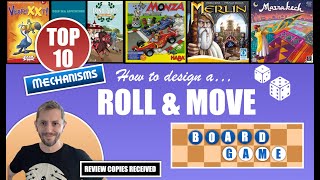
- Clever economic system layered on simple dice movement
- Game design that decouples ownership from benefit
- Multiple paths to victory through careful investment
- Particularly enjoyed by the host in this genre
- Shipping and trading
- Manila harbor
- economic simulation
Mechanics (from transcript analysis)
- Economic victory — Game ends when any share price maxes out, highest earner from pawn placement and investment wins
- Position Investment — Players pay to position themselves on boats or at key harbor locations
- roll and move — Boat movement controlled by simple dice roll
- Share Trading — Players accumulate shares in different types of goods
Video topics + discussion points
Quotes (from this video)
- Where once randomness ruled modern games prioritized player agency designers strived to incorporate meaningful decisions into their games and role and move became a dirty word among the modern tabletop community
- I myself put out a video called dicer not the answer back in 2017 one of my most watched lamenting role and move
- In 2022 i feel like maybe just maybe we've tipped too far in the other direction thrown the baby out with the bath water
- This video is a quest for redemption
- When done well roller move is one of the most intuitive exciting mechanisms out there
- In a pure roll and move game the player rolls a die or spins a spinner and moves their playing piece according to the result
- In talisman you roll the die and then you choose to move clockwise or anticlockwise around the board that one deviation from the purest role of move games the decision to go left or right immediately put talisman head and shoulders above most board games on the market at the time
- Hero quest showcases the strength of the roller move mechanism its elegant simplicity and the excitement of a successful role outrunning an ogre
- It can be really frustrating to lose a long game which you were totally invested in purely because you rolled badly
- Spooky stairs is a great example of a game where the roll and move mechanism itself isn't tampered with but the basic race mechanism is turned on its head by incorporating a chaotic memory mechanism
- This game beautifully highlights the intuitive nature of roll and move as a mechanism
- More than any other on this list this game demonstrates how such a simple mechanism can create agonizing decisions and a hugely interactive variable board game experience I can't recommend this one enough
- Roll and move games don't have to be devoid of meaningful choices
- Formula d has a great roll and move mechanism which i haven't seen replicated in any other game
- Push your luck and roll and move complement each other nicely
- Among hobby gamers roll a move is widely considered something of an untouchable mechanism in 2022 and that's a shame
- Roll and move isn't a cursed mechanism
- Like every mechanism roller move has strengths and weaknesses
- It can be used effectively to create an exciting intuitive system or it can be used ineffectively to create a wildly random experience which feels primitive and unfair
References (from this video)

- highs and lows with wild bids
- appeals to fans of Camel Up
- game length can stretch if play is slow
- early information can be scarce for bets
- Camel Up
Mechanics (from transcript analysis)
- Dice betting and river progression — Roll dice to advance barges and determine payouts.
- Risk and reward bets — Choose bets that influence end-game scoring and outcomes.
Video topics + discussion points
Quotes (from this video)
- The artwork is absolutely stellar but not quite my style of game.
- it's four rounds so you can get this played in around 20 minutes.
- World Exchanges is a well-deserved number one.
- Camel Up you'll probably like this one.
- I think this game did a fantastic job of making it feel immersive.
- an amazing temperature, boom boom boom.
References (from this video)

- colonization themes reimagined
- Manila / Philippine archipelago
Mechanics (from transcript analysis)
Video topics + discussion points
Quotes (from this video)
- I am just a huge fan of this kind of time loop sort of thing
- The more people respond, the better this system is going to be
- Spoiler alert for a game that's I'll be covering soon on the channel